

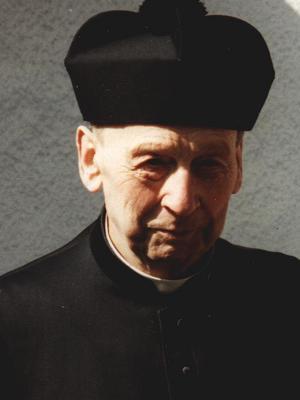
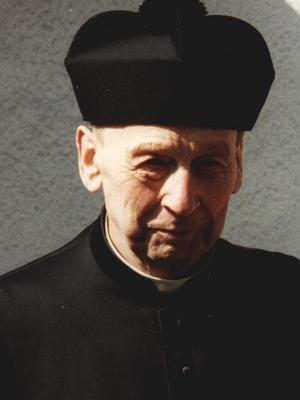
Prelate Alfons Rolnik
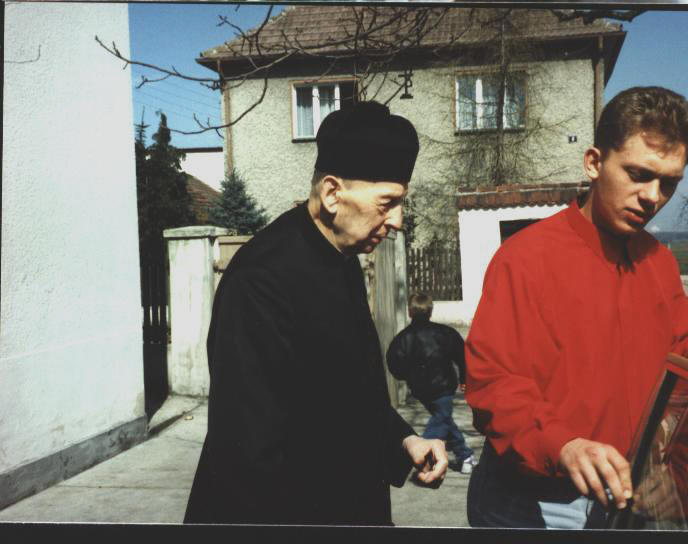
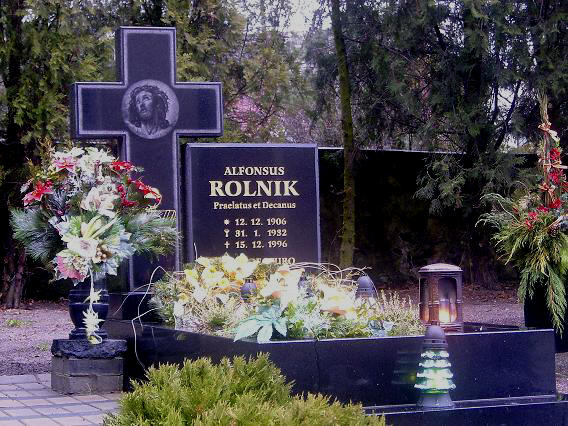
Prelate Alfons Rolnik was born in Paulsdorf (Pawłów) near Zabrze on 12 December 1906. His life’s path to our Folwark was very long. Only after his retirement did we get to know him from his best side. His health was no longer good, but in spirit he was in excellent condition. His favourite saying: “Es kommt nicht darauf an, wie ALT man ist, sondern: wie man ALT ist” (“It does not matter how old you are, what matters is how you are old”).
But how much he still managed to do for us, only we residents know. He was with us almost to the very end. Only 7 days before his death he celebrated his 90th birthday among us. He died on 15.12.1996 at the age of 90 years and 3 days.
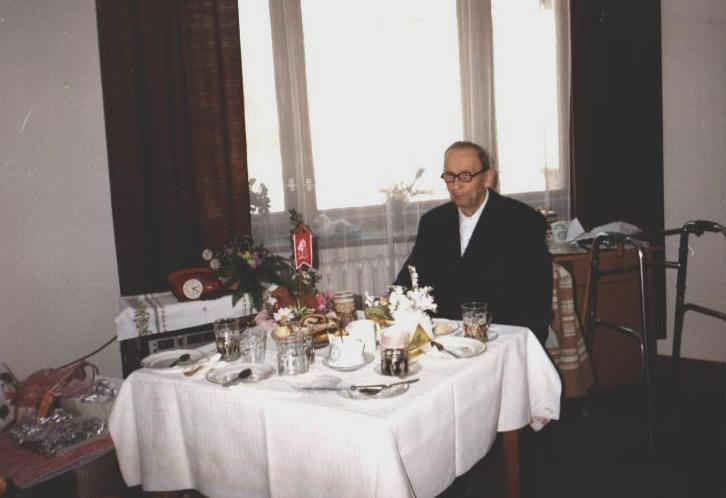
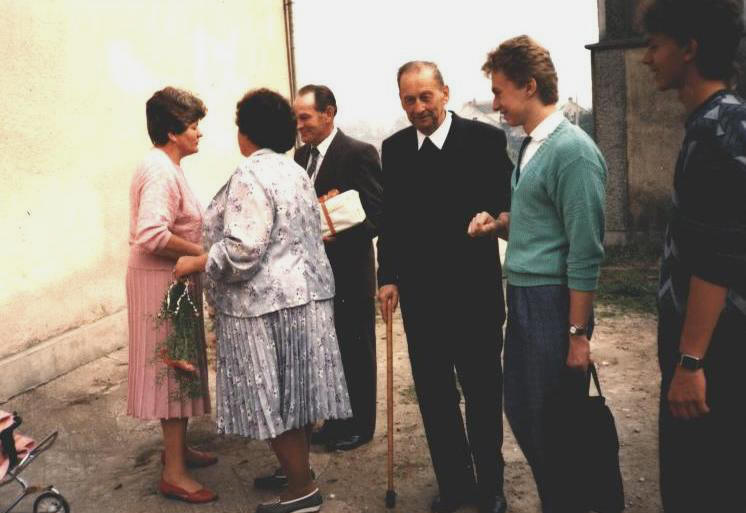
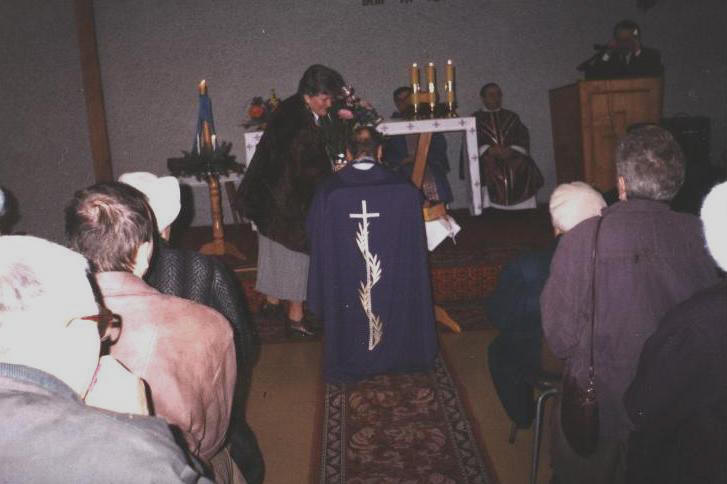
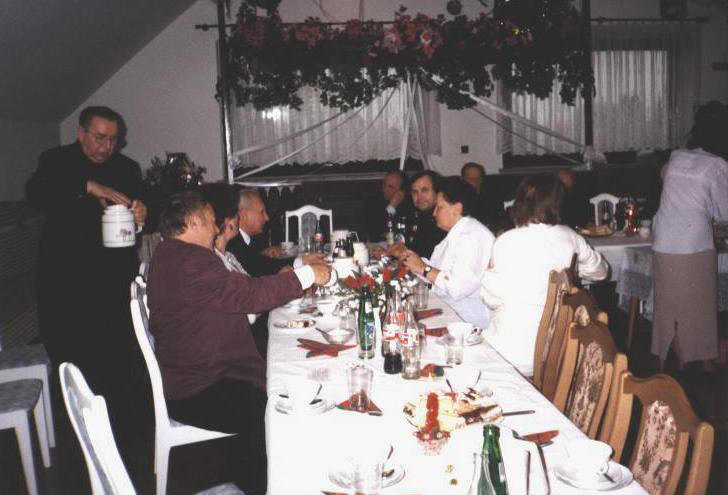
P.S. He told excellent jokes, here is one of them (in dialect): Hejdla calls to the neighbour: “Francka, pożycz mi nudelkuli.” – “Nie moga, a camu?” – “Bo joł tys cekom na mojego Hopa.” (nudelkula – rolling pin)
Curriculum vitae written by Fr Rolnik
At my request Fr Rolnik wrote his curriculum vitae by hand (the original is in private hands). The original grammar and spelling were preserved in the Polish version; the following translation renders the content.
My curriculum vitae!Father: Juliusz Rolnik, master shoemaker. Mother: Józefa, née Grossmann. Born: 12.12.1906 in Paulsdorf (Pawłów) near Zabrze. In 1917 my parents died: my father on 5.02.1917, my mother on 24.08.1917.
I studied in 1921/1922 at the monastery of Ettal in Bavaria, lived in the scholasticate and attended the Gymnasium. Hard times, inflation. The way was long, the railway journey during the holidays there and back was very expensive, to Bytom and back. The partition of Upper Silesia between Germany and Poland I experienced far from my homeland. Bytom remained with Germany, and then I moved back to Bytom without border difficulties. I then studied at the “Hindenburggymnasium” in Bytom and lived in the boarding house for boys. I took the Abitur in 1927. I completed my theological studies at the “University” in Wrocław. During this period I lived in the “theological boarding house on Cathedral Square” in Wrocław.
From 1927 to 1932 he continued his “philosophical and theological studies” at the University of Wrocław. On 31 January 1932 he received priestly ordination in Wrocław from Cardinal Bertram. After ordination he completed special training in “pastoral care for the deaf” in Racibórz.
From 1932 to 1934 he worked as a curate in Zabrze-Biskupice. From 1934 to 1939 as curate and pastor to the deaf in the “Institute for the Deaf” in Racibórz and the Racibórz district. In 1939 “curatus” at the Church of the Holy Cross in Opole.
In the same year, in November, he became parish priest of the parish of Sieraków, deanery of Olesno, where he served until March 1963. From 15 March 1963 to the end of August 1978 he served as parish priest of the parish of St Hyacinth in Bytom-Rozbark and at the same time was dean of the Bytom deanery. On 15 March 1969 he broke his legs, and a second time on 10 October 1971. He writes in his curriculum vitae: “I was transferred to a home for the elderly and retired, because nursing at home is not possible.”
From September 1978 he retired and lived in Chrząszczyce in our parish. Although retired, he took on various replacements. On 28 February 1982 he became the “uncrowned” parish priest of the “non-parish” of Folwark.
To complete his rich biography it should be added that he worked as a pastor to the deaf for 44 years (1934–1978). His four biological sisters also served God: three as Borromean sisters (see the additional information below), and one as a lay sister, a Caritas sister.
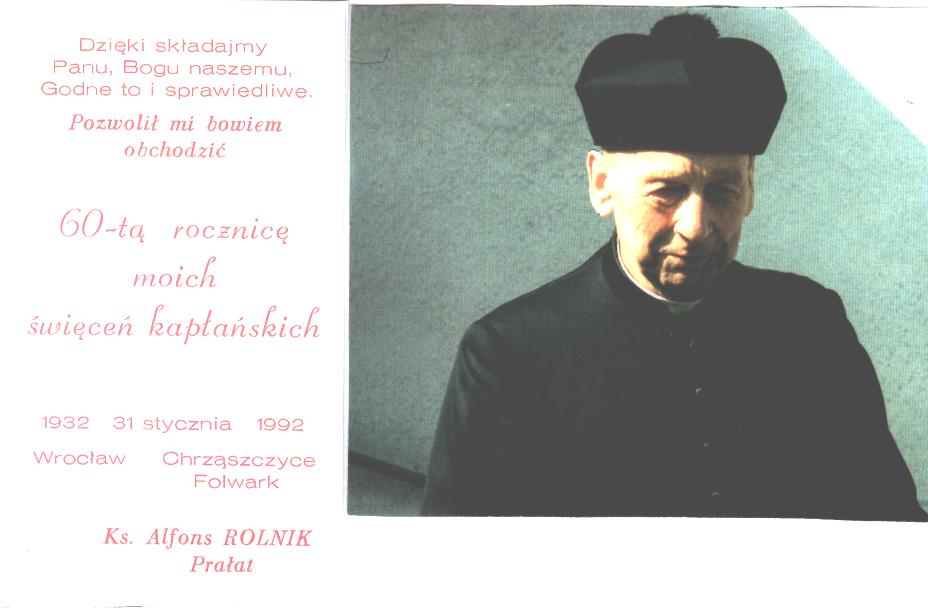
On 31 January 1992 fell the 60th anniversary of his ordination, which he defined thus: “Let us give thanks to the Lord our God, it is right and just. For He allowed me to celebrate the 60th anniversary of my priestly ordination.”
1932 – 31 January – 1992: Wrocław, Chrząszczyce, Folwark.
In “Gość Niedzielny” no. 51/52 of 22–29 December 1996 Teresa Sienkiewicz-Miś conducted an extensive interview with the Prelate at the House of Retired Priests in Opole, quote: “…My permanent place of residence is Chrząszczyce, hence I am also in contact with the faithful of Folwark, Górki and Złotniki. Among them, God willing, I will celebrate my 90th birthday, and in January 1997 the 65th anniversary of receiving priestly ordination.”
Born: 12.12.1906. Died: 15.12.1996.
Additional information: the Borromean Sisters
The founder of the Congregation of the Sisters of Mercy of St Charles Borromeo, Joseph Chauvenel, was born around 1620 in Nancy, in Lorraine, the son of the knight Emanuel Chauvenel and his wife Claude Bernet. He was distinguished by extraordinary mercy towards the poor. They were his only and constant concern, and he devoted his short life to them. He died at the age of 31 (of the plague, during the Thirty Years’ War). In his will he made the poor his heirs (the son’s last will was carried out by his father), thus giving rise to the Congregation of the Sisters of Mercy.
They are called to bear witness to merciful love, realising the motto of the Congregation, “God and the poor”. The merciful love of the Sisters is a concrete expression of love for God and neighbour. They extend their care to the poor and needy. They practise mercy in hospitals, educational institutions and care homes. In parishes they work as organists and sacristans and teach religion in schools. They deepen their love for God and people by cultivating a life of prayer. Their patron is St Charles Borromeo. They have houses in Poland, in Rome and missions in Zambia.
Literature: Dr Joseph Reinkens, Die barmherzigen Schwestern vom heil. Carl Borromaus zu Nancy, Breslau 1885