

We are in the year 1335. Silesia came into the orbit of the Bohemian state, and with it the town of Opole and our Folwark. The King of Bohemia, now ours too, was John of Luxembourg, who as heir to the Přemyslids (married to the daughter of Wenceslas II) also took the title of King of Poland and laid claim to the Polish crown.
The Luxembourgs were a dynasty ruling from 1196 in Luxembourg, from 1310 in Bohemia (John), from 1373 in Brandenburg, from 1387 in Hungary. The family died out in the male line in 1437, the last being Sigismund. The Habsburgs claimed the Luxembourg inheritance: Elizabeth, daughter of Sigismund of Luxembourg, King of Bohemia and Hungary, was the wife of Albert II of Habsburg.
In part I there was little about our Silesian land, when it was a “bone of contention” between its neighbours and the lot of its inhabitants was growing harder day by day. Let us look back.
How did Opole differ from Folwark in those times?
Opole was a somewhat larger village, which shared the fate of the neighbouring countries: Moravia, Bohemia and Poland.
The legends and chronicles, however, are rich and worth mentioning. Alongside Emperor Otto III and Pope Sylvester II, St Adalbert (Wojciech) was among the outstanding people. As we know, Silesia at this time belonged to the Diocese of Prague because of its state allegiance; this is documented. So the year 1000 is not the start of the Christianisation of Silesia. St Adalbert was the second Bishop of Prague, and from 982 also our bishop. Bohemia played an important role in the cultural and political development of Silesia. United earlier within the Great Moravian state, they made contact with western Christianity at least 100 years earlier. Czech predominated in our speech (the Germans called our speech Wasserpolnisch, the Poles a dialect).
Legend! With great probability we can say that, owing to his pastoral duties in the early days of the Christianisation of Silesia, his stay in Opole in 984 was a fact. During his stay he is said to have preached the Gospel on the Hill (Górka) (today the Church of the Virgin Mary and a chapel dedicated to him). Legend says that when Adalbert ran out of water for baptising, he struck a rock with his crozier and a spring gushed out. The well, located between the buildings of the monastery, church and chapel, provided the townspeople with water for ten centuries. This is shown in a drawing by Werner of 1763 and an oil painting from the mid 19th century (by the painter Nowiński), with a large flywheel for drawing up the bucket. The water was of the first quality and reputedly had healing properties; it was far from the River Oder.
If the legend is true, then it is proof that Opole in the 10th century was a significant village. Both the originally founded village of Opole and Folwark were subject to Polish law.
Opole received town rights only after another 100 years. And the process of granting this right was not a matter of one year, or even one generation, at the time when, after many wars and fires, Bolesław Wysoki appeared and later Henry the Bearded.
And what were the differences up to then? The town had more inhabitants, and it had a market square and fortifications. Merchants, who guaranteed trade, and craftsmen lived in towns. Both in the town and in the village lived subjects, in servile subjection. All of them were obliged to countless services for the duke, his court and officials. They had to pay various taxes, work in the forest, keep watch, take part in military campaigns, and build fortifications and strongholds. They had to do any work the lord ordered. To all this was added provisioning. They had to deliver grain, cattle, pigs, poultry, eggs, honey, wax and so on to the court. I have not read anywhere which lord at the castle was milder and which harsher and more ruthless in enforcing this. Subjects were forbidden to do anything without the lord's consent. This was the so-called settlement of town and village under Polish law.
The history of the times when the Silesian land became a “bone of contention” between Poland and Bohemia is quite well documented. I have leafed through many different accounts by our historians on the subject, and not only Polish ones.
My observations (I stress that I am not a historian and have never before dealt with history; all this is new to me) will be read by many as biased, and I agree. My family roots, and I searched deeply, reach back furthest to Ochodze, a place that belonged until the end of the 19th century to our parish of Chrząszczyce. Only my father, in 1935, found my mother on the right bank of the River Oder, in Brynica. In my family tree I found no ancestor with a “von”; all were subjects (unfree) until the second half of the 19th century. Hence my interest in the question of who was their lord and oppressor. And as I found out, there were many, regardless of which state Silesia belonged to. Not only my ancestors, by the way: 99% of the inhabitants of Folwark, Opole and the surrounding area were in a similar situation.
The period of division into provinces was an ideal time to build one common state for the Western Slavs. Poland and Bohemia were then the strongest among them in every respect. But there was no harmony, which, as we know, builds! Historians explain: so it was in the neighbouring “countries” as well. Bolesław Chrobry had such intentions. For a short time he ruled in Bohemia and extended his influence far to the west and south. An exceptionally favourable external situation helped him. On the imperial throne sat the very young Otto III, who was well disposed to Chrobry. He treated him as his helper in the Christianisation of Europe.
The Pope then was Sylvester II (appointed, in fact, by Otto III himself), and the Bishop of Prague was Adalbert, later a saint. Today historians rate his (Chrobry's) conquests very highly. Over the years word reached us of Chrobry's great deeds:
He drove posts in the Dnieper and the Saale
on the borders of the state,
in steel armour behind him stood
brave warriors
To the wicked he was like a scourge of God
and to the good, good,
and later generations
called him: Chrobry (the Brave)
He is the patron of many streets and squares, and has many monuments.
He was energetic. His ruthlessness was easily forgiven. B. Zientara writes in “Poczet Królów polskich”: He drove out two wives in turn, caring nothing for canon marriage law; he wronged his first-born son, depriving him of his inheritance and exiling him to Italy. He shamefully treated his Czech cousin (Bolesław the Red), who came to Kraków to meet his kinsman “to exchange views on international problems”: he was blinded by Chrobry and imprisoned for many years. To this can be added the devastation and plunder spread by Chrobry's warriors wherever they were sent (the short stay in Bohemia). Strongholds and villages burned, property was looted, not even sparing churches, and crowds of captives were driven away. During the expedition against Kiev, the victorious Bolesław made the sister of the Ruthenian prince, Przemysława, whose hand he had earlier sought in vain, his concubine. Przybywój and Odolan, the first known magnates opposed to Chrobry, were blinded.
But chroniclers write about this somewhat differently. He was simply a cruel ruler! Cruel from today's point of view, not only to his subjects but also to his own family. In Prague, from where he had to flee, and in Kiev, where he dishonoured the sister before the prince's eyes: this was a short-sighted policy of “building a strong Poland”, based on organised and unbridled plunder. His cruelties were his downfall, and in later years that of the country of Poland, which he built. For many contemporaries, however, he is great. It is sad!
But for those years one can hardly speak of countries here. There was plenty of land, nobody staked out his borders at this time, and the Slav brothers had no love for one another. The rulers were interested only in the spoils of war, a significant source of income given their own primitive economy of that time. It was about labour, captives, who were made subjects on their estates, unfree people.
The time came when land, until then without a master, became a source of income. Earlier the land belonged to the community (Folwark's too, which probably had a different name then); now gradually but inevitably the powerful seized it. The largest landowner was of course the ruler, who gave it for temporary or hereditary use to simple peasants or unfree people, who paid dues in kind, labour and other services.
While the situation of the feudal lords grew better and better, hard times came for ordinary inhabitants. The people fell into ever greater dependence on the powerful, a dependence of subjection and servitude. And all who tried to resist were forced into submission. Between the cultural level of the ruler and those closest to him, the court and warriors, and the level of ordinary inhabitants of the Silesian land at that time, there was an enormous gulf.
Among the Polanie, after the death of Bolesław Chrobry, a struggle for power began between the brothers (Mieszko II and Bezprym, sons of Bolesław Chrobry), in which the powerful took sides. Chaos reigned in the state, which at first suited the powerful. The collapse of central power, however, turned against them. In the 11th century (around 1038) the situation became so inflamed that the population rose in open revolt against the feudal lords and “young” Christianity.
... “And there was great disorder in the lands of Poland, and the people rose up and killed bishops and priests and their lords” ... states a yearbook, the so-called letopis, M. Bogucka “Dawna Polska”.
Heavy fighting went on, and churches, monasteries and castles were destroyed. During the so-called pagan reaction Opole and the oldest Wrocław cathedral were destroyed, and the bishops from Wrocław took refuge (probably near Namysłów).
Why did the subjects destroy churches?
Christianity was first accepted by the rulers and the powerful. It was on the people of the Church that rulers relied at this time in administering the state. The duke was an ally of the development of Christianity and set aside a tithe of his income for the upkeep of the clergy, which placed an additional burden on the simple people, most of whom were still pagans. Christianisation proceeded slowly among the subjects; the population, attached to its old beliefs, accepted the new religion unwillingly. Such a revolution could not take place without dramatic clashes ... in the words of the German chronicler Thietmar of Merseburg (died 1018): “to inspire his flock with the spirit of Christianity, Mieszko's son Bolesław Chrobry ordered teeth to be knocked out for breaking the fast commanded by the Church.”
And on top of all the misfortunes on our land!
... “The turmoil in 1039 was exploited by the Bohemian Duke Břetislav, who took Kraków and occupied Silesia, and between Kraków and Wrocław the land was devastated by fire and sword.” F. Idzikowski “Geschichte der Stadt Oppeln 1863”
After the death of Mieszko II (+1034) his under-age son Kazimierz “Odnowiciel” (the Restorer) came to the throne and, in the care of his mother Rycheza (German by origin), with the support of a 500-strong unit of armed German mercenaries (from Emperor Henry II), took control of the situation in 1049. He recovered Silesia, for which, however, he paid the Czechs tribute.
For the next 100 years nothing changed for our subjects in Folwark. Only the lords at the castle changed. In 1138 Bolesław “Krzywousty”, King of Poland, in the opinion of many earlier and more recent historians introduced the unfortunate “testament”, the principle of seniority and the division into provinces.
Władysław II, the eldest son (his wife was Agnes, granddaughter of Emperor Henry IV and half-sister of Conrad III, the German king), received Silesia as well as the senior province.
As soon as 4 years later, in 1142, we have the first civil war with the younger brothers. Władysław II did not break the brothers stirring against him, and on top of this he cruelly had his former friend Piotr Włostowicz (a magnate in Silesia) mutilated (his eyes put out and driven from the country) for alleged treason. For this act, which the powerful did not forgive him, in 1146 he and his whole family became Władysław II “Wygnaniec” (the Exile). He found refuge with his brother-in-law Conrad III, in Germany at Altenburg castle. He died in exile in 1159 at Altenburg, and in 1163 his wife Agnes died. After the death of Conrad III (1157), Frederick I “Barbarossa” became emperor and demanded Silesia by force of arms in the name of the sons of Władysław II, still in exile.
The King of Poland and administrator of the Silesian province, Bolesław IV “Kędzierzawy”, at Krzyszków near Poznań “in humiliating circumstances paid homage to Frederick and paid a high tribute for Silesia ... he agreed to the return of the sons” ... of Władysław II “Wygnaniec”, Bolesław Wysoki, Mieszko Plątonogi and Conrad, to Silesia (1163).
They did not, however, receive the whole province or full independence. But in 1166, with significant armed support from Germany, they recovered the remaining provinces and could exercise power independently.
In 1163 Opole and the surrounding area, as a Polish town, passed under the rule of the sons and in later years the grandsons of Władysław II “Wygnaniec”.
Modern historians take an unfavourable view of their links with Germany, because they supported and encouraged with privileges the German settlers they brought in to found new villages, and merchants and craftsmen to found new towns. Historians ask what motives guided them? But related through family, with a German mother, brought up at German courts, they felt more bound to the German Luxembourgs than to the Polish Piasts. This pro-western orientation, especially in economic matters, proved a blessing for Silesia. As a result our lands in a short time became the economically leading province of Poland. Because of the constant fights over the patrimony with the Polish Piasts, the Silesian Piasts sought help in Bohemia and from the emperor. From this too came the later feudal dependence on Bohemia, which in 1335 ended with the incorporation of Silesia into the Bohemian crown and the breaking of links with Poland for centuries.
Bolesław Wysoki received Opole, Wrocław and Głogów, Mieszko Plątonogi the Racibórz lands, and Conrad was destined for the clergy. The division was unequal, so Silesia again faced armed disputes between the eternally quarrelling Piasts. The Piasts of the neighbouring provinces of Poland also joined these disputes, which guaranteed that villages and towns in Silesia were burned every few years, sent up in smoke. One of our historians writes: In moments free from fighting his brothers and his own son, Bolesław Wysoki tried to introduce new forms of government in his own duchy ...
Bolesław I “Wysoki”, brought up for many years in Germany, having seen many countries at the emperor's side, became acquainted with the organisation of other duchies in the west and south of Europe. During his rule the colonisation of Silesia by German and Walloon settlers began, and he brought the Cistercians to Lubiąż.
He founded Opole under German law. In this way the inhabitants of Opole, until then under Polish law, gained personal freedom and ceased to be unfree, and self-government was granted to the townspeople. The introduction of the new law was favourable for the inhabitants of what was now a town. The new law was introduced gradually, often with resistance from the powerful, and many years passed before they could say: yes, we live in a different world. Officially, in documents, the years 1211-1217 are accepted, but even in the 16th century many changes were made.
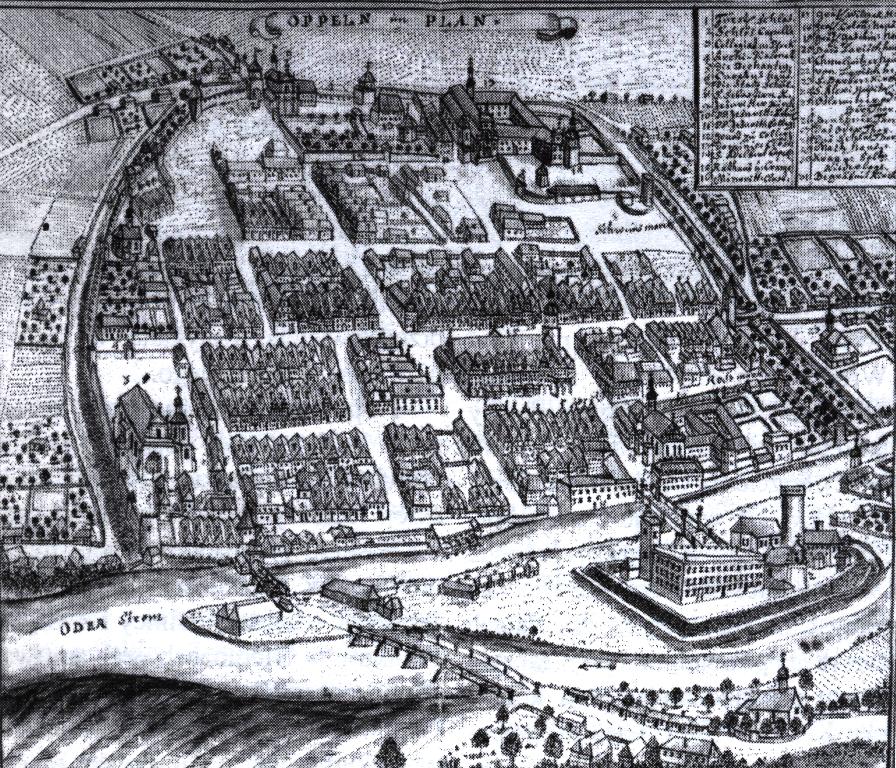
The town of Opole in the 1750s. Copy of a drawing by F.B. Werner. The time when Opole belonged to the Prussia of Frederick II. F. Idzikowski states that in the town (1751) there lived 1186 people, including 236 men, 254 women, 354 children and 343 servants (journeymen, farmhands, male and female servants). 200 houses had the right to brew beer, which the inhabitants of the surrounding villages had to buy (Szczepanowice, Wójtowa Wieś, Folwark, Winów, Górki and others beyond the Oder). He does not mention Chrząszczyce, Złotniki, Chrzowice or Boguszyce.
Unfortunately! Folwark did not receive this distinction; in our village the law cruel to its inhabitants, Polish law, still applied. Life and death, everything depended on the duke at the castle on Ostrówek island.
In the next part, on “Magdeburg law” and its consequences for the town of Opole. The Folwarczanie must wait a long time yet for the new law.