

The 13th century begins. In its first half, from 1201 to 1241, the “Monarchy of the Henrys” begins in Silesia.
Many Polish historians (pre-war and post-war) regard Henry the Bearded as a Germanised Germaniser of Silesia, while post-war popular science literature turns him into a Polish patriot who develops the “Recovered Territories” and defends against the so-called “Drang nach Osten”. In scholarly works, not only popular ones, learned historians try to play down the importance of German immigration, greatly understating the number of colonists. Today more and more historians are beginning to understand that such a biased presentation of Silesian history leads nowhere. Everyone knows that Mieszko I already had a German second wife, Oda, Bolesław Chrobry a German second wife, Emnilda, Mieszko II a wife who was the emperor's niece, the German Rycheza, and Bolesław III Krzywousty a German second wife, Salomea. Bolesław IV “Kędzierzawy” was the son of the German Salomea, Mieszko III the Old a son of the German Salomea. Władysław II Wygnaniec had a German wife, Agnes, the emperor's granddaughter. Bolesław Wysoki had a German wife, Christina, from a family of central German counts. Henry the Bearded was the son of the German Christina and had a German wife, Hedwig, daughter of Berthold VI, Count of Andechs. Hedwig, later a saint, played an enormous role, and not only in Henry's life. (All information taken from “Poczet królów polskich”). If from Mieszko I onwards half German blood flowed in the veins of his successors, how much flowed in the following generations?
“That is why one must agree with Benedykt Zientara, who writes: The existence of a sense of Slavic community of interests in the early Middle Ages is a myth created only by the Slavophiles of the 19th century. On the contrary, the whole of the western Slavic world was in a state of rivalry between various political entities, deepened by the struggle of the new Christian dynasties against fiercely resisting paganism. The rivalry of the Piasts and Přemyslids and diplomatic intrigues, interrupted by military campaigns, devastated the lands of Silesia.”
“The Slavic population of Silesia had a weak sense of national or indeed state belonging; the Silesians considered themselves the Christian souls of these parts” ... Norman Davies “Boże Igrzyska”. Christianity came to Silesia in the 10th century, as archaeological excavations document: cremation graves end and inhumation graves begin. But did they become Christians at once? In the past they burned their dead so that their souls could pass freely to the next world. Now the lord duke, following the command of the new faith, ordered them to be buried in the ground.
“And perhaps he will rise and appear as a ghoul”. To this day we are afraid to walk through a cemetery at night!
Constant wars, unfree inhabitants forced to take an active part in them, often far from home. The people did not love such a “duke” and lord, whether he was Polish, Czech or German.
The search for traces of national identity in Silesia, amid the fumes of propaganda, is fortunately losing its importance. One can speak of a nation only in the sphere of power and politics. 100 years ago Silesia was German, today it is Polish. Everything is moving in a good direction, however: there will be one Europe, multinational as it was 1000 years ago, without borders and, let us hope, without wars.
Henry I “the Bearded”, son of Bolesław “Wysoki” and his mother Christina, is regarded by historians as the organiser of Silesia's development. He was married to Hedwig, who in later years was more important than her husband. Hedwig was the daughter of Count Berthold VI of Andechs and Duke of Merania. The Andechs family had great influence at the imperial court and was an outstanding centre of chivalric culture, where care was taken over the proper education of children. Two of Hedwig's sisters married the kings of France and Hungary.
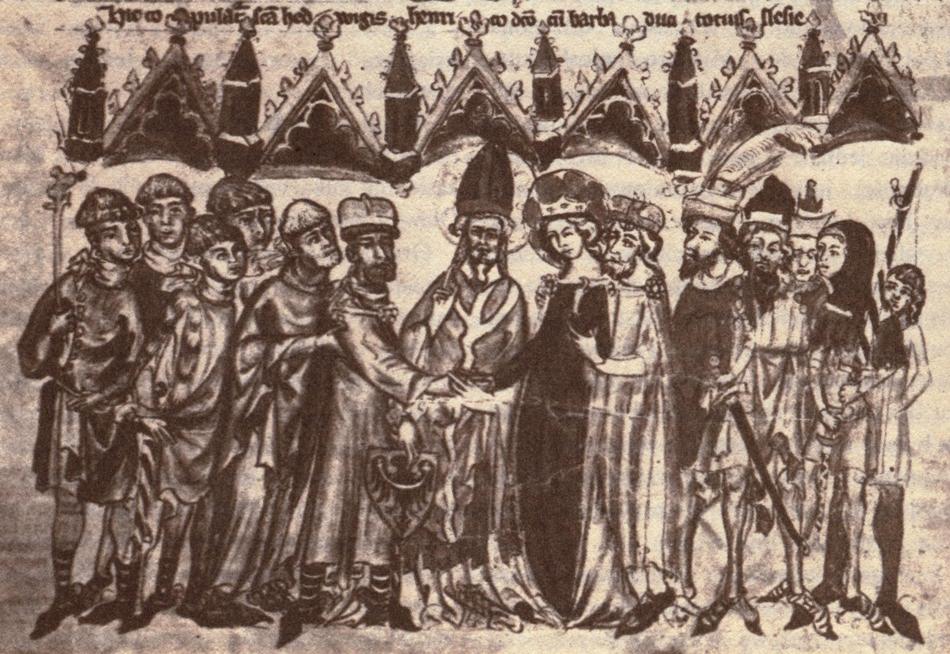
The marriage of Henry the Bearded
and St Hedwig.
(copy, Master of the Legend of St Hedwig)
Silesia's development was made possible by organised colonisation with German settlers. The settlers were guaranteed a free right of settlement, later called “German law”. The new areas were separated from the old ducal administration (under Polish law) and from the local population, who remained subject to ducal, Polish law. The law on which the existing structure of Piast power rested did in fact allow settlers to be established. The local population, as already mentioned in the previous parts of “Pofyrtane dzieje”, was obliged to provide all services for the duke (provisions, transport, building) and was subject and unfree. Henry used them to help settle the colonists: food supply, transport, building new settlements. Founding new villages and towns under German law guaranteed the settlers many privileges, above all personal freedom. These were privileges that the earlier inhabitants did not receive for a long time. In the long run, however, the segregation could not be maintained. We find the first records of local people being settled under German law from 1228. The organisation of settlement was not free of conflict, especially on the estates of the bishops, who began to demand from the colonists the tithe paid by peasants under Polish law. All these innovations I have mentioned concerned the Duchy of Wrocław. For after the death of Bolesław Wysoki the Duchy of Opole fell into the hands of Mieszko Plątonogi, and here everything went somewhat differently.
In 1163 Opole passed into the possession of the dukes (of the Wygnaniec line) Bolesław Wysoki and Mieszko Plątonogi, so they themselves began founding villages and towns under German law. Idzikowski reports: A document issued on 11 November 1328 in Czarnowąsy. It records that the monastery founded the village of Dobrzeń Wielki under German law, “because under Polish law, owing to its instability, the peasants and subjects derive no benefit”. In this way the inhabitants of Dobrzeń Wielki gained personal freedom, were released from all the indeterminate burdens of Polish law and were obliged only to strictly defined dues and services. Nor was the sheaf tithe, to which villages founded under Polish law were obliged, any longer given to the Church.
Further on in “Geschichte der Stadt Oppeln” we read: Since most of the surviving documents speak of these matters, we can assume with full certainty that the dukes did no less for the ducal capital, which from 1273 was permanently Opole, than for other, more distant towns and places. Kazimierz (1211-1230), Duke of Opole (son of Mieszko Plątonogi), granted the village of Leśnica in 1217 the same rights as applied in Opole and Racibórz. In Opole itself, as Idzikowski reports, “in the period from 1163 to 1313 (Mieszko Plątonogi, his son Kazimierz, then Władysław and Bolesław II) many elements of German law were introduced”. We are approaching the times when the dukes of Opole negotiated over feudal dependence on Bohemia. (The townspeople of Opole began to fear for their acquired rights.)
In our Folwark nothing changed; the whole story takes place a few kilometres north of the village, in Opole.
Pofyrtane dzieje Folwarku, to be continued