

Here is the first information about our inhabitants. The year 1566.
The “Monarchy of the Henrys” in our Opole, and so also in Folwark, ends with the Mongol invasion (1241). Henry “the Pious” tried to stop the Tatars (one of the Mongol tribes, as they were then called) at Legnica (9.04.1241). The battle ended with his death and the defeat of his army. Great destruction was left in Silesia after the Tatars passed through, as many historians write; but after leafing through many books on the subject I have the impression that it was no greater than that caused by the little wars of the Piasts, and that the Battle of Legnica was not so great either. But the death of Henry “the Pious” was the beginning of great changes. The influx of German settlers into Silesia continued, and many new villages and towns were founded under German law. The transfer of old villages, founded under Polish law, to German law began, but the founding of new villages under Polish law did not stop either. From the west, with the population, came many German clergy and knights, whom the Piasts needed for their many little wars with each other. The knights did not always fight, and for lack of occupation they took to robbery, banditry and plunder (Raubritter, robber knight: often, as well as taking a horse, cart, money or goods, he also cut off a hand or killed on the spot, together with his dozen companions). The robber knights not only engaged in common robbery but seized numerous castles, terrorised the area and looted merchant caravans.
Of course the little wars between the Piast dukes went on: all wanted the throne of Kraków, all wanted to win the largest possible piece of Silesian land. On top of this the Bohemian King Wenceslas II (crowned King of Poland in 1300) made almost all the Silesian Piasts his vassals (10.01.1289, Kazimierz II, Duke of Bytom, was the first). In 1310 John of Luxembourg (married to the daughter of Wenceslas II) took the throne in Bohemia and also assumed the title of King of Poland. The years 1306-1322 were a time of avalanche-like fragmentation of Silesia, which as a result meant that all the new owners sought shelter under the wing of the Bohemian King John of Luxembourg, paying him homage and taking their duchies in fief from his hands (in Wrocław in 1327 Bolko II of Opole submitted to him). In 1348 came the formal incorporation of Silesia into the Bohemian crown.
In 1404 there came to Wrocław Władysław Jagiełło, King of Poland, and Wenceslas IV, King of Bohemia, where the Bohemian king proposed to cede to Jagiełło Silesia and the right of overlordship over its many dukes, in exchange for help in the struggle against Sigismund of Luxembourg (the anti-royal opposition in Bohemia). This did not happen, however, because of the resistance of the Polish magnates.
In 1415 Jan Hus dies (rector of Prague University and lecturer in theology, he proclaimed a programme of renewing the Church by a return to original Christianity). Hus's (radical) views won broad support in the society of the time. In 1419 an uprising broke out in Prague, followed by civil war. The Hussites were divided: the Utraquists represented the wealthy burghers and part of the nobility, the Taborites the peasants, the urban poor and the poor nobility.
In 1428 the great Hussite expedition, of the Taborites, into Silesia began. With the help of the local population they took most of the castles and a number of towns. Many towns opened their own gates to save themselves from being burned, and the Silesian dukes (Bolesław IV of Opole too) accepted the four articles of Prague: (1 - free preaching of the word of God, 2 - the possibility for everyone to receive communion in both kinds, 3 - the abolition of the secular power of the clergy and of its estates, 4 - the punishment of mortal sins by the secular power.)
At Głogówek the Hussites (Taborites) had their “base”, supported by Duke Bolko V (in 1425-1460 lord of Głogówek and Prudnik, he styled himself Duke of Opole and was the son of Bolko IV, Duke of Opole). His help for the Taborites was not disinterested; with their help he organised an expedition against the estates of the Bishopric of Wrocław and a raid on Jasna Góra, the Pauline monastery (1430). Were ideological motives at work in both cases?? Or was it ordinary robbery! He removed the clergy from his Głogówek and Prudnik and seized all church property. Bolko V not only looted church property; like the robber knights he attacked merchants on the roads and even at their stops in towns, and in Kluczbork he seized 75 wagons of goods.
Such were the times. Robbery was also the occupation of those who should have stood guard (the royal starost Leonard Assenheimer was beheaded in Wrocław for robbery in 1445). The chronicles written years later (from a Catholic standpoint) are shocking. The Hussites boiled people in oil, drowned them, drove nails through heads.
The Hussite defeat came in 1434, when their leader Prokop the Great fell at Lipany. But the Głogówek state of Bolko V, with its looted conquests and estates, lasted until his death in 1460. After 1434 many persecuted Hussites in Silesia also found refuge here. The practice of robbery went on for a very long time and was a great plague for the towns and villages of Silesia; it was eliminated only in 1520-1530.
The war years 1429-1434 meant great destruction in Silesia: many towns burned, peasant farms lay fallow, the German language retreated, the influence of the Church was limited, and priests began to preach in a language the faithful could understand.
The official language, German, was displaced in the following years (in Upper Silesia) and replaced by Czech (correspondence, urbaria), which became the official language.
In 1437 Sigismund of Luxembourg died (with no successor in the male line); his place was fought over by (his son-in-law Albert of Habsburg, Kazimierz son of Jagiełło, Albert's widow, her son). The time of anarchy, many battles, many changes and the growing activity of the “Raubritter” lasted until 1526.
And what was happening in Opole?
Until the 13th century there was no official parish in Silesia. Only in 1217 did Bishop Thomas begin the division into a network of parishes. In his study “Geschichte der Stadt Oppeln” Idzikowski states: The Opole collegiate church provided pastoral care in Chrząszczyce, Chróścina, Czarnowąsy and Groszowice. And the parish in Opole included: Bierkowice, Chrząstowice, Suchy Bór, Dziekaństwo, Gosławice, Półwieś, Chmielowice, Kępa, Lędziny, Kolonia Bierkowicka, Luboszyce, Nowa Wieś Królewska, Sławice, Szczepanowice, Zakrzów, Zawada, Wójtowa Wieś and Żerkowice (1295, Geschichte d. Bisthum Breslau, Heyne). Idzikowski further writes: ... The collegiate church, favoured by the duke as well as the burghers, grew ever richer ... In the period from 1361 to 1531 the collegiate church owned: 7 houses in Opole, the tithe of ¼ mark from 47 villages, the sheaf tithe from 107 villages, 5 manor farms, 15 gardens, 4 complete villages, 2 vineyards, 13 butcher's stalls and a certain number of fields.
Today we know that these clerical dignitaries had little time for their parishioners, which explains why Protestantism entered the town of Opole so easily.
Some information on events and tragedies.
In 1347 half the inhabitants of Europe died in a plague epidemic. The plague also raged in our area.
1501, 29 September: the whole town of Opole burned down.
1514, 27 September: the whole town of Opole burned down.
In the 16th century Hevelius lists 17 great floods in Opole.
1532, 27 March: the Most Serene Duke Jan died, last lord of Opole, Głogów and Racibórz. Known to us as Jan II “the Good”, last in the line of the Piast dukes of Opole. Before his death Duke Jan granted the Estates of the duchy the so-called “Hanajskie przywileje” (p. 83), confirming the inseparability of his duchies from the Bohemian crown.
In 1584 the Gregorian calendar was introduced.
The town, destroyed by fires and wars, was held back in its development practically until the time of Frederick the Great. We find confirmation of this in the urbaria, whose entries from 1330 to 1730 differ little, and on the town plans only a few new cottages are visible.
In 1518 the sermons of Martin Luther appeared in print in Wrocław. In the towns of Lwówek, Legnica and Złotoryja, ruled by dukes of the Hohenzollern family, churches went over to Lutheranism. The duke “encouraged” people to accept Protestantism on pain of exile. Radical representatives of Protestantism, the Anabaptists, urged the overthrow of the feudal (unfree) system, the command of community of goods and the ban on owning anything. They did not recognise the baptism of infants, only of adults, nor the institution of the state, unnecessary for true Christians. These slogans found many supporters in Silesia, but also many opponents among the nobility of both faiths (Catholic and Protestant). The agitation of the Anabaptists gave rise to peasant revolts (Ząbkowice Śląskie and Piotrowice near Jawor). The peasants captured by the duke were flogged at the pillory, each had one ear cut off as a warning, and they were turned loose in the country.
In 1526 Ferdinand of Habsburg (brother of Emperor Charles V) had the most votes and the right to the Bohemian crown. In 1527 the Estates of the lands of the Bohemian crown entrusted the royal dignity to Ferdinand I.
On 1 May 1527 in Wrocław all the Silesian towns and dukes paid him homage, for almost 400 years until 1918. And in Silesia for over 200 years.
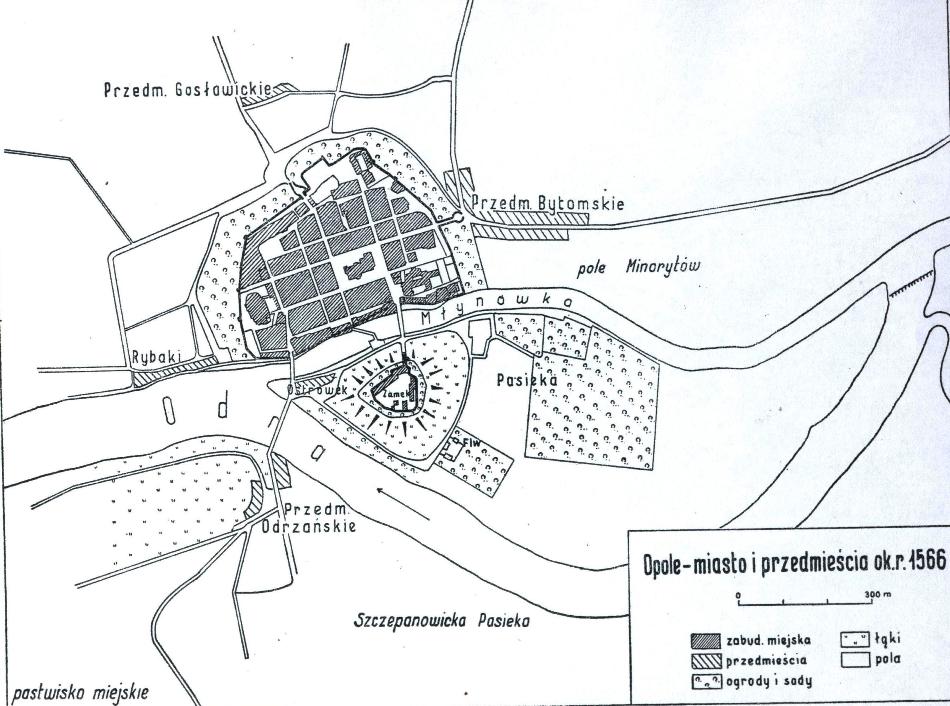
Opole fell to the Habsburg princes ruling in Bohemia. From feudal lord, Ferdinand became the actual owner of Silesia, and so of Opole.
From the very beginning he introduced strict orders for all the Estates, and condemned the Anabaptists and Bohemian Brethren to exile. An edict of Ferdinand forbade taking property from the clergy and introducing religious novelties. He introduced a single coinage for Silesia and only one mint, in Wrocław. An order commanded the drowning of printers and booksellers spreading heretical books.
And for all the unfree subjects living in Folwark (and all Silesia), below I present a copy of the law signed by “our” Emperor Ferdinand I of Habsburg.
Title of the original, in 16th-century script: “Opplische Urbarium”
The original is in the Wojewódzkie Archiwum Państwowe in Wrocław (manuscript of the Opole urbarium of 1566 and of Racibórz of 1567, reference Rep.35I.89c. Notes in red ink from 1617-1618 were also made in the urbarium, Racibórz reference Rep.35.I.97c.)
The imperial edict of Ferdinand I
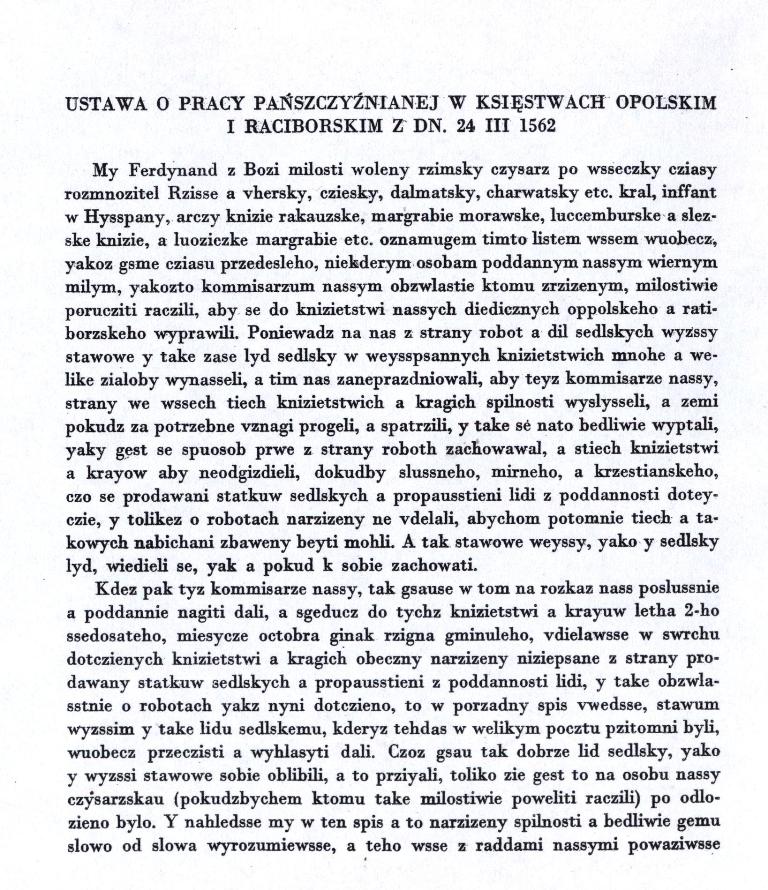
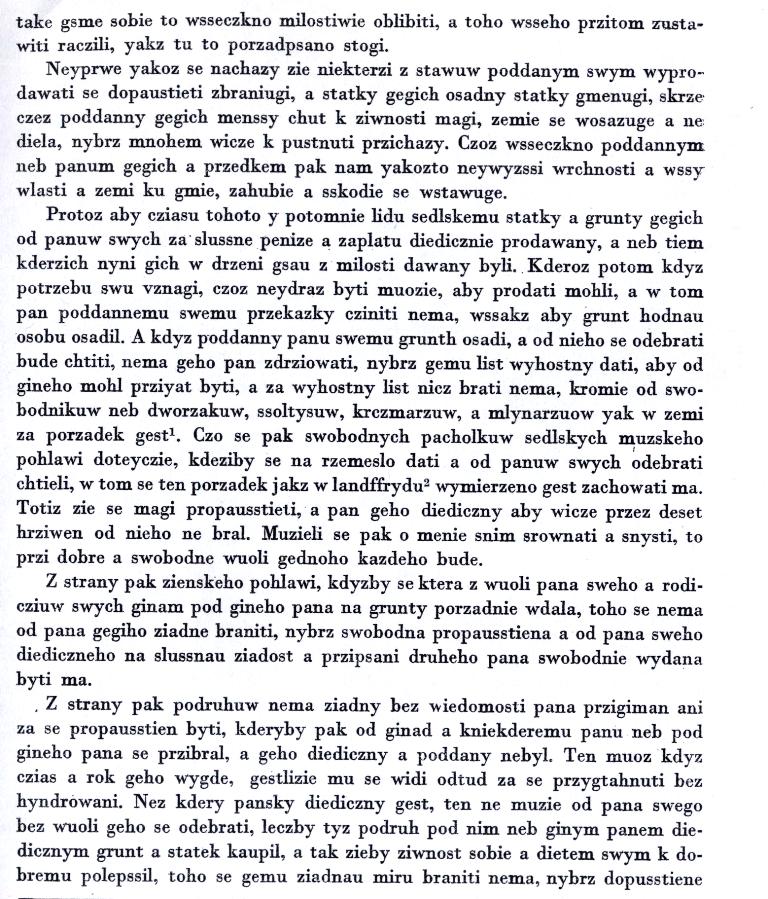
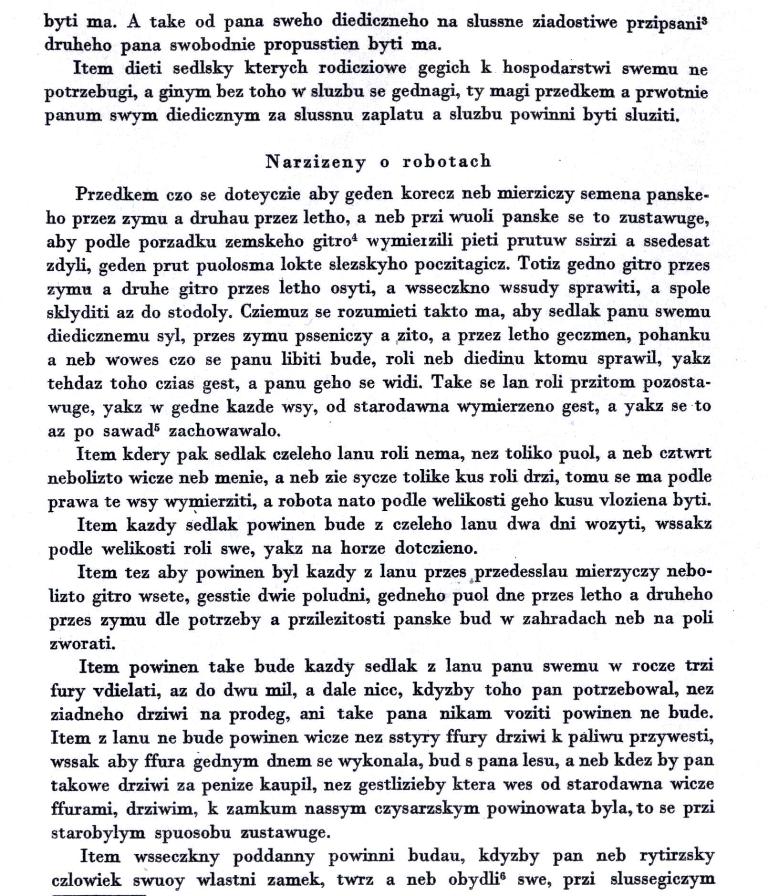
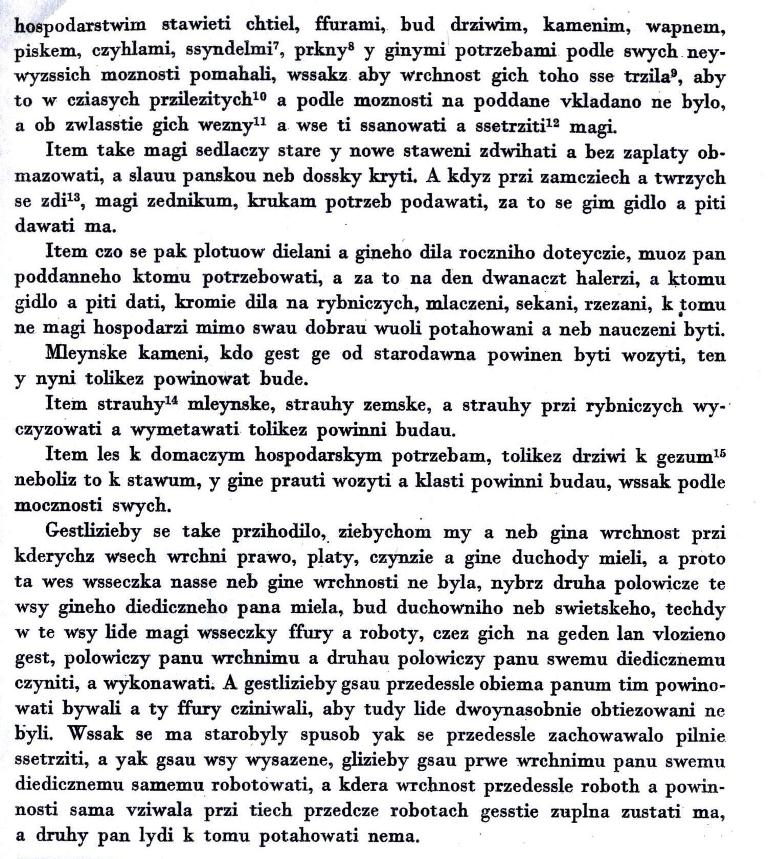
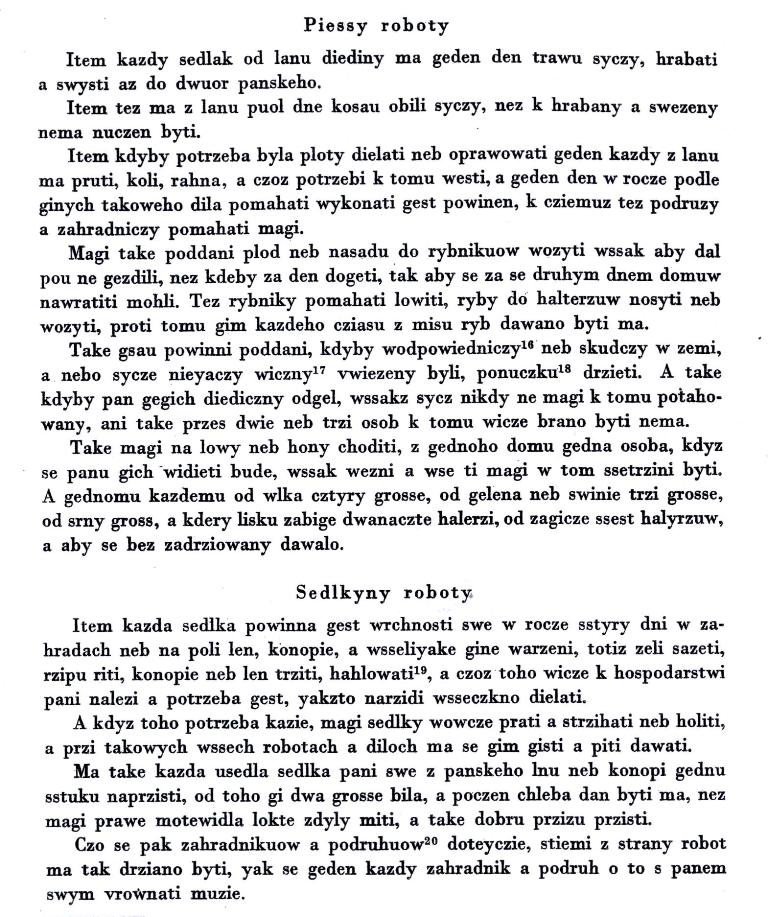
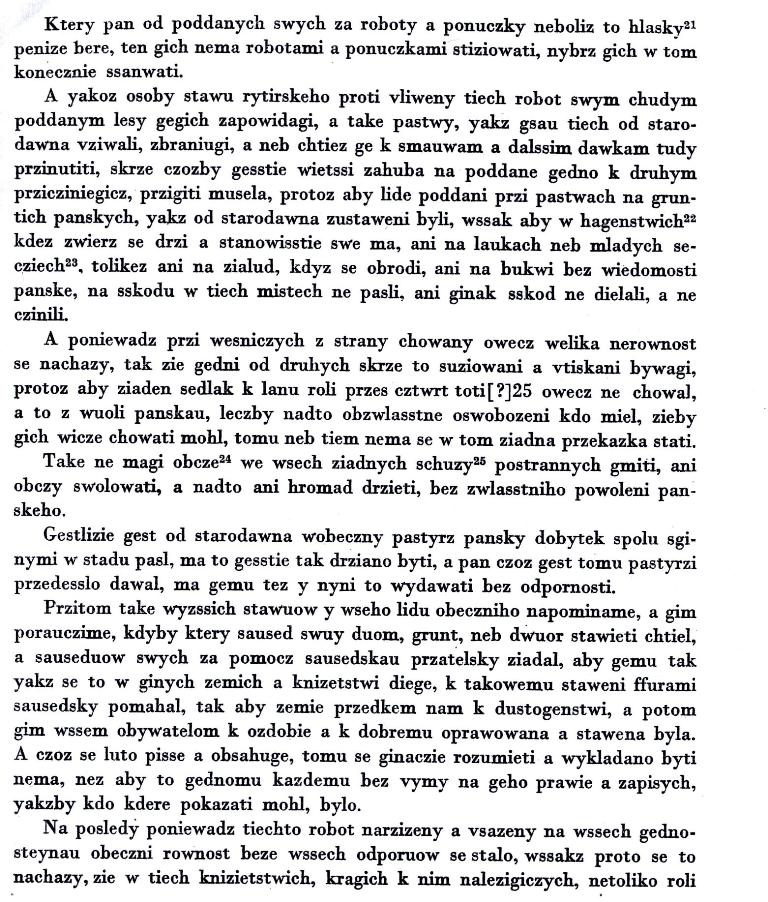
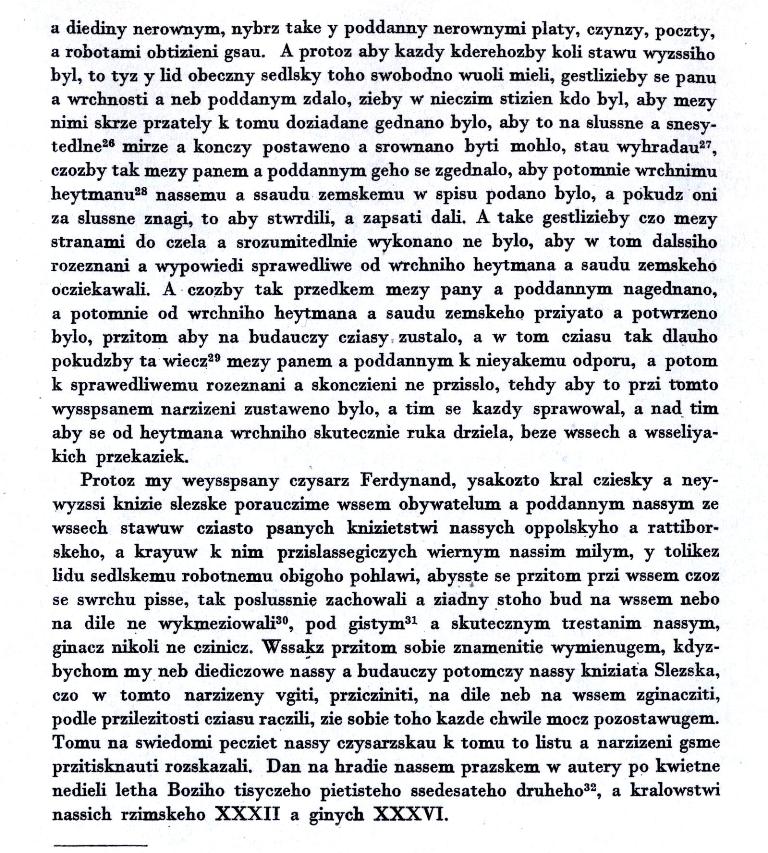
For now I lack the time to translate everything into a language the inhabitants of Folwark can understand. I hope that Father Janek Kornek, who resides at Dub nad Moravou in the Czech Republic, will help me with this.
The information below is (in my opinion) the first publication of names of the inhabitants of our Folwark in the entire history of our village. I have managed to translate it in part
(a mixture of three languages, Czech, German and Polish).
Urbaria concerning the Castle in Opole: names, services, obligations, taxes and dues for all the surrounding villages belonging to the castle on Ostrówek island. In time I shall present the neighbouring villages (Winów, Górki, Chrzowice, Chrząszczyce and others) from 1566. To begin with, Folwark:
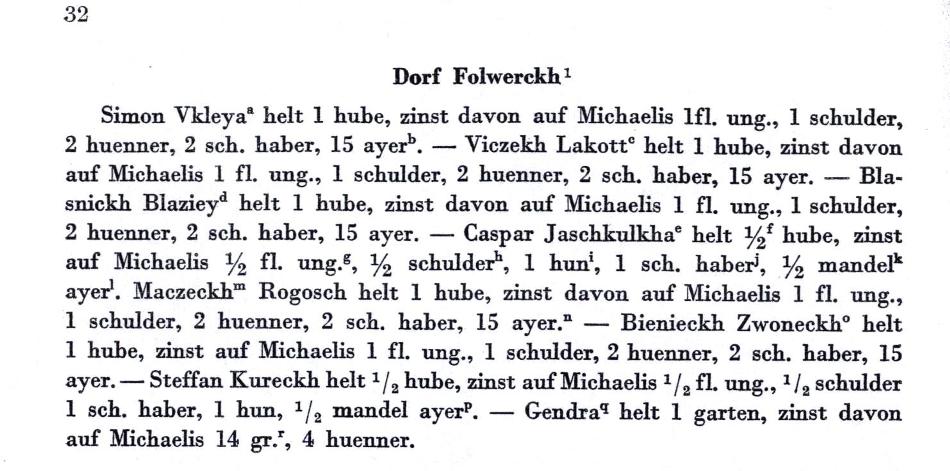
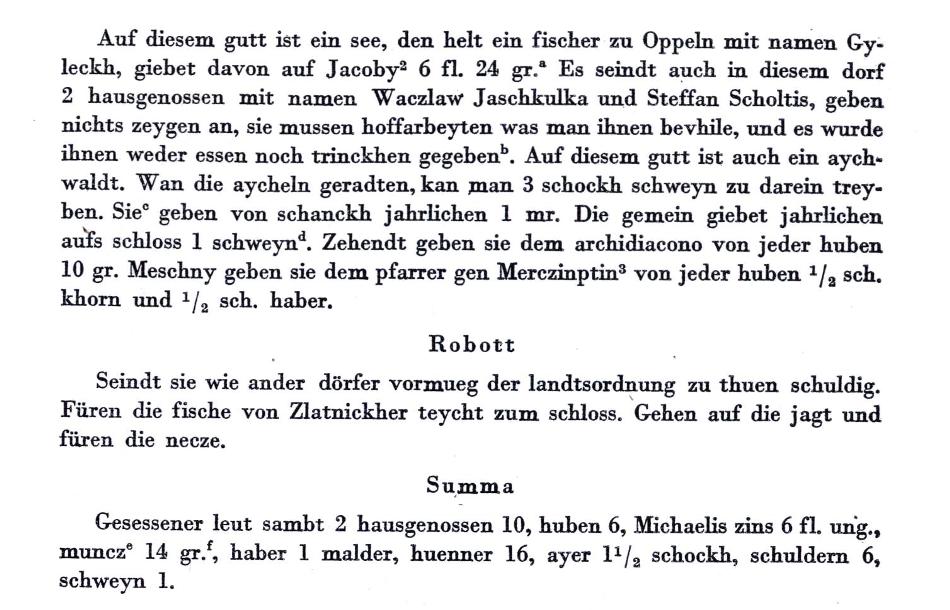
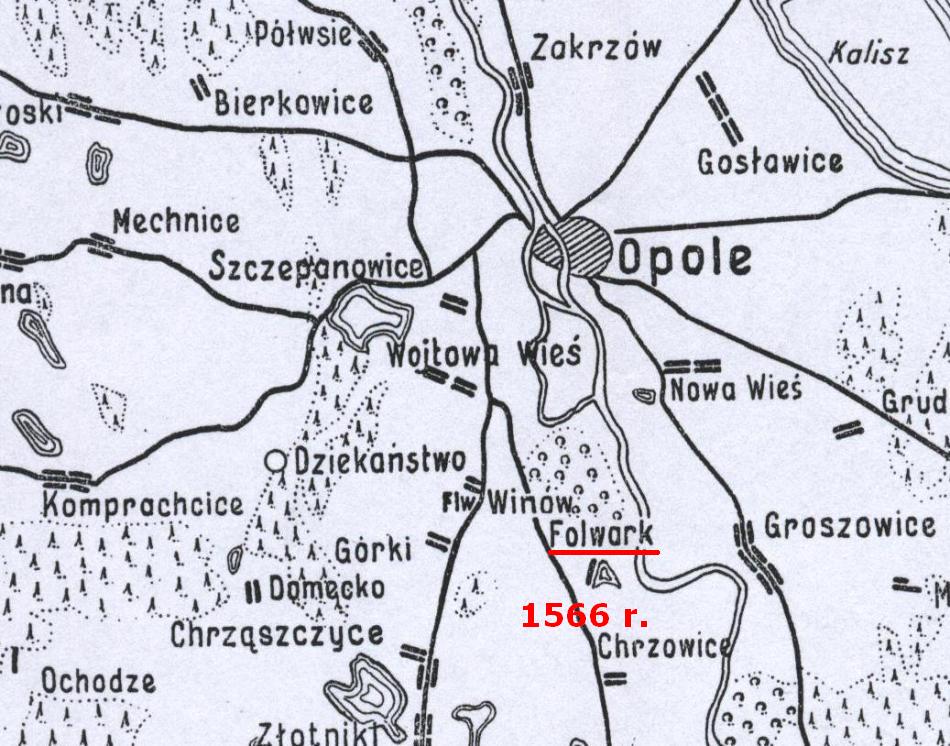
map prepared by Dr S. Gołachowski
The village of Folwerckh
1. Simon Vkleya (and from 1617 entered in red ink) Martin Stach: holds 1 łan of land. Tax (rent, due) on it by St Michael's Day (29 September): 1 Hungarian florin, 1 schulder, and 2 hens, 2 bushels of oats (1 bushel about 75 litres), 15 eggs. (Added) On the other parts of the land he has used until now he must from this year (1573) pay an additional 24 groschen each year.
2. Viczekh Lakotta (and from 1617 entered in red ink) Hedwigis Lakottowa Wittig: holds 1 łan of land. Tax (rent, due) on it by St Michael's Day (29 September): 1 Hungarian florin, 1 schulder, two hens, 2 bushels of oats (1 bushel about 75 litres), 15 eggs.
3. Blasnickh Blaziey (and from 1617) entered Blazekh Pleszka: holds 1 łan. Tax (rent) on it by St Michael's Day (29 September): 1 Hungarian florin, 1 schulder, and 2 hens, 2 bushels of oats and 15 eggs.
The other translations are in progress. Three languages were used at this time; you need many dictionaries to understand our ancestors.
Explanation: 1 łan = 1 huba = about 66 Prussian (Magdeburg) morgen, 1 Magdeburg morgen = 0.2553 ha
1 Franconian łan = about 24.2 ha