

The Habsburg dynasty:
1 - King Rudolf I (1218-1291)
2 - King Albert (1255-1308)
3 - King Frederick (the Fair) (1289-1330)
4 - Duke Albert II (1298-1358)
5 - Duke Rudolf IV (1339-1365)
6 - Duke Albert III (1348-1395)
7 - Duke Albert IV (1377-1404)
8 - King Albert II (1397-1439)
9 - Duke Leopold III (1351-1386)
10 - Emperor Frederick III (1415-1493)
11 - Emperor Maximilian I (1459-1519)
12 - Emperor Charles V (1500-1558)
13 - Emperor Ferdinand I (1503-1564)
14 - Emperor Maximilian II (1527-1576)
15 - Emperor Rudolf II (1552-1612)
16 - Emperor Matthias (1557-1619)
17 - Emperor Ferdinand II (1578-1637)
18 - Emperor Ferdinand III (1608-1657)
19 - Emperor Leopold I (1640-1705)
20 - Emperor Joseph I (1678-1711)
21 - Emperor Charles VI (1685-1740)
22 - Empress Maria Theresa (1717-1780)
23 - Emperor Joseph II (1741-1790)
24 - Emperor Leopold II (1747-1792)
25 - Emperor Francis II/I (1768-1835)
26 - Emperor Ferdinand (1793-1875)
27 - Emperor Francis Joseph (1830-1916)
28 - Emperor Charles I (1887-1922)
* Emperors in the Opole land (from 1558 to 1740)
In 1532 the princes of the Habsburg dynasty took over Silesia from the Czechs.
Ferdinand I, born on 10 March 1503 in Spain, died on 25 July 1564 in Vienna.
Here is the explanation of the birthplace, Spain: the Habsburgs at this time also ruled in that country, and the division into two lines came when Charles V was emperor.
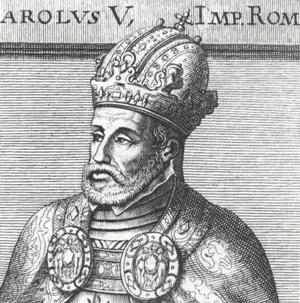
photo: Wikipedia
Roman Emperor of the German Nation Carolus V
Born on 24 February 1500 in Geneva (Switzerland), died on 21 September 1558 in San Jeronimo de Yuste (Spain). At 55 he was already very ill (gout, Urikopathia) and could no longer move, so he abdicated. In January 1556 he handed (Naples, Sicily, northern Italy and Spain with all its colonies) to his son Philip, and in September 1556 the whole empire to his brother Ferdinand, 3 years his junior, asking him in due time to give legal force to Philip's power in Spain. In this way the great empire was divided into two parts, Spanish and Austrian.
As already mentioned in part V, in 1526 Ferdinand I of Habsburg (brother of Emperor Charles V) had the most votes and the right to the Bohemian crown. The Estates of the lands of the Bohemian crown entrusted the royal dignity to him. The coronation took place in Prague on 24 February 1527.
On 1 May 1527 in Wrocław all the towns and dukes of Silesia paid him homage. The Habsburg dynasty lasted until 1918, and in Silesia over 200 years until 1740.
In January 1531 the Estates elected Ferdinand I King of Rome and Germany (coronation on 11.01.1531 in Aachen).
Back to Opole. On 27 March 1532 the last representative of the Opole Piasts died, Jan II “the Good”, who was also lord (from 1521) of the Duchy of Racibórz. During his reign he managed to gather almost all of Upper Silesia into his hands. The duke issued many documents showing his good management, town rights and privileges. In 1531 he issued the great land privilege for the Duchy of Opole-Racibórz (the so-called Hanajski privilege). It was almost like a constitution for the lands of Upper Silesia. After his death the inheritance problems began. Jan never married and had no successors, the reason, according to credible sources, being impotence. So for many years before Jan's death the ducal court in Opole became a place of rivalry between various rulers hoping for a lucrative inheritance.
In 1512 Jan “the Good” made a pact of mutual inheritance with Duke Georg of Krnov (Margrave of Brandenburg) of the Hohenzollern dynasty. The Duchy of Krnov (as the independent areas of Krnov, Bruntál and Vrbno, today in the Czech Republic, bordering the Duchy of Racibórz). The agreement between the last Piast, Jan the Good, and Duke Georg of Hohenzollern was annulled by the Habsburgs (in 1528), but Duke Georg did not cease his efforts to obtain the Duchy of Opole. After long negotiations with Ferdinand, during Jan the Good's lifetime, the agreement was modified: Georg was allowed only a right of pledge for 183 333 Hungarian guilders, not earlier however than a year after Jan's death, and when Ferdinand paid this sum, the Duchy of Opole was to remain inseparably with Bohemia.
After these changes to the agreement (Jan the Good and Georg of Hohenzollern), King Ferdinand, to guard against a possible armed seizure of the duchies of Opole and Racibórz by Margrave Georg, occupied Opole with his army during Jan the Good's lifetime: 1000 armed men under Achaz von Haunold.
This clause allowed the Habsburgs, after the death of Duke Jan the Good, to take to Vienna the enormous wealth kept at Opole castle. The Bishop of Wrocław, Jakob von Salza, came to Opole to collect the duke's estate. The wealth is said to have been enormous: large quantities of silver and gold coins, jewellery, porcelain, weapons and large food stocks. When Opole castle had been stripped, Duke Georg of Hohenzollern was allowed to take over the duchies of Opole and Racibórz.
Duke Georg died in 1543. After his death his son Georg Friedrich took over the patrimony, but as early as 1552 Ferdinand I took the Opole and Racibórz estates from him in exchange for the Duchy of Żagań and monetary compensation. In the same year Ferdinand I gave the duchies of Opole and Racibórz to the Queen of Hungary, Isabella Zapolya, in exchange for Transylvania. Queen Isabella Zapolya set out with her son from Transylvania for Opole in August 1551 and reached Opole on 8 March 1552. As Idzikowski writes in Geschichte der Stadt Oppeln: here, on Ferdinand I's orders, efforts were made to please her in everything. But she periodically left the town and went to Wieluń, Piotrków, Warszawa. She also began cutting down forests belonging to the ducal chamber in Wrocław, thereby breaking the law. In 1550 the Estates asked King Ferdinand to limit Isabella's rights and for the duchy to pass under the emperor's rule. At the start of 1557 Queen Isabella's right of pledge was abolished. Queen Isabella moved to Poland, to the court of her brother.
The return of the duchies of Opole and Racibórz to Habsburg administration began a new organisation, which lasted until the time of the new owners, the Hohenzollerns, until 1740. At the head of the duchy stood the provincial starost, to whom the burgrave was subordinate (responsible for the economy at the castle). The senior regent ran the country estates, and all were subordinate to the Silesian Chamber * in Wrocław.
Queen Isabella's departure was not yet the end of “trading” in Silesia. Twice more the duchies of Opole and Racibórz were given to Transylvania, in 1598 and 1621-1624, and in the years 1645-1666 they were in the hands of the Polish royal family of the Vasas, Władysław IV (as a pledge for a loan). After various intrigues we return (our lands return) to the Habsburgs, until Silesia was occupied by Prussia in 1740.
*Cammer - Silesian Chamber, an office created in 1558 to deal with financial matters, first of all collecting income from the royal estates. This office was the superior authority for all royal financial officials and for the lower authorities of general administration in financial matters. The chamber sitting in Wrocław comprised a chairman and three or four councillors (and quite a large apparatus of officials).
In 1532 King Ferdinand I went from feudal lord to actual owner of the Duchy of Opole. Since he was at the same time (1527) embroiled in war with Jan Zapolya (the voivode who beat him to the Hungarian crown) and with the Turks, who helped the voivode and besieged Vienna, he treated Silesia as a treasury where he could repair his finances. Here we find the explanation for the creation of the Silesian urbaria, listing all the income from the duchies of Opole and Racibórz and the serf labour obligations, the imperial edict (1562). In 1558 the Cammer was set up. The intrigues with Margrave Georg over the patrimony (the treasury of Jan the Good). The first urbaria for the Opole and Racibórz part of Silesia were created in 1532-1534 but were lost during the Second World War.
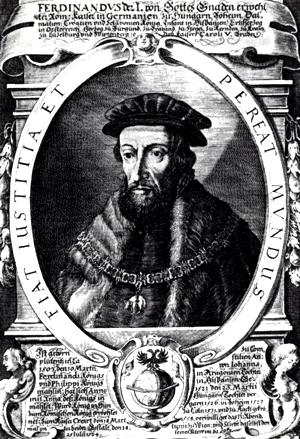
photo: Wikipedia.
Roman Emperor of the German Nation Ferdinand I
The biography of Ferdinand I, “our first emperor”, is very interesting. Born in Spain in 1503. At 18 he was crowned King of Germany (28 April 1521) with the permission of his elder brother, Emperor Charles V. He ruled in Austria, Tyrol and the upper provinces of Italy. On 26 May of the same year he married Princess Anna, born in Prague. This union produced 15 princes and princesses, 13 of whom outlived their parents.
In 1526 crowned King of Hungary.
In 1527 crowned King of Bohemia in Prague.
On 1 May 1527 in Wrocław all the Silesian towns and dukes paid him homage.
In 1531 crowned King of Rome and Germany.
In 1558 recognised in Frankfurt am Main as Roman Emperor of the German Nation.
Ferdinand's children.
1 - Elisabeth *1526 in Prague +1545 in Vilnius. From 1543 (aged 17) wife of Zygmunt II August, King of Poland, the last of the Jagiellons, whose mother was Bona Sforza (Milan)
2 - Maximilian II, our later second emperor.
3 - Anna *1528 in Prague +1590 in Munich, Princess of Bavaria. Married to Count Albert V of Bavaria
4 - Ferdinand II *1529 Linz +1595 in Innsbruck. Married, first wife (two years older) Philippine Welser (a patrician), second wife (aged 16) Anna Katharina, Princess of Mantua.
5 - Maria *1531 in Innsbruck +1581 in Hambach on the Lower Rhine. In 1546, aged 15, married to Wilhelm, Duke of Berg.
6 - Magdalena *1532 in Innsbruck +1590 in Hall/Tirol, nun. Founder of a house for ladies where she was superior (she died as a servant of God, blessed)
7 - Katharina *1533 in Innsbruck +1572 in Linz. In 1549, aged 16, married to Francis III, Duke of Mantua
8 - Eleonora *1534 in Innsbruck +1594 in Mantua. In 1561, aged 27, married to William III, Duke of Mantua.
9 - Margarethe *1536 in Innsbruck +1566 in Hall/Tirol, from 1563 in a convent.
10 - Johann *1538 in Innsbruck +1539 in Innsbruck
11 - Barbara *1539 in Innsbruck +1572 in Ferrara. In 1565, aged 26, married to Alfonso II, Duke of Ferrara
12 - Charles II *1540 in Vienna +1590 in Graz. Married to the 20-year-old Maria Anna, Princess of Bavaria
13 - Ursula *1541 in Vienna +1543 in Innsbruck
14 - Helena *1543 in Innsbruck +1574 in Hall/Tirol, nun in Hall/Tirol
15 - Johanna *1547 in Vienna +1578 in Florence. In 1565, aged 18, married to Francis I, Archduke of Tuscany
Ferdinand I was born (1503) in Spain and grew up there beside his mother, unlike his brother Charles V, who was born (1500) in Switzerland and brought up in Vienna by his aunt. The brothers (as the chronicles write) did not know each other by sight, and Charles, from birth to the age of 17, did not know his mother by sight (perhaps from a portrait?), nor his sister Eleonora. In Spain, where they met in 1517, he also saw his sister Catherine for the first time. At 15, in 1515, Charles was officially declared of age, and at 16 he became King of Spain. His mother was deprived of her rights, which she opposed, and for this she was interned by her son (with the consent of Emperor Maximilian I, compulsory residence in Spain).
Ferdinand I, brought up at the Spanish court by his interned mother Johanna (Infanta of Castile and Aragon) as second claimant to the imperial dignity, was very jealous of his elder brother Charles. After Charles's coronation as King of Spain he had (1518) to move to Brussels. In 1521 Charles, already King of Rome and Germany (from 1519), allowed the coronation of his 18-year-old brother as King of Austria.
After taking this office Ferdinand met great difficulties in his kingdom, Austria. The Estates in the state rebelled again after Emperor Maximilian I had abolished their privileges. The young king, with “Spanish stubbornness”, ordered all the leaders (together with inhabitants of Vienna) to be captured and killed. He acted similarly (1525) with the peasants, who rebelled because of the contributions imposed.
During the Hungarian-Turkish war (1526) the young King of Hungary (Ludwig II) drowned. He had to fight for the right to the Hungarian throne with the claimant, the voivode Johann Zapolya, who had already reached an understanding with the Turks. Zapolya won the “first round” and crowned himself King of Hungary (1526). The second war with Zapolya (1527) was won and the right to the Hungarian crown recognised. In 1529 the Turkish Sultan surrounded Vienna, but a great “plague” broke out and the Turks withdrew.
The chronicler writes: We must thank the Habsburgs, who guarded the eastern borders for the next 150 years, that the Ottomans did not take all of Europe.
After his defeat Zapolya recognised Ferdinand's rights to the Hungarian throne, keeping only Transylvania for himself, but after the birth of his son Zygmunt (1540) he revoked this. Zapolya died in the same year, and rule in Transylvania was taken over, in the name of her under-age son Jan Zygmunt, by Queen Isabella. As mentioned above, in 1551 Ferdinand exchanged Transylvania for the duchies of Opole and Racibórz. For a short time Isabella Zapolya was our queen. After Zapolya's death fighting broke out again with the Turks, who added many Hungarian provinces to their state. Peace came only in 1547, for which Ferdinand had to pay 30 000 ducats every year.
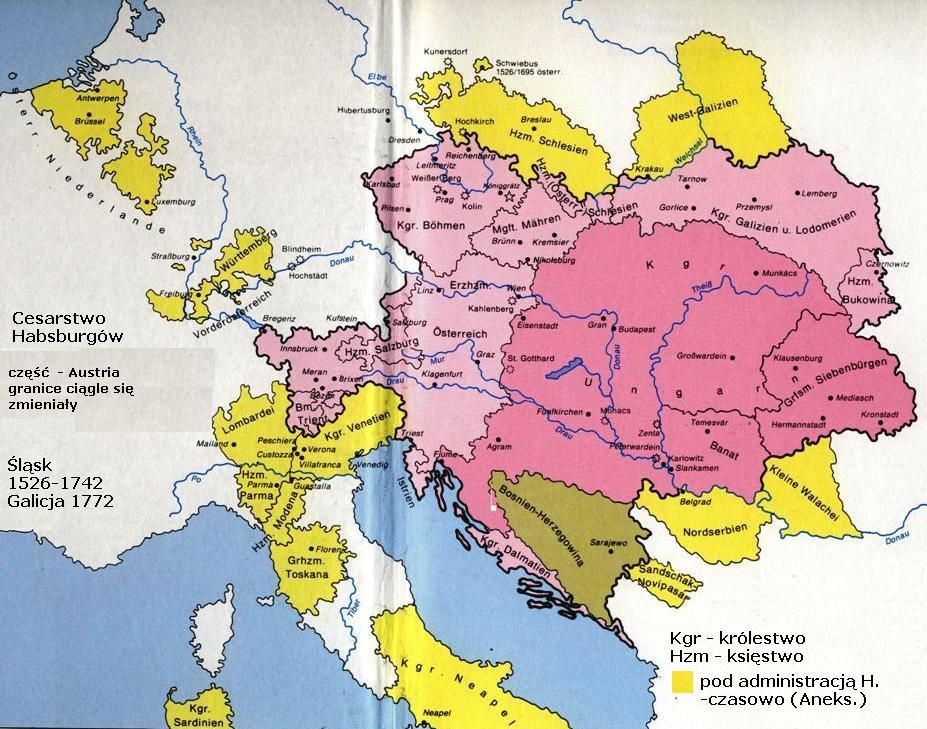
The peace bought with ducats allowed Ferdinand to support his brother (already emperor) Charles V in the west, in the great Habsburg land, in the fight against the Protestants.
Martin Luther (1483-1546), who in 1517 called on theologians to debate indulgences and other abuses in the Church. For this he was excommunicated by the Pope. Under the ban he formulated three basic principles of the Reformation (in short):
1) The Bible is the highest authority in matters of faith and Christian life and cannot be subject to dogmatic interpretations by either the Pope or the institution of the Church.
2) Man is justified before God only by grace through faith.
3) Every believer has direct access to God.
Luther's theses found many supporters, also in our Duchy of Opole-Racibórz.
On the basis of social discontent and partly under the influence of a misunderstood version of Luther's teaching on Christian freedom, the Peasants' War broke out in Germany in 1525. At first Luther tried to mediate and spoke up for the peasants' moderate demands, but when the peasants committed crimes he called on the state power (Ferdinand I) to intervene. The final battle took place at Frankenhausen, where the rebel peasantry was completely routed and the captured peasants were massacred, despite Luther's requests to treat those who surrendered leniently. In all about 150 thousand people died during the Peasants' War.
After the death of his brother, the Emperor of Rome and the German Reich, Charles V (1558), Ferdinand I took his place.
Ferdinand tried (before the third Council of Trent) to bridge the gulf between Catholics and Protestants (he proposed communion in both kinds, permission for priests to marry, services in the people's language, division of large bishoprics); his efforts remained fruitless. The Council of Trent ended without restoring peace in the Church. However, a number of charitable organisations were established and many abuses abolished.
In 1562 he brought about the coronation of his son Maximilian II (a supporter of Protestantism) as King of Rome and the German Nation. Before his election as king, Maximilian II undertook to his father to remain faithful to the Catholic Church and its teaching.
On 25 August 1564, after a long illness, Emperor Ferdinand I died.
In the rich literature on this subject we can read that in all negotiations he was a convinced, believing Catholic. His actions made it possible to keep the influence of Protestantism far from his Habsburg possessions. His wife Anna had great influence on his rule, especially in the early years. Empress Anna, who bore him 15 children, always travelled with her husband, which the Estates held against her, as she exposed the empire to great travel costs.
The emperor's reply to these charges:
“Einem frommen Herrn gebührt, seinen Ehestand zu halten, es ist besser einige Umkosten auf seine Ehegattin zu verwenden als auf Buhlerei” (A pious lord should keep to his marriage; it is better to spend some costs on one's wife than on fornication.)
Such was our first emperor, to whom the subject Folwarczanie belonged in the years 1532-1564.
Greetings from Folwark, Rudolf