

Information in the urbaria:
Des Fürstenthumbs Oppeln Urbari und Grundtbuch Desselben Geschloss, Stadt, Dörfer
und aller wirdtschaften und einkomen
recorded by order of His Imperial Majesty by the gentlemen:
Wilhälm Kurtzpach, Baron of Trachenberg (Żmigród, Milicz county),
Councillor of the Silesian Chamber of His Royal Majesty, Hans Bernhardt Maltzan, Baron of Wartenberg (Syców),
Count Jan Schlowski von Schlowitz (a place in Bohemia)
Councillor of the Kingdom of Bohemia of His Royal Majesty, Seifried Ribisch
im monat Mayo 1566 jahrs.
in the years 1566 to 1567, with corrections entered in 1617 to 1618.
Folwerckh, for comparison
Krczowicze, Chrzumptzicze, Zlotnickhi, Gorkhy and Forwerch Wyno.
These urbaria cover the whole Duchy of Opole; I have copied only the information of interest for Folwark.
We have reached the times when, for the first time in history, the names of the inhabitants of Folwark were recorded in the castle urbaria. This was not done because the Folwarczanie had now become important, but so that the lord at the castle would know from whom, what and how much he could demand. Until 1534 Folwark was the property of the duke at the castle. The inhabitants, like the land, were his property; what counted was a “soul” fit for work. People were a tool that had to work as much as necessary so that the lord at the castle and his retinue could live well and wage many wars with his “family”.
Since the Polish feudal economic system was not very productive for the “enlightened” Piasts, they introduced the settlement of villages under German law. First they settled colonists in the 13th century, and in the following years, slowly, the “old” villages. And so 300 years had to pass before our Folwark was settled under Magdeburg law in 1534. Peasants were allotted pieces of land (mostly 1 łan, about 16.5 ha) and leased them for a suitable fee. The fees varied from village to village. As well as money rent, peasants paid in grain, hens, eggs, pigs and cattle. But serf labour, now regulated (imperial edict of 24 March 1526), they had to work off for a set number of days on the manor. These additional (unpaid) duties and tasks also varied from village to village. To all the services for the castle were added compulsory services to the collegiate church in Opole and Meschne for the parish church in Chrząszczyce, the so-called tithe (every tenth sheaf). The sheaf tithe could be converted into money.
In practice the urbaria had two meanings. First, the owner knew his financial situation (what he could count on from his subjects); second, our lands kept changing owners, so it was important for a new owner to know what he was getting or had won. We know from history that the Duchy of Opole was also given as a pledge for debts.
The Silesian urbaria, especially those of Opole, are regarded as the most accurate because they were written from direct inspection; that is, the commission checked on the spot who leased how much. So we find many remarks by the commission recommending the building of new ponds on waste land, or as for Folwark a proposal to graze pigs (acorns) in the oak forests growing between Folwark and Winów. The castle later charged a fee of 1 mark from the whole village for the grazing.
In the Opole urbarium we also find information that in the village of Winów, where there were 5 peasant farms, the peasants were bought out (moved away) and a typical “manor farm” (folwark) was founded. A sheepfold was built, in which 800 sheep could be kept over the winter for the castle's needs. Similarly a certain knight Heinrich Buchta bought all the land in Domecko and founded a “manor farm”. This was advantageous for the owner, because the land was farmed partly with free serf labour and partly in exchange for 2/3 of the crop, with 1/3 given to the castle.
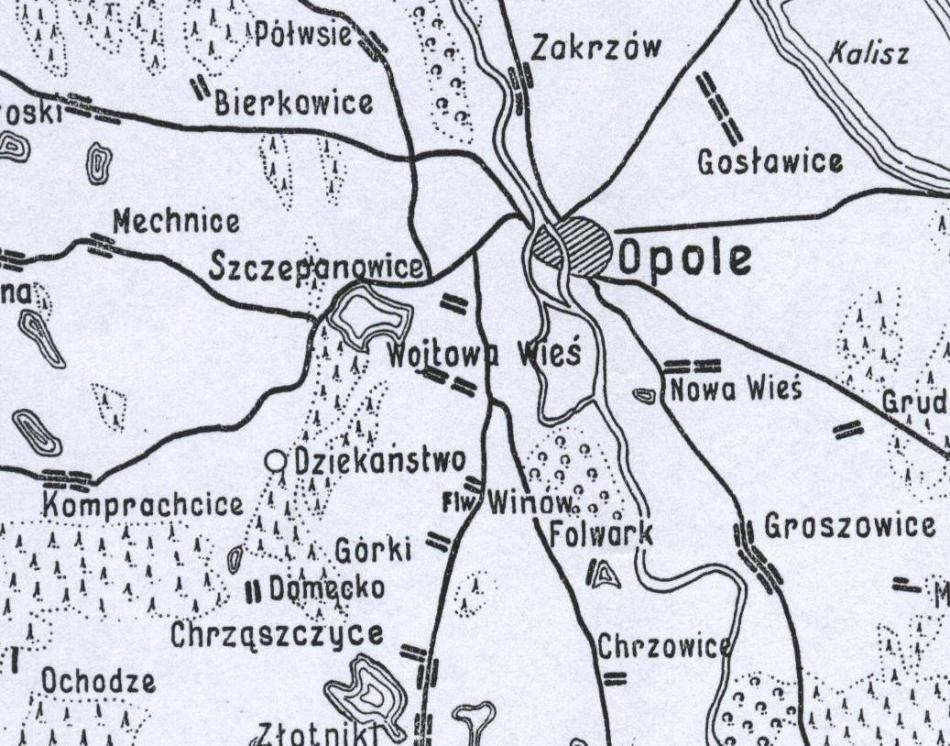
On the map the villages are marked with thick lines. One thick line means about 5 peasants, tenants. Folwark has /, Górki //, Chrzowice //, Chrząszczyce ////, Złotniki ////. Also visible is the lake at Złotniki, from which the Folwarczanie had to deliver fish to the castle in Opole. The villages of Chrząszczyce, Złotniki and Chrzowice did not belong to Opole but to the castle at Prószków, where the duties to Count Proszkowski were somewhat different. Unfortunately the castle urbaria for the town of Prószków were lost during the Second World War and we are unlikely to find them. I do, however, have the duties of the peasants (and their names) of Chrząszczyce, Złotniki and Chrzowice in my documents; they were with those of Opole castle because of the sheaf tithe to the collegiate church in Opole. After “translating” them I shall give them on the page for comparison with our Folwark.
map prepared by Dr S. Gołachowski
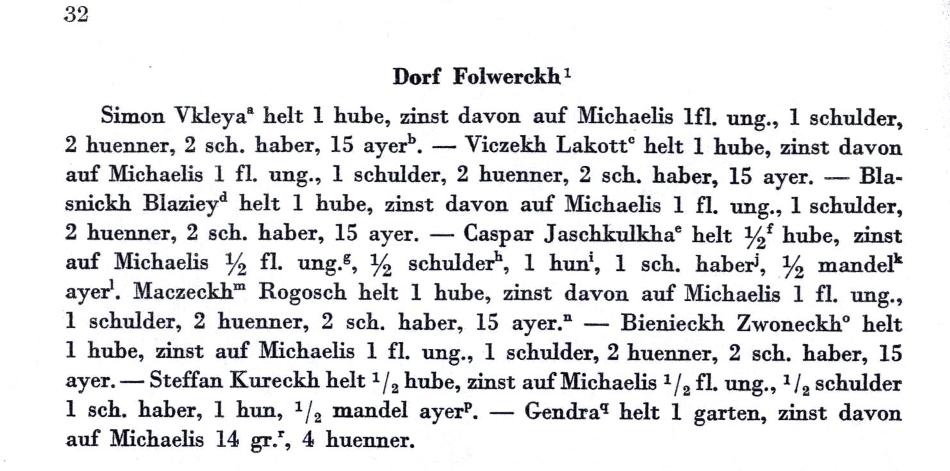
Above, the amount of rent in 1566 with corrections in 1618 for Dorf Folwerckh
today the village of Folwark
1. Simon Vkleya crossed out, (and from 1617) entered Martin Stach: holds 1 łan of land (rent). From this, by St Michael's Day (29 September): 1 Hungarian florin, 1 schulder and 2 hens, 2 bushels of oats (1 bushel about 75 litres), 15 eggs (added). On the other parts of the land he has used until now he must from this year (1573) pay an additional 24 groschen each year.
2. Viczekh Lakotta crossed out, (and from 1617) entered Hedwigis Lakottowa Wittig: holds 1 łan of land (rent). From this, by St Michael's Day (29 September): 1 Hungarian florin, 1 schulder, two hens, 2 bushels of oats (1 bushel about 75 litres), 15 eggs.
3. Blasnickh Blaziey crossed out, (and from 1617) entered Blazekh Pleszka: holds 1 łan (rent). From this, by St Michael's Day (29 September): 1 Hungarian florin, 1 schulder and 2 hens, 2 bushels of oats and 15 eggs.
4. Caspar Jaschkulkha crossed out, (and from 1617) entered Thomekh Czolekh: holds 1 łan of land (rent). From this, by St Michael's Day (29 September): ½ Hungarian florin (corrected to 1 Hungarian florin), ½ schulder (corrected to 1 schulder), 1 hen (corrected to 2 hens), 1 bushel of oats (corrected to 2 bushels of oats), ½ mendel of eggs (corrected to 1 mendel of eggs) (added in the margin: Note, this Kaspar Jasskulka bought for himself half a łan from Steffan Kureckh and must now pay both dues).
5. Maczeckh (the name Maczeckh corrected in 1617 to) Walekh Rogosch: holds 1 łan of land. Rent on it at St Michael's (29 September): 1 Hungarian florin, 1 schulder, 2 hens, 2 bushels of oats, 15 eggs. Added in the margin: and on that piece of land he has used until now (without dues) he must from St Michael's (29 September 1573), as joined to his own, pay 18 groschen a year.
6. Bienieckh Zwoneckh crossed out, (and from 1617) entered Gregor Lakotta: holds 1 łan of land (rent). From this, by St Michael's (29 September): 1 Hungarian florin, 1 schulder, 2 hens, 2 bushels of oats, 15 eggs.
7. Steffan Kureckh: holds 1/2 łan of land (rent). By St Michael's Day (29 September): ½ Hungarian florin, ½ schulder, 1 bushel of oats, 1 hen, ½ mendel of eggs (note added in the margin). On this place a smallholder named Stanek Kusia was settled. He uses 1 garden. He must pay (as rent) from St Michael's of this year (1576) to St Michael's (annually) 48 groschen. Along with this garden he was also allowed to develop a piece of land (an der winer granicz, this concerns Rzykos) for a purchase price of 12 thalers. To be used without rent from 24 April 1578. Then the name Stanek Kusia was crossed out and Blasien Scholcz written. Then the name Blasien Scholcz was crossed out and Andres Mimecz written in red ink in 1617.
8. Gendra crossed out (and from 1617) entered Woytekh Zagrodnig: holds 1 garden (rent). From this, by St Michael's (29 September): 14 groschen, 4 hens. Added: Note, AD 1599, he was set the same rent as Blasien Scholcz pays on the garden (allotted) to him, because he does not work at the “manor, castle”, and he gives 1 thaler 12 groschen a year.
Explanation: 1 łan = 1 huba = about 66 Prussian (Magdeburg) morgen, 1 Magdeburg morgen = 0.2553 ha
1 Hungarian florin = 54 groschen
1 florin = 36 groschen
1 thaler = 36 groschen (in the Opole urbaria counted as: 1 thaler = 34 groschen)
1 schockh (kopa, mendel) = 60 pieces
1 groschen = 2 kreuzer = 12 heller
1 fuder = the load of one cart
1 scheffel (bushel) = 4 viertel = 16 metze = 64 measures (dry measure, about 75 litres)
1 schulder = ?? (I found no equivalent)
1 malder = 12 bushels (grain measure, about 600 kg)
1 garben = 1 sheaf tithe in kind
Zehendt = church tithe
Meschny = due to the parish priest
Note: the values of coins in Silesia changed greatly in the 16th century and were converted in different ways, so there may be some discrepancies in my translation.
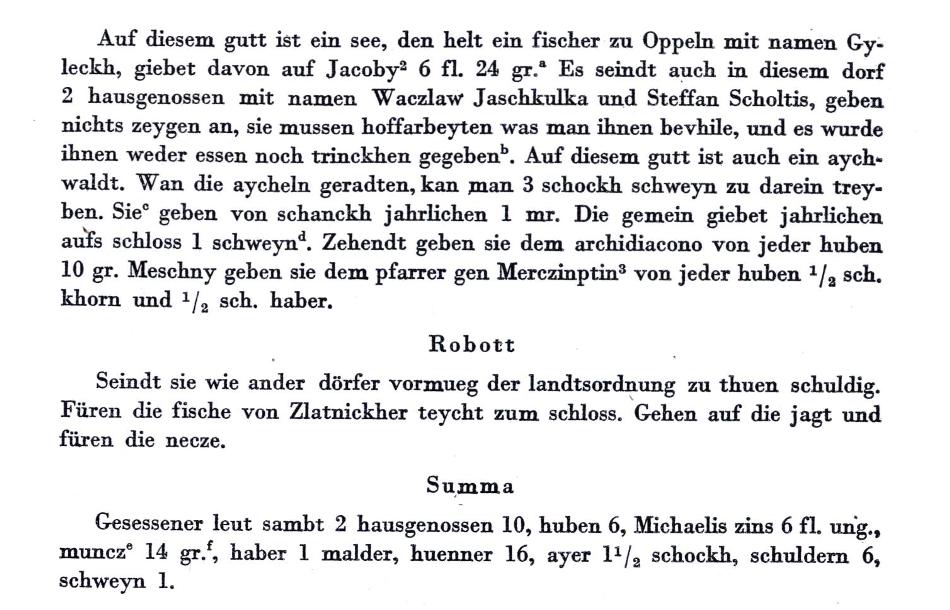
Other dues:
On these (Folwark) royal estates there is one lake, used by a fisherman from Opole named Gyleckh, who pays a rent of 6 florins 24 groschen for its use, added (or 5 thalers), payable on St James's Day (25 July).
In the village there are also two cottagers named Waczlaw Jaschkulka and Stefan Scholtis, who pay nothing and explain that they must do the work at the castle manor as ordered, and for this they receive neither drink nor food (added in red ink in 1617: they pay 4 groschen on the main livestock, 7 groschen on cattle and pigs, 4 groschen on small animals, and they lie like everyone).
On these (Folwark) estates there is also an oak forest. When the acorns fall, 3 schock of pigs can be driven into this forest.
For the sale of beer they give 1 mark a year.
The village gives the castle 1 pig a year (added: for this they give 5 thalers).
They give the tithe to the church in Opole (the archdeacon), 10 groschen from each łan of land. The due to the parish priest in Chrząszczyce from each łan of land is ½ bushel of grain and ½ bushel of oats.
Robott.
Serf labour.
They are obliged to work off serf labour like all villages (according to the landtsordnung, the law on serf labour in the Duchy of Opole and Racibórz of 24 March 1562, edict of Emperor Ferdinand I). You can try to read the edict on the previous page (Pofyrtane dzieje Folwarku); it is written in Old Czech, because that was then in use in Folwark alongside Old German and Old Polish.
The Folwarczanie: In addition they were obliged to catch fish in the Złotniki pond; the fish caught in the Złotniki lake had to be delivered to the castle. They were obliged to take part in hunts and to drive game into nets.
Summary: annual dues of the inhabitants of Folwark to the royal castle in Opole.
Settled people 10 in all (including 2 cottagers), leasing 6 łany of land, rent payable at St Michael's (29 September), in all 6 Hungarian florins 14 groschen, oats 1 malder (about 600 kg) (that is 12 bushels, taking 1 bushel = 75 litres, which is about 50 kg), 16 hens, about 135 eggs, 1 pig and 6 schulders (schulder: a unit of debt; I found no conversion to determine the value of 1 schulder).
The urbaria did not give the number of inhabitants, only of the peasants who leased land. Assuming that a family averaged about 6 people, about 60 people in all lived in Folwark.
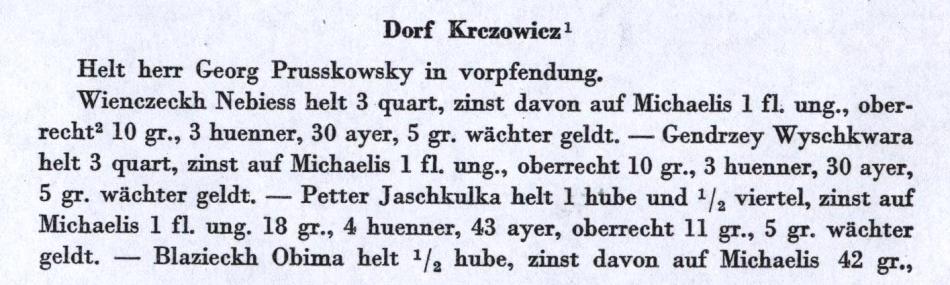
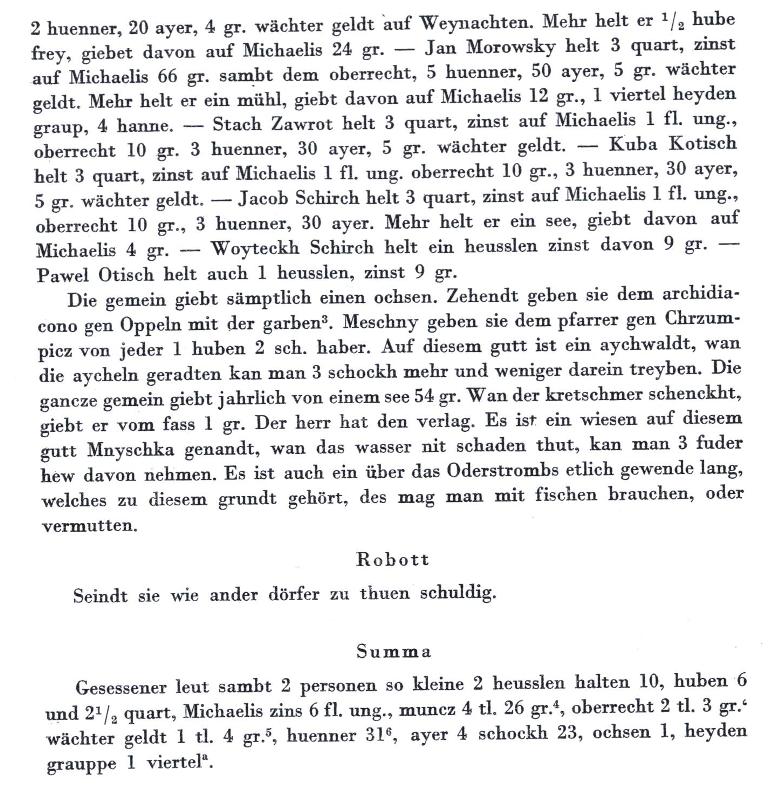
Dorf Krczowicz (the village of Chrzowice, all the land in Chrzowice belonged to the castle at Prószków). Duties of the peasants in Chrzowice in 1566-1618.
1 - Wienczeckh Nebiess leases ¾ łan (about 12 ha). Rent at St Michael's (29 September) 1 Hungarian florin, 10 gr. due for the castle's high jurisdiction, 3 hens, 30 eggs and 5 gr. watch due.
2 - Gendrzey Wyschkwara leases ¾ łan (about 12 ha). Rent at St Michael's (29 September), amount as above.
3 - Petter Jaschkulka leases 1 łan and 8 Magdeburg morgen. Rent at St Michael's (29 September) 1 Hungarian florin and 18 gr. Due: 4 hens, 43 eggs, Oberrecht 11 gr. due for the castle's high jurisdiction, 5 gr. watch due.
4 - Blazieckh Obima leases ½ łan. Rent at St Michael's (29 September) 42 gr., 2 hens, 20 eggs, 4 gr. for the watch at Christmas. In addition he leases ½ łan free of dues, rent on it 24 gr. payable at St Michael's.
5 - Jan Morowsky leases ¾ łan (about 12 ha). Rent at St Michael's (29 September) 66 gr. Due 5 hens, 50 eggs, 5 gr. for the watch. In addition he keeps a mill, for which he pays 12 gr. at St Michael's and as a due 1 viertel (18.5 litres of groats), 4 cocks.
6 - Stach Zawrot leases ¾ łan (about 12 ha). Rent at St Michael's (29 September) 1 Hungarian florin. Due: 10 gr. for the castle's high jurisdiction, 5 gr. watch due, and 3 hens, 30 eggs.
7 - Kuba Kotisch leases ¾ łan (about 12 ha). Rent at St Michael's (29 September) 1 Hungarian florin. Due: 10 gr. for the castle's high jurisdiction, 5 gr. watch due, and 3 hens, 30 eggs.
8 - Jakob Schirch leases ¾ łan (about 12 ha). Rent at St Michael's (29 September) 1 Hungarian florin. Due: 10 gr. for the castle's high jurisdiction, 3 hens, 30 eggs. Besides this he leases a lake, for which he pays 4 gr. at St Michael's.
9 - Woyteckh Schirch leases a house, rent 9 groschen.
10 - Pawel Otisch also leases a house, rent 9 groschen.
Village, dues in all: 1 bull to the castle at Prószków. They pay the sheaf tithe to the archidiacono (collegiate church) in Opole. The church due from each łan: 2 bushels of oats (150 litres) they give to the priest at Chrzumpicz. On the castle's estates in Krczowice there is also an oak forest; when the acorns are ripe more or less 180 pigs can be grazed. The whole village also pays 54 gr. each year for one lake. The innkeeper pays 1 gr. per barrel of beer sold to Prószków castle. On these castle estates there is also a meadow called “Mnyszka”; if the water does no damage during floods, 3 cartloads (of hay, grass) can be gathered from it. Beyond the River Oder there is also an area belonging to this, which can be developed for stocking with fish.
Robott: serf labour
Work for the castle applies to all peasants and their women, as in all other villages (see the imperial edict of Ferdinand I).
Summary. The village has 10 settled people, including two cottagers. They lease in all 6 and 3/4 łany. They pay rent at St Michael's, in all 6 Hungarian florins (in muncz, that is in current currency, 4 thalers 26 groschen; it should be 4 thalers 4 groschen, counting the thaler at 34 groschen). The due for “Oberrecht”, the castle's high jurisdiction, the village pays with 2 thalers 3 groschen, Wächter geldt (for the watch) 1 thaler 4 groschen, hens 30, eggs 4 mendels (of 60) + 23 = 263, 1 bull, millet groats (1 viertel = 18.5 litres).
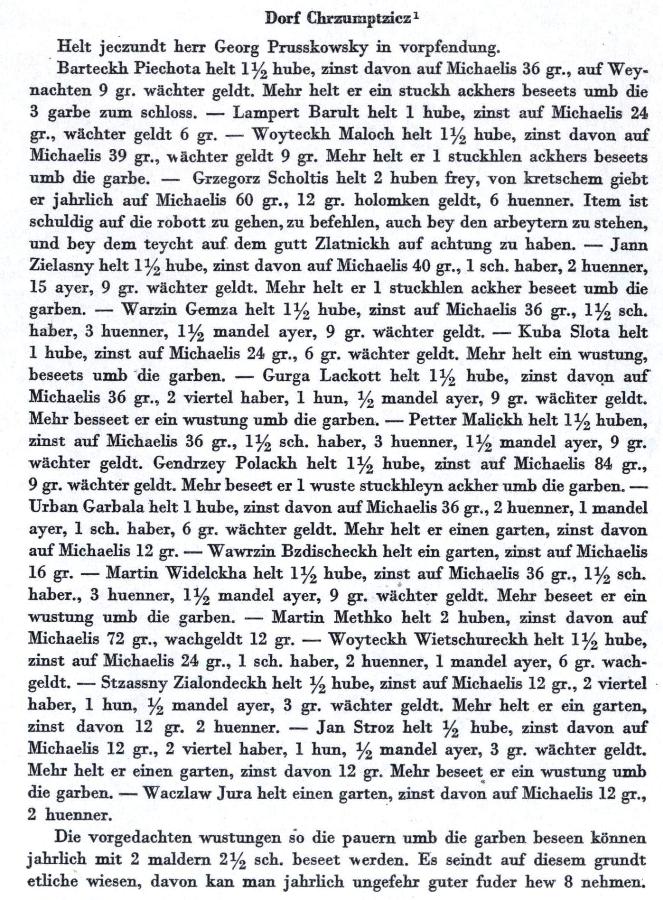
Dorf Chrzumptzicz (Chrząszczyce, all the land in Chrząszczyce belonged to the castle at Prószków).
1 - Barteckh Piechota leases 1 ½ łany, rent payable at St Michael's (29 September) 36 gr. Watch due 9 gr., payable at Christmas. He also leases a piece of land, for which he gives 3 sheaf tithes to Prószków castle.
2 - Lampert Baruld leases 1 łan, rent payable at St Michael's 24 gr. Watch due 6 gr.
3 - Woyteckh Maloch leases 1 ½ łany, rent payable at St Michael's 39 gr. Watch due 9 gr.
4 - Grzegorz Scholtis (in the urbarium the surname is given as scholtis = sołtys; the record of duties shows that Grzegorz acted as sołtys) leases 2 łany free of rent. For the sale of beer he gives 60 gr. a year at St Michael's, while 12 gr. (holumkhengedt) is a fee charged to free peasants and sołtysi in lieu of the duty of armed service at the castle (for the permanent castle guards). Due 6 hens. Additional duties as sołtys: he must supervise the “Robott”, serf labour, and be present while this work is done. He must also watch over the pond on the Złotniki estates.
5 - Jann Zielasny leases 1 ½ łany of land, for which he pays rent at St Michael's 40 gr. Due: 1 bushel of oats, 2 hens, 15 eggs and 9 gr. for the watch. He also leases a piece of land from which the castle at Prószków has 1 sheaf tithe.
6 - Wargin Gemza leases 1 ½ łany of land, for which he pays rent at St Michael's 36 gr. Dues: 1 ½ bushels of oats, 3 hens, 1 ½ mendels of eggs and 9 gr. for the watch.
7 - Kuba Slota leases 1 łan of land, rent payable at St Michael's 24 gr. and 6 gr. for the watch. He also leases waste land for a rent of 1 sheaf tithe.
8 - Gurga Lackott leases 1 ½ łany, rent payable at St Michael's 36 gr. Dues: ½ bushel of oats, 1 hen, ½ mendel of eggs (30) and 9 gr. for the watch. He also leases waste land, for a rent of 1 sheaf tithe.
9 - Petter Malickh leases 1 ½ łany, for which he pays rent at St Michael's 36 gr. Dues 1 ½ bushels of oats, 3 hens, 1 ½ mendels of eggs and 9 gr. for the watch.
10 - Gendrzey Polackh leases 1 ½ łany, for which he pays rent at St Michael's 84 gr., due 9 gr. for the watch. Besides this he uses 1 piece of waste land and a piece of land for a rent of 1 sheaf tithe.
11 - Urban Garbala uses 1 łan of land, rent payable at St Michael's 36 gr. Dues: 2 hens, 1 mendel of eggs, 1 bushel of oats and 6 gr. for the watch. Besides this he uses a garden, for which he pays a rent of 12 gr. at St Michael's.
12 - Wawrzyn Bzdischeckh uses only 1 garden for a rent, payable at St Michael's, of 16 gr.
13 - Martin Widelckha leases 1 ½ łany of land, rent payable at St Michael's 36 gr. Dues: 1 ½ bushels of oats, 3 hens, 1 ½ mendels of eggs (90) and 9 gr. for the watch. Besides this he uses one piece of waste land for 1 sheaf tithe.
14 - Martin Metko leases 2 łany of land, rent payable at St Michael's 72 gr. Dues 12 gr. for the watch.
15 - Woyteckh Wietschureckh leases 1 ½ łany of land, rent payable at St Michael's 24 gr. Dues: 1 bushel of oats, 2 hens, 1 mendel of eggs (60) and 6 gr. for the watch.
16 - Stzassny Zialondeckh leases ½ łan of land, rent payable at St Michael's 12 gr. Dues: ½ bushel of oats, 1 hen, ½ mendel of eggs and 3 gr. for the watch. Besides this he uses a garden, for which he pays 12 gr. and 2 hens.
17 - Jan Stroz leases ½ łan of land, rent at St Michael's 12 gr. Dues: ½ bushel of oats, 1 hen, ½ mendel of eggs and 3 gr. for the watch. He also leases a garden for a rent of 12 gr. and 1 piece of waste land for 1 (garben) sheaf tithe.
18 - Waczlaw Jura leases 1 garden for a rent, payable at St Michael's, of 12 gr. Due 2 hens.
Remarks of the commission.
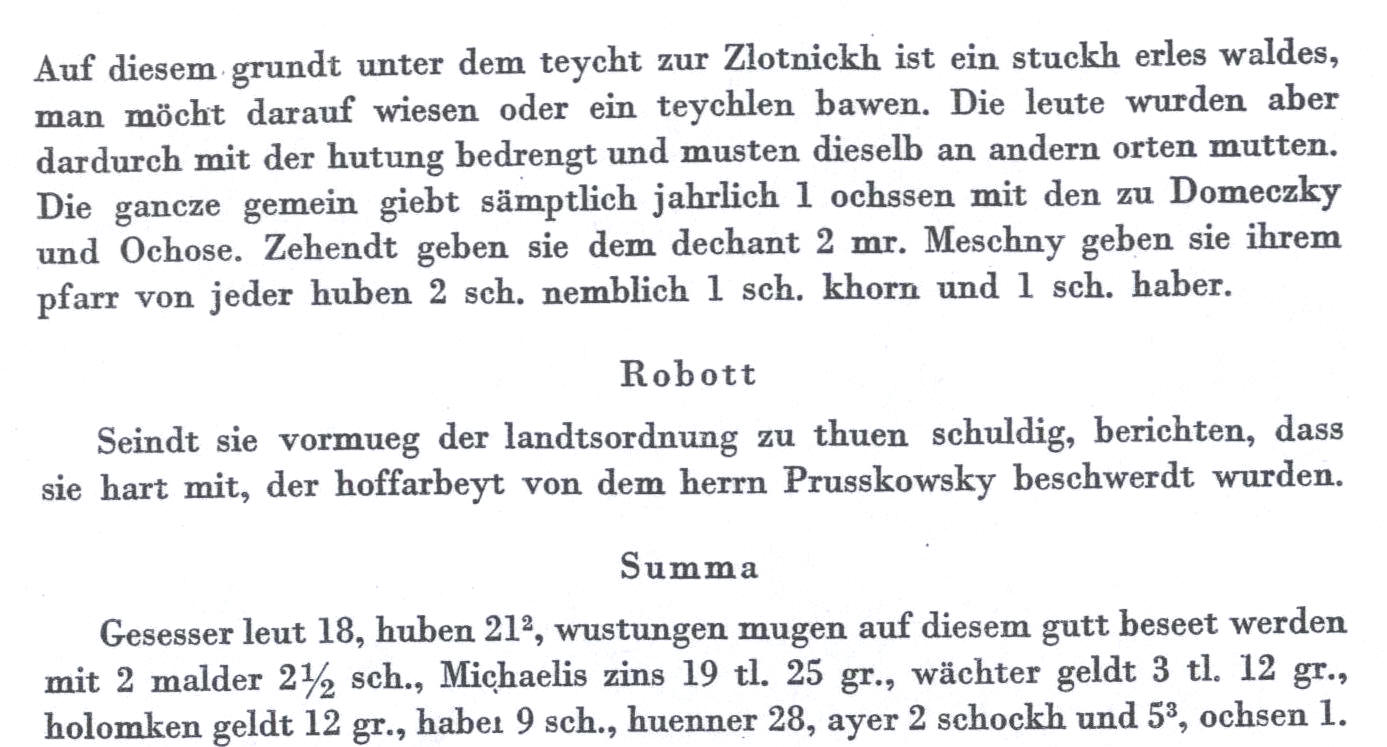
The waste land listed above the peasants can sow in order to pay the due; for this they need 24-26 ½ bushels. On the village's estates there are several meadows from which about 8 cartloads (of hay, grass) can be gathered each year. On the village's estates below the Złotniki lake there is also a forest on which meadows could be laid out or a pond (a small lake) built. But this would burden the people with additional work, and they would be forced to ask neighbouring villages for help. The whole village gives 1 ox a year as a due (together with Domeczky and Ochose). They give the tithe to the deanery in Opole, 2 marks. Meschne (due to the priest) they give to their priest: 2 bushels from each łan (1 bushel of grain and 1 bushel of oats).
Robott: serf labour.
Since they became subject to the new (landtsordnung), the new law (imperial edict of Ferdinand I), Count Pruszkowsky has used them very harshly for much work at his castle (a complaint recorded by the commission).
Summary of the survey:
In the village (1566) live 18 peasants, leasing 20 ½ łany of land. The waste land on these estates can be developed (sown with 2 malder and 2 ½ scheffel = 24 bushels + 2 ½ bushels, this much being needed to sow it). The village pays rent at St Michael's (29 September), in all 19 thalers 25 gr. For the watch 3 thalers and 12 gr. Holomken gelt (for the duty of armed service) 12 gr. Dues: 9 bushels of oats, 28 hens, 2 schock 15 eggs and 1 ox.
Assuming 6 people per family, about 108 people could have lived in Chrząszczyce then.
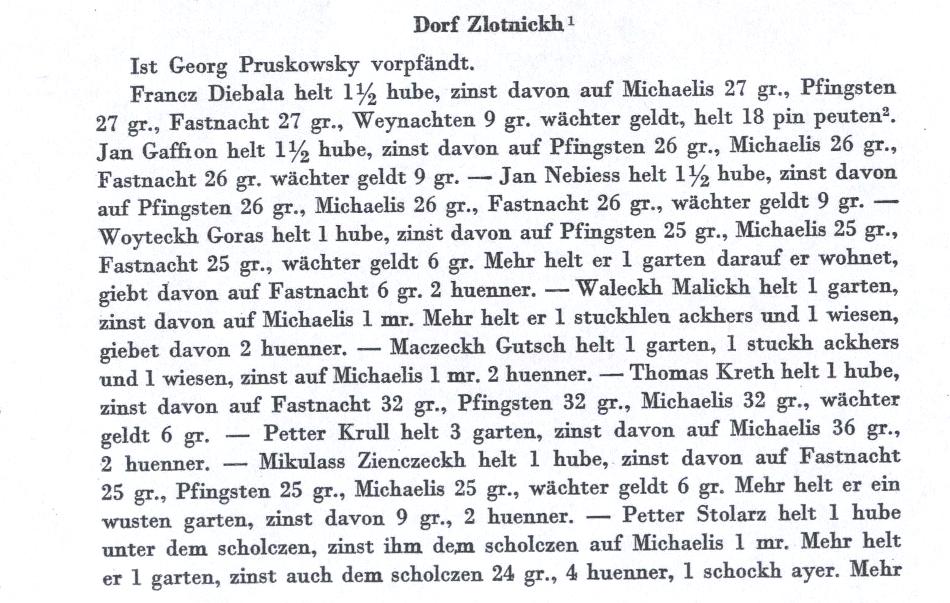
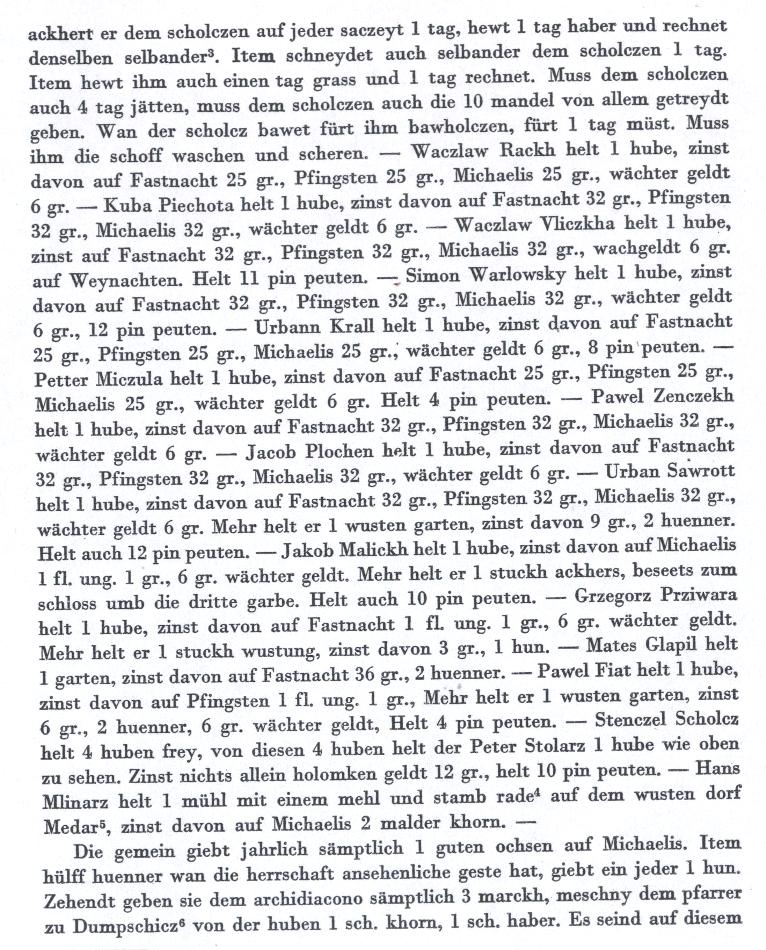
Dorf Zlotnickh (in 1566-1618) (the village of Złotniki, all the land in Złotniki belonged to the castle at Prószków).
1 - Francz Diebala leases 1 ½ łany of land. Rent payable at St Michael's 27 gr., Whitsun 27 gr., Shrovetide 27 gr. At Christmas 9 gr. for the watch. He also has 18 Pin peuten = 18 tree hives.
Tree hive: a chamber hollowed out inside a tree trunk for keeping bees. The hives were mostly placed in oaks and pines, more rarely in hornbeams, beeches or limes. Natural hollows were used, but most often they were specially hollowed out.
2 - Jan Gaffion leases 1 ½ łany of land. Rent payable: 26 gr. at Whitsun, 26 gr. at St Michael's and 26 gr. at Shrovetide. For the watch 9 gr.
3 - Jan Niebiess leases 1 ½ łany of land. Rent as above.
4 - Woyteckh Goras leases 1 łan of land. Rent payable 25 gr. at Whitsun, 25 gr. at St Michael's, 25 gr. at Shrovetide and 6 gr. for the watch. In addition he leases 1 garden, where he lives, for which he pays 6 gr. at Shrovetide and a due of 2 hens.
5 - Waleckh Malickh leases 1 garden, rent 1 mark payable at St Michael's. Besides this he leases a piece of arable land and 1 meadow, for which he gives a due of 2 hens.
6 - Maczeckh Gutsch leases 1 garden, 1 piece of land and 1 meadow. Rent 1 mark payable at St Michael's, and a due of 2 hens.
7 - Thomas Kreth leases 1 łan of land. Rent payable at Shrovetide 32 gr., Whitsun 32 gr. and St Michael's 32 gr. For the watch 6 groschen.
8 - Petter Krull leases 3 gardens. Rent payable at St Michael's 36 gr. Due 2 hens.
9 - Mikulass Zienczeckh leases 1 łan of land. Rent at Shrovetide 25 gr., Whitsun 25 gr., St Michael's 25 gr. For the watch 6 gr. In addition he leases 1 garden (waste land, fallow), for which he pays a rent of 9 gr. and a due of 2 hens.
10 - Petter Stolarz leases 1 łan of land from the Szolcz (sołtys). He pays the rent to the Szolcz (sołtys), 1 mark at St Michael's. Besides this he leases 1 garden from the Szolcz (sołtys), to whom he pays a rent of 24 gr. Dues: 4 hens and 60 eggs. He works the sołtys's field and also works at weeding and mowing grass, must clean for him and work at felling timber. He also works at washing and shearing the sheep.
11 - Waczlaw Rackh leases 1 łan of land. He pays rent at Shrovetide 25 gr., Whitsun 25 gr., St Michael's 25 gr. and 6 gr. for the watch at Christmas.
12 - Kuba Piechota leases 1 łan of land. Rent as above 32 gr., 32 gr., 32 gr. and 6 gr. for the watch at Christmas.
13 - Waczlaw Vliczkha leases 1 łan of land. Rent as above 32 gr., 32 gr., 32 gr. and 6 gr. for the watch at Christmas. He also keeps 11 bee hives.
14 - Simon Warlowsky leases 1 łan of land. Rent as above 32 gr., 32 gr., 32 gr. and 6 gr. for the watch at Christmas. He also keeps 12 bee hives.
15 - Urbann Krall leases 1 łan of land. Rent as above 25 gr., 25 gr., 25 gr. and 6 gr. for the watch at Christmas. He also keeps 8 bee hives.
16 - Petter Miczula leases 1 łan of land. Rent as above 25 gr., 25 gr., 25 gr. and 6 gr. for the watch at Christmas. He also keeps 4 bee hives.
17 - Pawel Zenczekh leases 1 łan of land. Rent as above 32 gr., 32 gr., 32 gr. and 6 gr. for the watch at Christmas.
18 - Jacob Plochem leases 1 łan of land. Rent as above 32 gr., 32 gr., 32 gr. and 6 gr. for the watch at Christmas.
19 - Urban Sawrott leases 1 łan of land. Rent as above 32 gr., 32 gr., 32 gr. and 6 gr. for the watch. In addition he leases 1 garden (waste land) for a rent of 9 gr. and a due of 2 hens. He keeps 12 bee hives.
20 - Jakob Malickh leases 1 łan of land. Rent at St Michael's 1 Hungarian florin and 1 gr. For the watch 6 gr. In addition he sows 1 piece of land for Prószków castle, for 3 sheaf tithes to the castle. He also keeps 10 bee hives.
21 - Grzegorz Prziwara leases 1 łan of land. Rent 1 Hungarian florin 1 gr. at Shrovetide and 6 gr. for the watch. Besides this he leases 1 piece of fallow, for which he pays 3 gr. rent and a due of 1 hen.
22 - Mates Glapil leases 1 garden. Rent 36 gr. at Shrovetide, due 2 hens.
23 - Pawel Fiat leases 1 łan of land. Rent 1 Hungarian fl. and 1 gr., payable at Whitsun. In addition he leases 1 garden (fallow) for a rent of 6 gr. and a due of 2 hens. He pays 6 gr. for the watch. He also keeps 4 bee hives.
24 - Stenczel Scholcz leases 4 łany of land, free of rent. Of these 4 łany Petter Stolarz leases 1 łan (as stated above). Scholcz pays no rent, only holomken gelt, a fee charged to free peasants (and sołtysi) in lieu of the duty of armed service at the castle. He also keeps 10 bee hives.
25 - Hans Mlinarz leases 1 mill in the abandoned village of MEDAR with 1 run for flour and one separate wheel for making groats. Rent payable at St Michael's 2 malder of grain = 24 bushels = about 1800 litres.
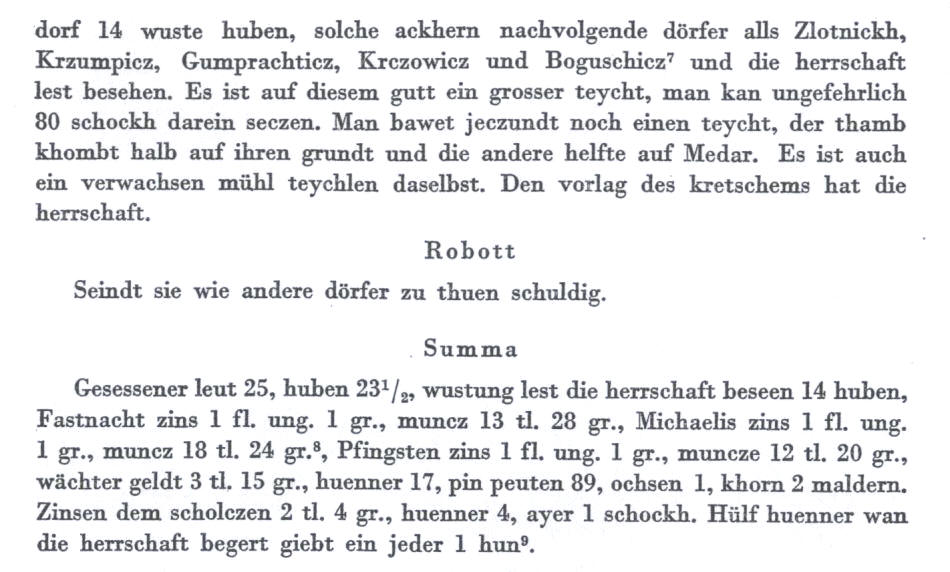
Dues and rents in Zlotnickh.
The village gives 1 good ox a year at St Michael's (29 September). And hens when distinguished guests stay at Prószków castle, each 1 hen.
The tithe. Zehend they give to the archidiacono (collegiate church in Opole), 3 marks in all. Meschny (due to the priest) they give to the pfarrer zu Dumpschicz (meaning Chrzumptzicz), von jeder huben 1 scheffel korn und 1 scheffel haber (from each łan 1 bushel of grain and 1 bushel of oats).
On the Złotniki estates there are 14 łany of fallow (waste land). The castle owner allows peasants from Krzumpicz (Chrząszczyce), Gumprachticz (Komprachcice) and Boguschicz (Boguszyce) to develop these lands belonging to Złotniki. On the Złotniki estates there is a large lake (pond), which can be stocked with about 80 sch. (1 schock = 60). There is another lake, half of it on the estates of the village of Medar (a village no longer in existence at this time). On the estates of the village of Medar there is also a small pond for the mill, overgrown. The right to sell beer belongs to the Prószków county.
Robott: serf labour.
The village is obliged to serf labour like all other villages in the Duchy of Opole, in accordance with the imperial edict.
Summary:
In the village of Zlotnickh (Złotniki) live 25 people (peasants), leasing 23 ½ łany of land. The county allows the fallow, 14 łany, to be sown. Rent at Shrovetide 1 Hung. fl. 1 gr., in current currency 13 thalers 28 groschen. At St Michael's 1 Hung. fl. and 1 gr., in current currency 18 thalers 24 groschen. At Whitsun 1 Hung. fl. 1 groschen, in current currency 12 thalers 20 groschen. Fee for the watch 3 thalers and 15 groschen. Dues: 17 hens, honey from 89 bee hives, 1 (good) ox. Grain 2 maldern (1 maldern = 12 scheffel = 12 bushels = 900 litres of grain). Rent for the sołtys (Stenczel Scholcz) 2 thalers and 4 gr., 4 hens and 60 eggs. Hens for Prószków castle, as the count wishes, each 1 hen. Holumkhengeldt: the sołtys's fee in lieu of the duty of armed service at the castle, 12 groschen.
Approximate number of inhabitants in Złotniki in 1566: about 150, assuming 6 people per family (per peasant).
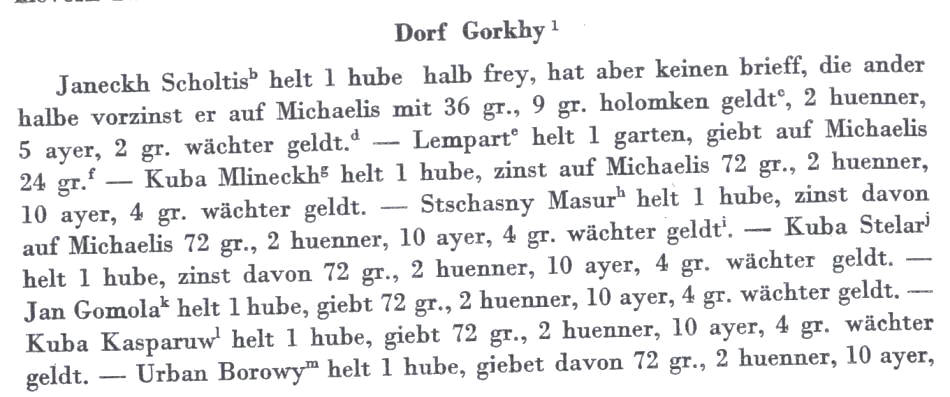
Dorf Gorkhy: the owner of the village of Górki was the duke at the castle in Opole.
1 - Janeckh Scholtis. In 1617 crossed out and entered Stefan Maloschekh, leases 1 łan of land (exempted from rent for half a łan), but he has no letter (authorisation for the exemption). The other half is subject to rent payable at St Michael's of 36 gr. Holunkhengeldt (fee for the duty of armed service) 9 gr. In 1617 Holumkhengeldt was crossed out and Blazekh Jelin added, which would mean that B.J. took over the duties of sołtys. Due Stefan Maloschekh: 2 hens, 5 eggs and 2 gr. for the watch. Added in the margin: in addition the Burggraf (the count managing the castle in the king's name) this year (1573) left him 1 garden (fallow) on lease, for which he must pay a rent of 36 gr. each year at St Michael's. Also added in the margin: Anno 1617 the sołtys bought the said garden (hereditarily) for 50 thalers and another 1 thaler on top.
2 - Lempart. In 1617 crossed out and entered Blazekh Jelin, leases 1 garden, rent payable at St Michael's 24 gr. (corrected) to 18 gr. Added: Anno 1573 the Burggraf, the count at the royal castle, leased him ½ łan of fallow without changing the rent. Then 18 gr. was corrected to 36 gr., payable at St Michael's.
3 - Kuba Mlineckh. In 1617 added Blazekh Jelin, crossed out and written Janekh Suchanek, leases 1 łan of land, rent payable at St Michael's 72 gr. Due 2 hens, 10 eggs and 4 gr. for the watch.
4 - Stschasny Masur crossed out and added Jonekh Suchanek, then crossed out and in 1617 added Urban. Leases 1 łan of land. Rent payable at St Michael's 72 gr. Due: 2 hens, 10 eggs and 4 gr. for the watch. Added: Szczepan Kokott from 1 garden, starting this year (1580) at St Michael's 24 gr. In 1617 Szczepan crossed out, added Kuba and the note Gärtner.
5 - Kuba Stelar, crossed out in 1617 and added Malthus Tlug, leases 1 łan of land. Rent 72 gr. Dues: 2 hens, 10 eggs. 4 gr. for the watch.
6 - Jan Gomola, in 1617 crossed out and entered Waleckh Heyduckh, leases 1 łan of land, pays 72 gr., 2 hens, 10 eggs and 4 gr. for the watch.
7 - Kuba Kasparuw, in 1617 crossed out and entered Matthus Ouswaldt, leases 1 łan of land, pays 72 gr., 2 hens, 10 eggs and 4 gr. for the watch.
8 - Urban Borowy, in 1617 crossed out and entered Bartek Bleska, leases 1 łan of land, pays 72 gr., 2 hens, 10 eggs and 4 gr. for the watch.
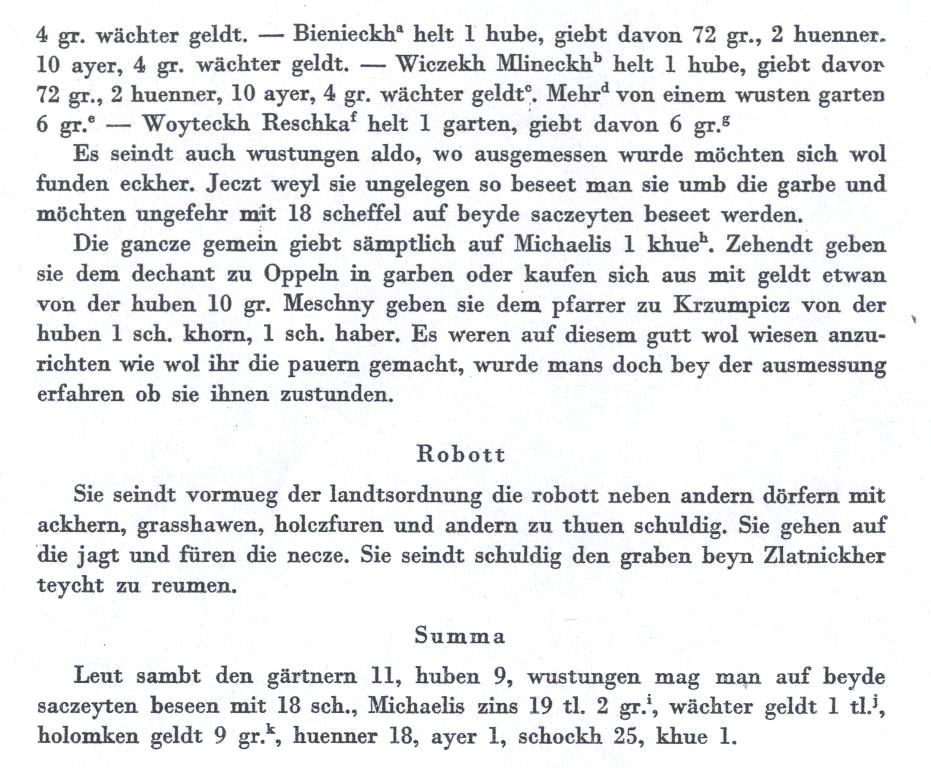
9 - Bienieckh, in 1617 crossed out and entered Justina Stellmasska, then the name Justina crossed out and Christina written, leases 1 łan of land, pays 72 gr., 2 hens, 10 eggs and 4 gr. for the watch.
10 - Wiczekh Mlineckh, in 1617 crossed out and written Warzin Ssaya, leases 1 łan of land, pays 72 gr., 2 hens, 10 eggs and 4 gr. for the watch, payable at St Michael's. Added: Waczlaw Rakh pays 24 gr. at St Michael's (1576) for the lease of 1 garden. In 1617 Waczlaw Rakh crossed out and Janek Nawara written.
11 - Staneckh Masur leases, Staneckh Masur crossed out and in 1617 written Stephan Kalus, from 1 garden (fallow) he pays 6 gr. at St Michael's.
(The next, the 12th subject, was probably a peasant (smallholder) attached to the Winów manor farm.) In 1412 the village of Winów was converted into a manor farm founded under ducal, Polish law, attached to Opole castle. The peasants who had earlier used the Winów estates (probably 4 families) were bought out and moved to other villages. The urbaria of 1566 record that earlier there were (4 pauern, peasants), and now “Wyno” was attached to the castle as a manor farm. On the orders of Count Hansen Oppersdorff with the permission of “His Highness the Roman Emperor”.
12 - Woyteckh Reschka, in 1617 crossed out and written Kuba Cholewa, leases 1 garden, for which he pays 6 gr. In addition, on the Górki estates the Burggraf left him 1 meadow that belonged to the Winów manor farm, for which from St Michael's of this year (1574), at each following St Michael's, the rent is 7 vierdung. Beside the entry above is added: 1617 Christekh Frey, Gärtner (smallholder), pays 5 thalers a year at St Michael's for arable land, meadow and garden.
Key: (1 Schwere Mark = 4 vierdung. 1 vierdung = 48 groschen.)
Schwer Mark, also called “grzywna”.
Besides this there was also: Schwere Schockh (Kopa) = 60 groschen.
1 thaler = 36 gr., but in the urbaria of Opole castle only 34 groschen were counted to 1 thaler.
Remarks of the commission:
In the area (of Górki) there is much fallow; the parts that have been measured (divided into plots) can be treated as arable land. They have now been sown for a rent (1 Garbe), one sheaf tithe. About 18 bushels are needed to sow them.
The whole village together gives one cow at St Michael's (added in brackets in 1617: 5 thalers). They give the sheaf tithe to the (dechant zu Oppeln), the collegiate church in Opole, or buy themselves out in money, about 10 gr. per łan. Meschne (due to the priest) they give to the priest in Krzumpicz = Chrząszczyce, from 1 łan 1 bushel of grain and 1 bushel of oats. On the Górki estates there are also meadows that the peasants have laid out for themselves. It should be checked in the measurements whether the meadows are due to them.
Robott: serf labour
They are obliged (by provincial regulation) to serf labour: ploughing, mowing grass, transporting wood and other work, like other villages. They take part in hunts and carry the nets. They are obliged to clean the ditch by the Złotniki pond.
Summary:
The village has 11 smallholders, leasing 9 łany of land. The fallow on both sides can be sown with 18 bushels. Rent payable at St Michael's (29 September), in all: 19 thalers 2 groschen (corrected in the margin: 20 thalers 22 gr., then corrected to 21 thalers 6 gr., added: from 1 meadow 7 vierdung). Fee for the watch 1 thaler, corrected to 34 groschen. Holomkengeldt (for the duty of armed service at the castle) 9 gr., then 9 gr. crossed out. Dues: 18 hens, 60 eggs, 1 cow.
Approximate number of inhabitants in Górki in 1566: about 66 people.
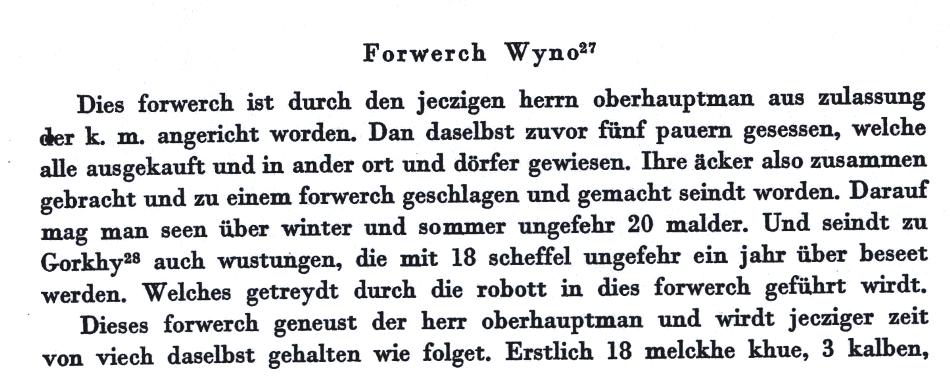
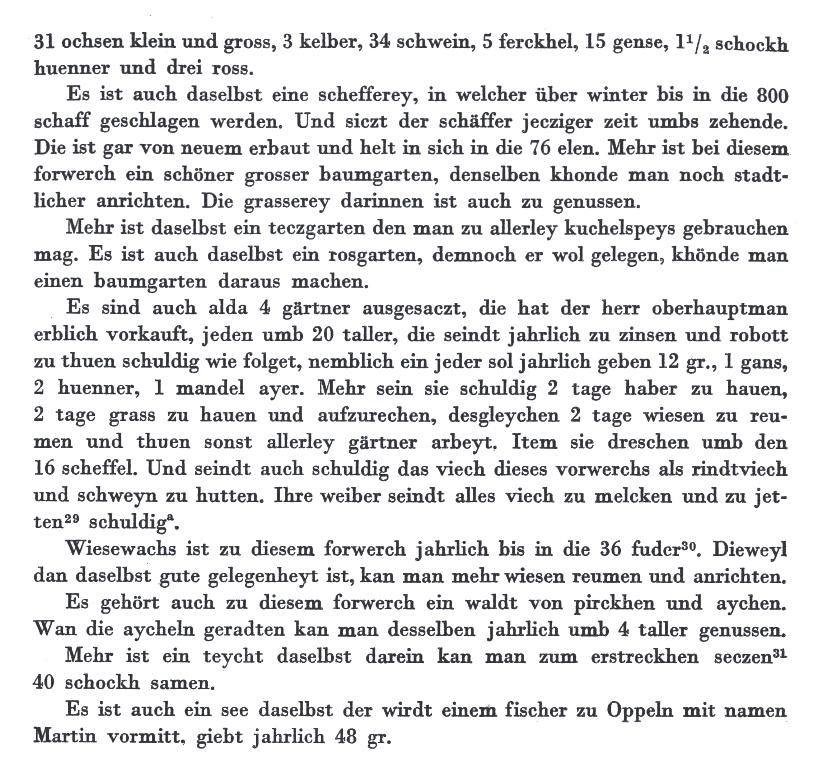
Forwerch Wyno: the manor farm of Winów.
This manor farm was founded by the present count (Oberhauptman), Starost Hans von Oppersdorf (1575), with the permission of His Imperial Majesty the Roman Emperor of the German Nation, Maximilian II. Earlier the land was leased by 5 peasants (kmiecie), who were bought out and settled in other villages. Their land was joined and the manor farm formed. The land was sown in autumn and spring (winter and summer crops) with about 20 malder = 240 bushels. Towards Górki there is fallow, which will also be sown with 18 bushels. The count starost is modernising this manor farm and now also keeps livestock as follows: to begin with 18 dairy cows, 3 calves, 31 oxen small and large, 34 pigs, 5 piglets, 15 geese, 90 hens.
A sheepfold was also founded, in which over 800 sheep spend the winter, looked after by a shepherd, currently for a tithe. The sheepfold is new, only just built.
Moreover, at this manor farm there is a fine large orchard with fruit trees, which could be laid out in a more modern (town) style and extended. The grass growing between the trees can be used. Moreover, there is also a vegetable garden here, whose produce is used in the kitchen, and a flower garden (roses?), which could be made into an orchard.
On the manor farm the count starost “set” 4 smallholders, to whom he sold (the holdings) with the right of inheritance, reckoning 20 thalers per holding. For holding them they are obliged to Robott, serf labour, and to pay rent and dues, as follows:
Each smallholder pays 12 gr. rent, dues: 1 goose, 2 hens, 60 eggs. Robotten: 2 days mowing oats, 2 days mowing and raking (drying) grass, 2 days carting hay, all work in the garden as needed. At threshing, (to thresh) 16 bushels. Their duties also include grazing cattle and pigs. Their women are obliged to milk the cows and weed the garden.
Added in the margin: Note, to these 4 smallholders the Burgrave (starost of the castle) allotted 1 piece of land on the estates of Wójtowa Wieś, for which the Starost (magnanimously) waived the rent. They will begin to pay the rent only from St George's Day (1589), at each following St George's Day each 24 gr., that is 2 florins in all.
Summary:
The hay harvest from the meadows of the Winów manor farm is 36 cartloads a year; in good conditions many other meadows can be mown. This manor farm also includes a forest in which birches and oaks grow. About 4 thalers a year can be made from the acorns gathered. There is also a pond, in which young fry can be put to grow, about 40 bushels. On the estates there is also a fish pond leased by a fisherman from Opole named Martin, who pays an annual rent of 48 gr.
The urbaria make no mention of plantations (gardens) of grapes on the Winów estates.
On gardens with grapes (weyn garten) there is this information:
Between the “Bytom gate” and the “Gosławice gate”, at some distance from the town, there are several vineyards. Permission to lay them out was given to: Sebastian Schneider for a rent of 18 gr., Cristina Schlickin for a rent of 20 gr., Valten Lorencz (for two gardens) 30 gr., Heinrich Danwiecz for 1 garden 15 gr., Greger Przygotka for 1 garden 12 gr.
See part VII: The first Habsburgs in Opole
Greetings from Folwark, Rudolf