

The “Thirty Years' War” of 1618-1648 had begun. Many pages have been written about it in various books. It began on 23 May 1618 and ended only on 24 October 1648.
The throwing out of the window (Defenestration of Prague) of the imperial governors at the Royal Castle in Hradčany, during a stormy discussion with the Protestants. The officials survived the fall, which the Catholics regarded as a miracle, but this event is taken as the start of the “Thirty Years' War”.
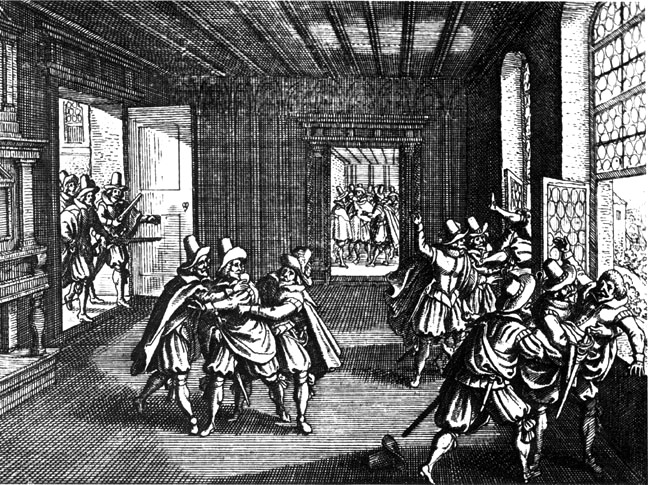
Woodcut - DEFENESTRATION OF PRAGUE - 17th century
Taking part in the war, directly or indirectly: almost all European states.
Catholics: Austria, Spain and some principalities of the German Reich, Bavaria, the archbishoprics of Cologne, Mainz and Trier and the Papal States. Poland (the Commonwealth of Both Nations) gave the Catholics no official help, but allowed the Lisowczycy (mercenary units who were paid no wages) to take part in the fighting. The Lisowczycy fed themselves from booty, which was their pay. They enjoyed great fame in Europe. They were also notorious for great cruelty and a love of plunder. As some sources report, they were in the habit of killing every passer-by they met, so as to leave no trace of their presence.
Protestants: States of the German Reich, supported by other European states (such as Sweden, Denmark, the Republic of the United Provinces, France). The United Provinces are Belgium, Holland and Luxembourg with parts of northern and eastern France.
Fighting went on everywhere, with varying intensity. For us Silesians the Chapel of Skulls in Czermna in the Kłodzko land, where about 25 000 skulls of those killed, murdered, or dead of hunger and plague in this period were collected, is the only visible trace of those times.
The Duchy of Opole escaped such great massacres, but we can read of murders, robberies and rapes in the chronicles of our region.
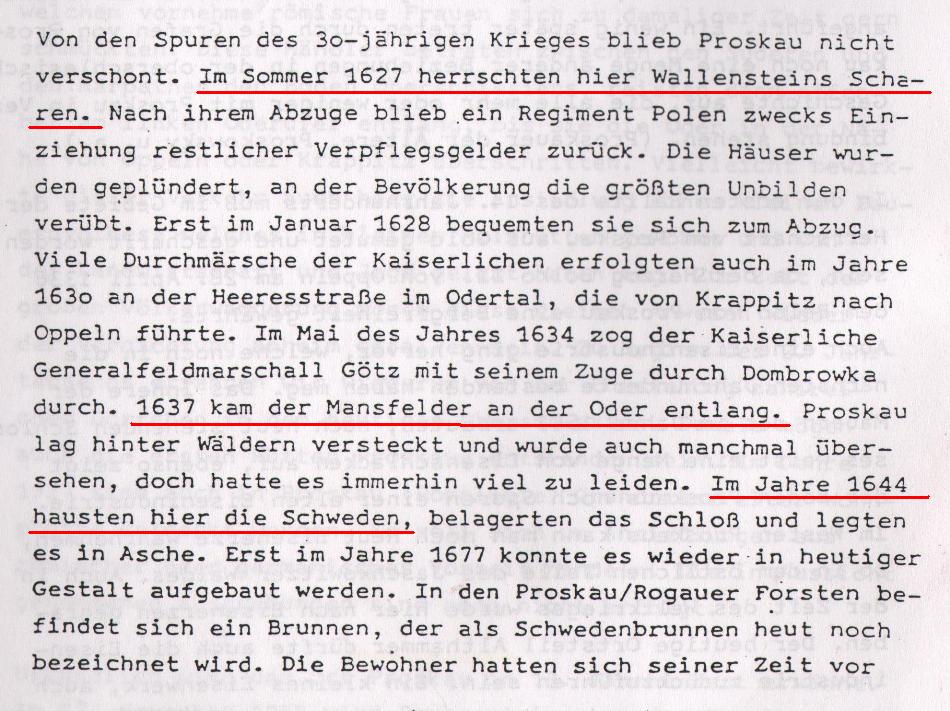
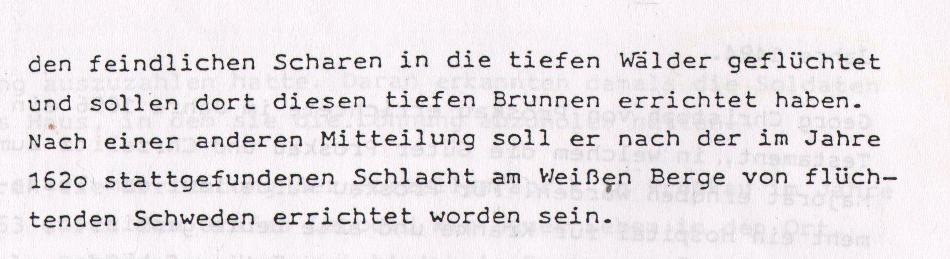
Scanned from “Die Chronik Proskau” ECCL PAROCHIALIS IN PROSCOVIENSIS
Below I give very shortened (rich) biographies of the commanders who with their troops “visited” our area.
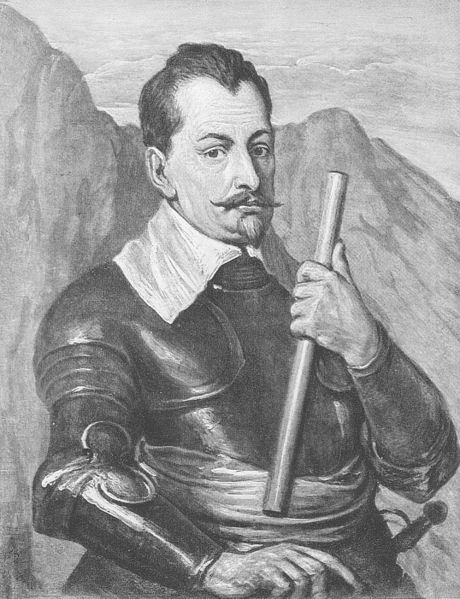
Wallenstein (Waldstein) von.
1583 - 1634
Commander-in-chief of the Catholic troops
Albrecht von Wallenstein was born into a family of poor nobility on 24 September 1583 in Heřmanice and died (murdered) on 25 February 1634 in Cheb in Bohemia. He grew up in a Protestant family, studied with the Jesuits in Olomouc and at the universities of Bologna and Padua. He married a rich but older widow, and her wealth, after her death, allowed him to equip a cavalry unit of two hundred horses, which he placed under his own command in the service of the future King of Bohemia and Emperor Ferdinand II of Habsburg during the war with Venice (1616).
From the start of the Thirty Years' War (Defenestration of Prague) Wallenstein stood on the Catholic side. During the rebellions in Bohemia the rebels seized his estates, and he managed to escape to Vienna with a sizeable fortune (money). He took part in the Battle of White Mountain and fought against Mansfeld in Moravia. He recovered his estates in Bohemia and enlarged them by confiscating Protestant property. His “new” possessions formed a considerable territory, known in Bohemia as “Friedland”. After a series of military successes he rose to Duke of Friedland. His ambitions and the requisitions made by his troops earned him many enemies.
Wallenstein's army drew no pay from the emperor's treasury; it lived solely from the booty it took along its way.
Meanwhile suspicions of treason against him grew in Vienna, and the emperor looked for a way to get rid of him. In a secret document signed by Emperor Ferdinand II and announced in Prague, he was removed from the post of commander-in-chief. Aware of the danger he faced from the emperor, he went to Cheb, hoping to find refuge with his former enemy (the Swedes). But several of his former officers (loyal to the emperor) took his life in Eger on 25.02.1634. After his death Emperor Ferdinand II confiscated all his property and divided it among the officers who had taken part in the murder.
Ernst von Mansfeld was born around 1580 and died on 29 November 1626. He gained military experience at the side of his stepbrother Karl (also a soldier), who served in the army of the Holy Roman Empire and Germany, the Habsburgs. There his (Mansfeld's) activity found no recognition. He was a Catholic, but this lack of recognition pushed him into service on the enemy side, the Protestants. He was a typical modern condottiere, a Kriegsunternehmer (war entrepreneur); he was a mercenary and commanded mercenaries. He got the funds for arms and uniforms from the ruler, while all the rest, provisions and pay, came from plunder, robbery and contributions he imposed, and from the spoils of war. He exploited the weakness of rulers and their states. He was notorious because his troops also robbed and raped in the areas they were meant to defend. So it was in Opole, as Idzikowski mentions in “Geschichte der Stadt Oppeln”.
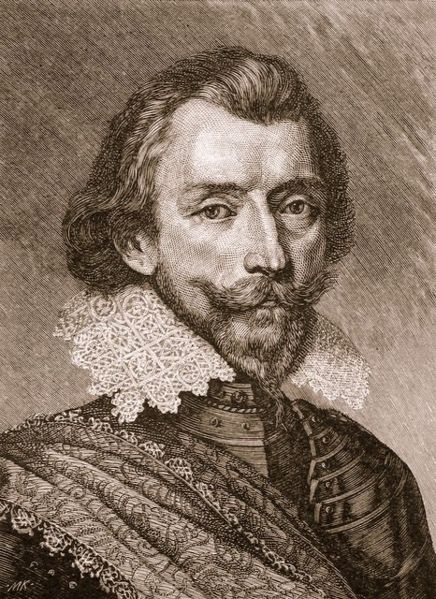
Mansfeld von
1580 - 1626
Commander-in-chief of the Protestant troops
... in 1642 Protestant troops (the enemy) invaded Silesia and took control of almost all of it. Oppeln was taken by storm, plundered and partly burned.
The castle burgrave, Wirsigk, was reprimanded because, despite the order he had received, he had not sent 500 peasants to defend Koźle. ... He explained that the peasants had resisted, especially those from Wójtowa Wieś, Górki, Szczepanowice and Folwark, because the enemy threatened them with fire and sword. Then the Catholic command demanded another 100 horses. “Friend and foe together intend to ruin us”, so Burgrave Wirsigk summed up the orders.
In these circumstances the peasants quickly made off and hid with their cattle in the forests, where they were out of reach of either side.
Only in 1644 was Mansfeld's army forced to surrender.
... In the period from 13 December 1643 to 4 August 1644 the town had to supply to Mansfeld and his troops stationed in the town:
Bread 57 402 portions for 1913 florins
meat 57 402 pounds for 2870 fl.
beer 172 206 quarts for 2870 fl.
oats 337 bushels for 337 fl. (bushel) = 4 Viertel, about 75 litres (50 kg)
hay 2 700 bundles for 67 fl.
straw 1 350 bundles for 33 fl.
total: 9 733 florins
For comparison: the annual budget of the town of Oppeln at that time was about 7500 florins.
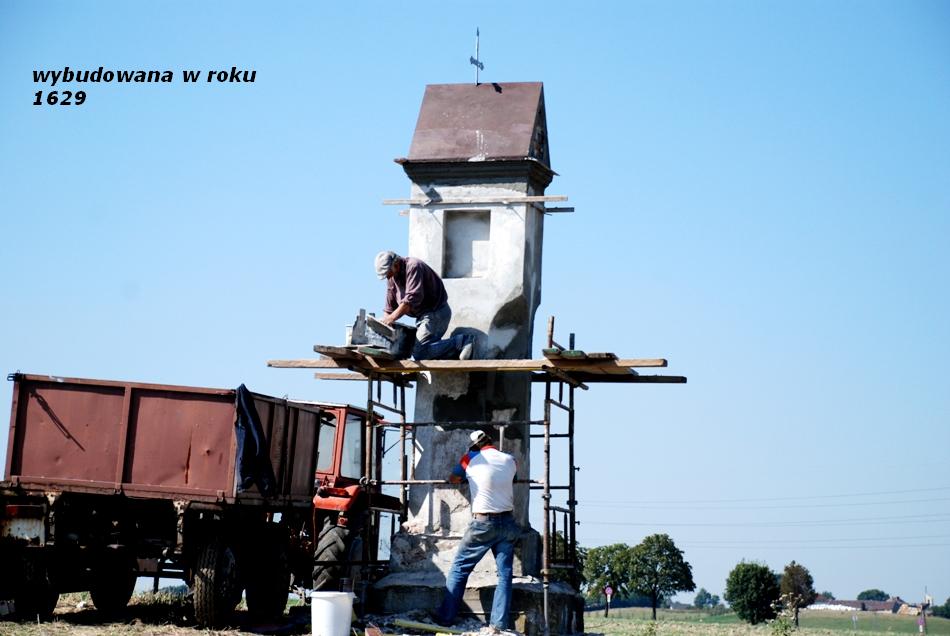
Built in 1627: past it marched in turn the imperial troops commanded by Wallenstein and the Protestant troops commanded by Mansfeld, while the Folwarczanie hid in the oak forests that grew on today's fields by the Oder. These are old times, and the old lady is beginning to crumble. This year (2009) funds were found for her renovation. The team of J. Chudala of Folwark (in September) during the renovation.
Which inhabitants of Folwark, Chrzowice, Chrząszczyce and Górki from this time do we know? I do not include Winów here because in 1534 the village was bought up (the peasants were moved to other places), converted into a lord's manor farm and placed under the direct management of the castle on Ostrówek island in Oppeln. The names that could be established in the urbaria and parish registers:
1566-1618
Folwark: Scholc Ukleya Lakott Blazieck Jaszkula Maczeck Rogosch Bienieck Zwoneck Kureck Gendra Waleck Zagrodnik Mimiec Kusia Plesska Czolek
Chrzowice: Wienczeck Wyschkwara Jaschkula Blazieck Morowski Zawrot Kotisch Schirch Otisch
Złotnik: Diebala Gaffion Nebiess Goras Malick Gotsch Kret Krull Zienczeck Stolarz Rack Piechota Uliczka Warlowsky Krall Miczula Zenczeck Plichen Sawrot Malick Prziwara Glapil Scholz Mlinarz
Chrząszczyce: Piechota Barult Zielasny Gemza Slota Lakott Malick Polack Bzdischeck Widelcka Methko Wietschureck Zialondeck Stroz Jura
Górki: Kasparuw Borowy Tschuchon Maloscheck Heyduck Bleska Kokott Jelin Suchanek Bienick Mlineck Reschka Stelmasska SSaya Rak Kalus Fey Mlinek Mazur Stelar Gomola
Many of the names above are still found today; they are our neighbours. A moment of reflection: let us think about the conditions in which our ancestors lived here on this land. What lords they had, and how they were treated in the time of Emperor Ferdinand II of Habsburg. They were entered in the books and urbaria not so that we would know today that they lived and worked here, but so that their owner would know what obligations they had and what benefit he would gain. Today we call this an inventory.
On 15 February 1637 Emperor Ferdinand II dies in Vienna. We must attribute to him the greatest blame for the outbreak and duration of the Thirty Years' War, for the victims and the suffering of the inhabitants of Europe and of Folwark.
These words are attributed to him: “Mit der Ehre und Pracht von Kaiser und Koenigen ist es wie bei einem Schauspiel. Ich finde keinen Unterschied zwischen den Theaterkoenigen und den wirklichen, nur dass die einen Stunden und die anderen Jahre regieren. Die Ehrenbezeigungen dauern bei beiden nur, solange sie auf der Buehne stehen. Nach ihrem Tode sind sie vergessen wie alle anderen.” (With the honour and splendour of emperors and kings it is as in a play. I find no difference between stage kings and real ones, except that the one rule for hours and the other for years. The honours for both last only as long as they stand on the stage. After their death they are forgotten like everyone else.)
He stood on the stage and played his part as in a theatre; it was a game for him! And thousands, hundreds of thousands of people suffered and died for him.
Emperor Ferdinand III, successor of Ferdinand II, elected on 22.12.1636 (during Ferdinand II's lifetime) King of the Holy Roman Empire and Germany.
Hardly had he got his hands on the neglected Duchy of Opole and Racibórz when he was already thinking of pawning it, and he had Putzen von Adlerthum (then senior regent) prepare its valuation.
In this way the Folwarczanie and the surrounding area (the whole duchy) came under the rule of the Polish king; the handover took place on 4 November 1645. This led to many changes and misunderstandings for the duchy, because the pledge was tied to various “conditions”, the most important of which was that Emperor Ferdinand III remained its owner. But more about that in the next part.
Greetings from Rudolf in Folwark