

Ferdinand III of Habsburg, by the grace of God Roman Emperor, King of Germany, Hungary, Bohemia, Croatia, Archduke of Austria, Duke of Burgundy, Brabant, Styria, Carinthia, Carniola, Margrave of Moravia, Duke of Luxembourg, Silesia, etc.
So it was always written on all documents he issued or that were addressed to him.
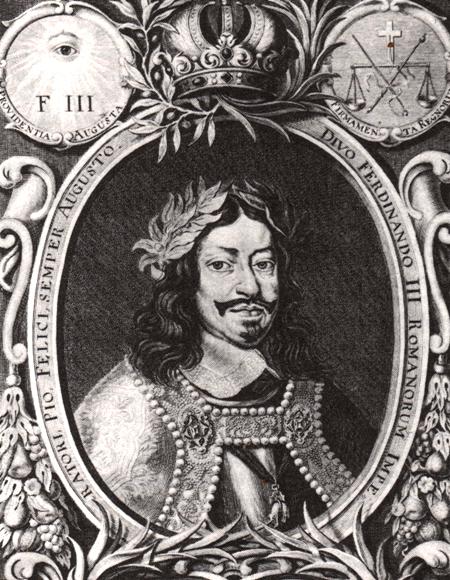
Son of the Emperor of the Holy Roman Empire of the German Nation Ferdinand II and the Bavarian Princess Maria Anna of Bavaria.
Born on 13 July 1608 in Graz
Crowned: 1625 King of Hungary, 1627 King of Bohemia, 1636 King of the Romans and Germany, during the lifetime of his father, Emperor Ferdinand II.
From 15 February 1637 to 2 April 1657 Roman Emperor.
Married:
I - 26.02.1631 Maria Anna, Infanta of Spain
II - 2.07.1648 Maria Leopoldina, Archduchess of Tyrol
III - 30.04.1651 Eleonora Gonzaga, Princess of Mantua
Children:
From the first marriage: Ferdinand V, Maria Anna, Philipp August, Maximilian Thomas, Leopold VI (later Emperor Leopold I) and Maria.
From the second marriage: Charles Joseph
From the third marriage: Theresia Maria Josefa, Eleonora Maria Josefa, later queen as wife of the King of Poland 1669-1673, Michał Korybut (Wiśniowiecki), Maria Anna Josefa and Ferdinand Josef Alois.
(11 in all)
He died on 2 April 1657 in Vienna; his successor was Leopold I.
None of his predecessors (emperors) on taking office inherited so many political and military problems at once. The Thirty Years' War was entering its third decade. He tried to bring the situation in Germany under control and to save the ruined country and the political position of the Habsburgs. The situation of the Catholic camp was deteriorating dramatically; everything was heading for the collapse of imperial power and the ruin of Germany.
He had to grant the princes and Estates many new rights, including the right to conclude treaties and wage war independently, which helped to weaken central power in the empire.
On 24 October 1648 the Emperor had to agree to the terms of the Peace of Westphalia and sign it, a treaty regarded today as one of the most significant in the history of modern Europe. France benefited most. The boundaries of influence changed, and in the German Reich three legal confessions were recognised with equal rights, Calvinism, Lutheranism and Catholicism. In 1651 the Emperor broke the treaty's provisions on religious tolerance and declared the Roman Catholic confession the only one permitted in the territories of his monarchy. This also applied to all of Silesia and Folwark, which remained within the Habsburg borders.
And what do we know about the time of Ferdinand III in our parts? The Thirty Years' War was raging. Its last period (the 1640s) again moved to our Silesia. Until then our inhabitants had suffered only from the imperial troops. Idzikowski writes: “In 1640 they took 27 horses at Domaradz, and in Opole itself an artillery colonel extorted money from the townspeople, quartered himself on the country estates and, asking no one, ordered cattle to be slaughtered. The matter became so drastic that Emperor Ferdinand III himself intervened, cutting the townspeople's silver rent by half.” If soldiers behaved like this in their own country, which they were supposed to defend, one can imagine how the enemy acted.
In 1642 Swedish troops under Torstensson took the town by storm, plundered it and partly burned it. The occupation lasted until 1644 (two years), and I have already mentioned the damage in part 11. For two years the two warring sides avoided decisive clashes; there were marches and counter-marches, in this way trying to drive the opponent out. The Swedish cavalry roamed all over Silesia from Jelenia Góra to Cieszyn, everywhere sowing indescribable devastation. Who suffered most then, who fed the soldiers on both sides? Imperial and Swedish troops alike extorted contributions, regardless of faith. At news of any army approaching, the inhabitants fled to the forests to save their lives and what was left of their belongings. The Folwarczanie fled to the forests by the Oder, which no longer exist today.
In August 1644 the Swedish troops in Opole surrendered. The Duchy of Opole and Racibórz was recovered by Ferdinand III. He recovered his land with its livestock and equipment. Just as today one can take out a loan “against a pledge” at a pawnshop or bank, so Ferdinand III then dealt with the duchy and its inhabitants.
The Habsburgs owed the Polish kings (Władysław IV Vasa) various sums under various headings, the most important being the outstanding dowries of no fewer than three Habsburg archduchesses married to Vasas (Anna and Constance, wives of Zygmunt III, and Cecilia Renata, first wife of Władysław IV).
The duchy was valued, its livestock assessed by Putzen von Adlerthum, and in November 1645 it was formally handed over to Władysław IV. The handover agreement, however, stressed the emperor's supreme rights to these lands and pointed out that the right to further pledging belonged only to the line of the Polish Vasas and not to the Commonwealth. Such changes required the emperor's consent, and without it higher offices could not be filled, new laws introduced, fortifications erected and so on. The imperial troops left the town of Opole only in 1647, when the emperor received the last instalment of the loan.
This change of statehood proved favourable for the duchy's inhabitants. The Thirty Years' War was still going on. Now the Duchy of Opole-Racibórz became neutral. The imperial troops left it and their place was taken (with the emperor's consent) by the Polish army (1647), so the Swedes too could not provoke the Poles, so as not to become entangled with them in new fighting. The Swedes and the Polish king, however, demanded that all the imperial troops still stationed in Silesia leave these lands, so that the duchies would be released from the cost of keeping them. Negotiations followed, but before they ended the Peace of Westphalia was concluded (1648).
On 24 October 1648 in Westphalia, at Münster and Osnabrück, the peace ending the Thirty Years' War was signed. The peace and its provisions deprived the emperor, the Habsburgs, of their previously significant influence in Europe. The German lands (states) became independent, and the emperor's power formal. The emperor kept full power only in the hereditary lands, where he had a free hand.
For Bohemia and Silesia this meant submission to Catholic reaction and absolutism. Certain concessions for the Protestants were forced by Sweden, which became guarantor of the peace terms. By special grace the emperor agreed to the building of three so-called “Churches of Peace” in Głogów, Jawor and Świdnica. Privileges that were very unfavourable for the Protestants: the churches could not have bell towers, could not be built in the town but only outside its walls, and most importantly could be built only of clay mixed with straw and wood. Ferdinand III achieved his aim, because as early as 1654 the Głogów church collapsed, and when rebuilt it burned down in 1758.
King Władysław IV took over the Duchy of Opole-Racibórz for his son Zygmunt, who however died prematurely. In 1648 Władysław IV also died, and Jan II Kazimierz was elected King of Poland (crowned on 17 January 1649). After Władysław's death Jan Kazimierz took over our duchy.
Tadeusz Wasilewski (Poczet królów) writes of King Kazimierz: “He was regarded as a zealous follower of Catholicism, which went with a pro-Austrian political orientation and later with a war waged solely against Protestant countries.” Busy with his own affairs (the coronation), he handed our duchy (the pledge) to his brother Charles Ferdinand, Bishop of Wrocław, who was now lord and ruler of our Folwark (and the duchy). In 1655 war broke out between Charles X Gustav, King of Sweden, and the King of Poland, Jan Kazimierz (known as the Swedish Deluge). Poland, with no means of defence at all, quickly succumbed to the “deluge”. King Jan Kazimierz fled to Silesia, to Głogówek, and for a time lived in Opole, at the same time taking the Duchy of Opole-Racibórz under his direct rule (1655).
Misunderstandings over holding it as a “pledge” (without permission to change the law) began from the very start. Opole held the “right” (granted by the emperor) to brew beer for 45 villages (including Folwark). The “alcohol” monopoly had always existed and brought the town considerable income; the Polish government tried to change this and sell its own beer in the villages. This provoked great opposition from the councillors of the town of Opole, who complained in writing to the imperial officials.
At the end of the letter we read: “... we beg the Emperor and the most illustrious royal heir in Poland, the lord holder of the pledge ... that we now, in our indescribable misery, wholly subject to the yoke of subjection, may not in the end be driven from our homes, and that like other free imperial towns in the Silesian land we may be treated as equals and respected as belonging to them faithfully and inseparably” (based on Idzikowski, “Geschichte der Stadt Oppeln”).
Beer was not the only cause of conflict, but also customs fees and the right to store goods transported on the Oder. Merchants stored their goods in the villages. Probably in Folwark too, as is shown by the wall that still exists under the buildings on ul. Wiejska. Could this have been a kind of harbour quay, a ramp?
In 1657 Emperor Ferdinand III dies in Vienna.
In 1658 we have a new emperor, Leopold I of Habsburg
The year 1664. The Folwarczanie (perhaps just Świętek) build a village chapel on the plot used by Świętek, probably the father of Tomasz and Casper Świętek, of whom we read in 1715.
In 1666 Emperor Leopold repays his debts to Poland and takes back the “pledge”. The Duchy of Opole and Racibórz, including Folwark, returns to the sceptre of the Habsburg emperor.
1715: In July Tomas Świętek and his wife Ewa baptised their daughter in the church at Chrzambczyce and gave her the name Anna. The baptism was performed by Father curatus Joannes Franciscus Jaroszowitz of Opole. The godparents were Franciszek Łakot, Helena Murowska of Folwark and Christyna Tysbierek of Górki.
1716: On 17 March Caspar Świętek and his wife Maryanna baptised their daughter Josepha in the church at Chrzambczyce. Godparents: Michael Hayduk of Górki, Urban of the Kornek family and Agnes Sulanka of Folwark
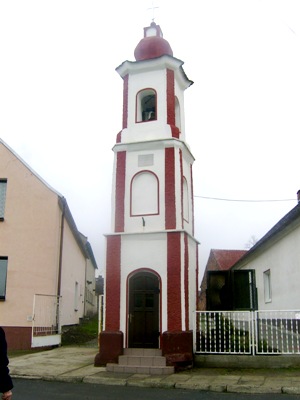
The village chapel, built in 1664 on the “Świętek” property
Here is my “speculation”. In the urbaria of 1566 and 1618 we find no entry of the name “Świętek” in Folwark or nearby. But we know that surnames were only just arising in those years and were always linked to the person concerned. For example Anna kowolonka, that is, the wife of a smith who had a forge, later recorded as Anna Kowal (Kowalska). I came across such changes very often while looking through our parish registers over a period of 300 years.
I am convinced that our “Świętek” too was “born” in this way. He must have been the son of one of our Folwark peasants, a pious man, a holy Joe, to whom the name (then a nickname) “stuck”, and so Świętek arose. I can find no other explanation. Except perhaps that to this day we call the house by the chapel (a holy place) “Świętkownia”.
The name arose (I am convinced) in Folwark, because I did not find it in any other nearby village when I looked through all the books.
I have great hope that the “dying out” of the Świętek family in Folwark can also be explained. Even the first information suggests that the main reason was births (all Evas) in the next two generations, and at this point the Smoleń family appeared.
(An example from my youth: where are you going? ... to Peyter Świętkowy ... to Peyter Byrgrowy ... to Peyter Jajsiowy ... today to Piotr Smoleń, the same inhabitant of Folwark (aged 82).)
Byrger, from Bürgermeister: Piotr's father Jan (Jajś) was sołtys in Folwark for some years (before 1945)
The year 1715. From 14 February in the registers baptizatis (baptisms) we find the first document concerning our inhabitants. Photocopy courtesy of the parish priest Dr hab. Krystian Ziaja, below:
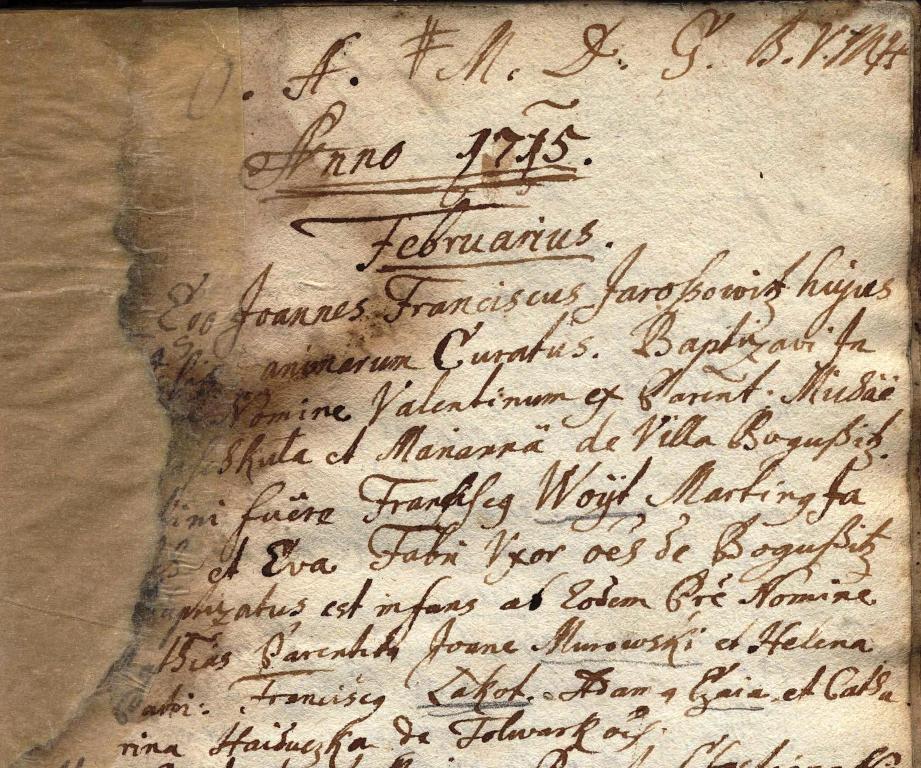
The first entry concerns Valentin of Boguszyce, the second Mathias Murowski of Folwark.
Babtizatus est infans Nomine Mathias Parentita Joanne Murowski et Helena Patri: Francisco Lakot. Adam Czaia et Catharina Haiduczka de Folwark omnes (in my non-professional translation)
Baptised is a son named Mathias, parents: Joannes Murowski and Helena, godparents: Franciszek Łakot, Adam Czaja and Katarzyna Hajduczka, all of Folwark. (date 14 or 15 February 1715)
In July of the same year (day illegible) we find the same kind of entry: Baptised is Anna, parents Thoma Świętek (mother illegible) of Folwark. Godparents Franciszek Łakot, Helena Murowska of Folwark and Cristina Tysbierkowa of Górki.
On 26 September 1715 there is a third child born in Folwark. Michael Czaja, parents Adam and mother Anna. Godparents Franciszek Łakot of Folwark, Adam Broy, seultetis of Chrzambczyce (sołtys of Chrząszczyce) and Helena Murowska et Villa de Folwark (of Folwark).
All baptisms (in 1715) were performed by Father Joannes Jaroszowitz, curatus of Oppeln.
From 14 February to 31 December of that year there were 45 baptisms in the whole parish, and for the following years, for comparison, see the table below. I compiled the table from the baptismal register, and this is its first publication in this form. The data show when the first inhabitants appeared in Nowa Kuźnia (date of foundation of the Neuhammer settlement 1723/25) and Kuźnia Domeckey. The date 1723, given in many publications on Neuhammer, should be taken as official, because the table (below) tells us that at least 6 families were already living there in 1721. In the registers we also find the names of godparents (et Nowey kusnic: Zimermam, Langier, Wesołowski, Furgacz, and also Anna Molitorisa, written in Latin, which would mean there was a mill there too, Molitoris = miller).
Źlinice was at this time among the largest villages, comparable only with Złotniki, but both are already more than 750 years old. Folwark and Chrzowice were villages lying then on the edge of the oak forests by the Oder, and the land was often struck by floods, so they were not among those developing, although both are much older, as archaeological finds in the area tell us.
| Place / year | 1715 | 1716 | 1717 | 1718 | 1719 | 1720 | 1721 | 1722 | 1723 | 1724 | 1725 | 1726 | 1727 |
|---|---|---|---|---|---|---|---|---|---|---|---|---|---|
| Folwark | 3 | 3 | 6 | 5 | 4 | 1 | 2 | 5 | 3 | 5 | 1 | 1 | 7 |
| Boguszyce | 6 | 6 | 4 | 13 | 4 | 4 | 4 | 10 | 5 | 7 | 7 | 5 | 9 |
| Górki | 4 | 5 | 6 | 6 | 2 | 5 | 6 | 9 | 8 | 7 | 6 | 6 | 2 |
| Złotnik | 9 | 5 | 11 | 9 | 2 | 10 | 4 | 14 | 5 | 10 | 5 | 7 | 14 |
| Źlinice | 5 | 11 | 5 | 10 | 13 | 7 | 7 | 17 | 11 | 16 | 12 | 15 | 14 |
| Chrzowice | 7 | 5 | 4 | 4 | 4 | 4 | 3 | 1 | 8 | 2 | 5 | 4 | 6 |
| Domecko | 4 | 6 | 3 | 11 | 4 | 8 | 7 | 8 | 6 | 5 | 5 | 5 | 4 |
| Domecko Kuźnia | - | - | - | - | - | - | - | 2 | 2 | 4 | 3 | 1 | 5 |
| Ochodze | 4 | 6 | 2 | 7 | 3 | 5 | 10 | 4 | 5 | 3 | 2 | 6 | 4 |
| Prószków | 1 | - | 1 | 1 | 3 | 3 | - | - | - | - | - | - | - |
| Chrząszczyce | 2 | 3 | 4 | 8 | 4 | 4 | 7 | 10 | 5 | 8 | 12 | 4 | 5 |
| Przysiecz | - | - | 1 | - | - | - | - | - | - | - | - | - | - |
| Płucnik | - | - | 1 | - | - | - | - | - | 1 | 1 | 1 | - | - |
| Nowa Kuźnia | - | - | - | - | 1 | 1 | 6 | 2 | 2 | 4 | 4 | 2 | 6 |
| From Nowy Młyn | - | - | - | - | - | - | - | - | - | - | - | - | 1 |
| others, no village entry | - | - | - | - | - | 6 | 1 | 4 | - | - | - | 1 | 1 |
| Total baptisms: | 45 | 50 | 48 | 74 | 45 | 58 | 57 | 86 | 61 | 72 | 63 | 57 | 78 |
On 29 July 1722 misfortune struck our parish, as can be read on page 49 of the 300-year-old baptismal register. A hailstorm coming from Prószków passed over Chrząszczyce, turned towards Chrzowice and Folwark and reached the town of Olesno, causing enormous damage to crops along its way and destroying them, as Father Franciszek Kapelka, who then resided in our parish, writes. I have copied it from the original, keeping the entry faithful.
Roku 1722 29 Lipnia w dzien S, Marty Panny dopusciel Pan Bog na nas niesczęsci przez Grad. ktory wielkie szkody nanaszym Grącie poczyniel a osobliwie na Farcynach, Poganki, Prosa, grochy, owse wniwecz obrociel, Jęczmienia malo co zostawiwszy przyszedl od Pruskowa szedl na Folwark na Chrzczowice a hed as na Gorzowo za Oleβno miasto, Skody nie oszacowane czyniąc a szerzyna tego nieβczesliwego powietrza unas byla roziarosć od stawu Chrząbeckiego az do modrjy ku Boguszycą przyslo o godzinie 7 popoludniu malą godzinę trwaiąc ktore go uchoway nas Boze y potomkow nasych tego Roku znowego placielo Zyto Opolskiey miary wiertel po 6 czeskich.
And that is all the information for today on “Pofyrtane dzieje Folwarku”. In the next instalments there will be more details with the names of former inhabitants of Folwark and the area. I shall only mention that the Thirty Years' War was a great tragedy for our inhabitants. Statistics say that before the war about 1 500 000 people lived in Silesia, and after it about 1 000 000 remained. The population losses were made good only after 100 years, that is in the years I show in the table above. Most inhabitants died of hunger and epidemics. The economic losses and the value of the contributions squeezed from the inhabitants cannot be estimated. Somewhere I read that the Duchy of Jawor-Świdnica, comparable with our Opole-Racibórz, had to pay about 16 million florins in contributions under various headings, for which 52 tonnes of gold could have been bought. After the war new “lords” also appeared, nobles, deserving officers who were rewarded by the emperor for their services or who bought abandoned estates for next to nothing.
Greetings from Folwark, Rudolf