

On 20.10.1740 the last Habsburg emperor in the male line, Charles VI, dies. His eldest son Leopold Johann, who was born and was to become emperor, dies without reaching even his first birthday. The other children are Maria Theresa, Maria Anna and Maria Amalia.
As long as the imperial family hoped that the next child would be a son, the daughters Theresa, Anna and Amalia stood in the shadows. This probably explains why we find very little information about Maria Theresa's childhood. The future empress spent her childhood in the company of her younger sister Maria Anna and was a cheerful child, hungry for new experiences.
Standing in the shadows, she could develop as a normal woman. That is how we get to know her: a beautiful blonde, healthy and very cheerful. Full of temperament, she enjoyed her youth and, as Richard Reifenscheid writes in “Die Habsburger”, “she missed no festival or masked ball, and at court she could dance tirelessly at every ball until broad daylight”. The Jesuits watched over her education. Her syllabus included history, languages, art, music and dance. She knew Latin (the official language), as we would say today, excellently, spoke French fluently and German with a Viennese accent, but had difficulty with German spelling. She also had musical talent, played the piano and sang wonderfully (an operatic career was predicted for her). In 1744, on the occasion of her sister's marriage, she sang the main aria in the opera (Ipermestra by J.A. Hasse).
Maria Theresa, our empress. She was born on 15 May 1717 in Vienna. Her birth was received with disappointment, as a male heir was expected. She met her future husband Francis III Stephen of Lorraine when she was 6. He came to the imperial court in Vienna aged 15. The families were related and supported each other in the war with the Turks. When Emperor Charles VI noticed that the two were drawn to each other, while Francis Stephen had none of the qualities of a prince of the Reich and practically no hope of inheriting a duchy, he was sent to Tuscany. After the death of his father Leopold the chance arose to take over the Duchy of Lorraine. After three years of rule he gave the duchy to his mother Charlotte of Orleans (regent). He himself returned by a roundabout route (France, England, Holland, Hanover) to Vienna. He could stay here only briefly, because Emperor Charles VI (Theresa's father) appointed him governor in Hungary.
Francis Stephen's return and his brief stay in Vienna became for the now 17-year-old, blossoming Maria Theresa, known as the most beautiful woman in Europe, the outbreak of her first passionate and only great love. And so Emperor Charles VI had to give way, so as not to stand in the way of his eldest daughter's great happiness.
On 21 January 1736 the official engagement took place, received with great joy by the whole court. The fiancé Francis Stephen now went to Pressburg to act as governor in Hungary until the official wedding (12 February 1736). The separation lasted 22 days, but letters went back and forth, and today we know what feeling united them.
Francis Stephen (writes): “Ihm seynt die Täge unerträglich da sie getrennt seien und er sei höchst obligiert für die Gnad seine Zeilen so gütigst beantwortet zu sehen”
Maria Theresa (replies): “Was man gern tut, macht keine ungelegenheit”, she wishes: “glückliche Reise und gutes Wetter, hoffe das dises die letzte sein wird, die Euer liebden ohne ihrer so ergebnen braut machen werden” and at the end, quite against court etiquette: “Adieu mäusl”
Although she was heir to the throne (in 1713 Charles VI issued the Pragmatic Sanction, establishing his eldest daughter as his successor in the Habsburg hereditary lands), her father kept her away from state affairs, hoping until his last days for a son. When Maria took the throne in 1740 after the death of Charles VI, she was poorly prepared to rule and the succession in the hereditary lands was uncertain. The King of Prussia, Frederick II the Great, claimed his rights to Silesia, citing the treaty of mutual inheritance of 1512 after the death of the last Piast, Jan II “the Good” (see the description in part VII).
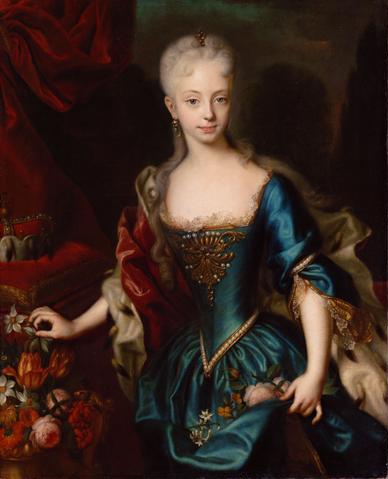
Maria Theresa
born on 15.05.1717 in the Hofburg, the Viennese palace of the rulers of Austria from Rudolf (13th century) to 1918.
12.02.1736 she married in Vienna Francis III Stephen, Duke of Lorraine
25.06.1741 crowned Queen of Hungary in Pressburg
12.05.1743 crowned Queen of Bohemia in Prague
1745 empress in Frankfurt am Main.
Many children: 11 daughters and 5 sons. (Every daughter had Maria as her first name.)
She died on 29 November 1780, aged 63.
It so happened that in 1740 two of Europe's “great” men died: Emperor Charles VI, King of Austria, and Frederick William I, King of Prussia. Silesia, Opole and Folwark were in the Austrian sphere, but the treaties of mutual inheritance after the death of the last Piast, Jan II the Good, were the seed of new conflicts on our land.
They pass into eternity:
31.05.1740 Frederick William, King of Prussia; his inheritance is taken over on 2 June by Frederick II “the Great”.
20.10.1740 Charles VI, emperor; his inheritance is taken over (a few hours after his death) by Maria Theresa.
New wars await us! The “Silesian Wars”
Frederick II received the oath of the assembled ministers in Charlottenburg and began his admirable reign, which raised Prussia to the level of a great power. All of it, naturally, by means of wars and conquests. The first opportunity was the death of the Emperor of the Holy Roman Empire, Charles VI.
On 6 December of that year he addressed a friendly letter to Maria Theresa and her husband Francis Stephen asking them to hand over part of the territory of Silesia to him, citing the treaty of 1512, while assuring her that he would support her efforts for the succession in the other lands of the Reich, which did not agree to the new empress. The Bavarian monarch, supported by France, Saxony and Prussia, refused to obey the new ruler of the Habsburg state and himself proclaimed himself emperor as Charles VII. The outraged Maria Theresa, who had not the slightest desire to give up her richest province, rejected Frederick II's proposal. And so began the War of the Austrian Succession.
On 16 December of that year Frederick II crossed the border of Silesia, and in February 1741 he was already in Upper Silesia. In April of that year (while his Field Marshal Count Schwerin was fighting victoriously at Mollwitz) he found himself with a small detachment outside our town, hoping to find his garrison here, but at the town gates they were fired on by the Austrians, who had already occupied Opole.
The Battle of Mollwitz: Today Małujowice, a village in Opole voivodeship, Brzeg county, Skarbimierz commune, on national road 39, exit from the A4 motorway towards Brzeg. The battle, which went down in history as the battle for Silesia, began on 10 April 1741, mainly on the site of the former airfield at Skarbimierz, and its outcome decided that Folwark would be in the sphere of the Prussian state for the next 200 years.
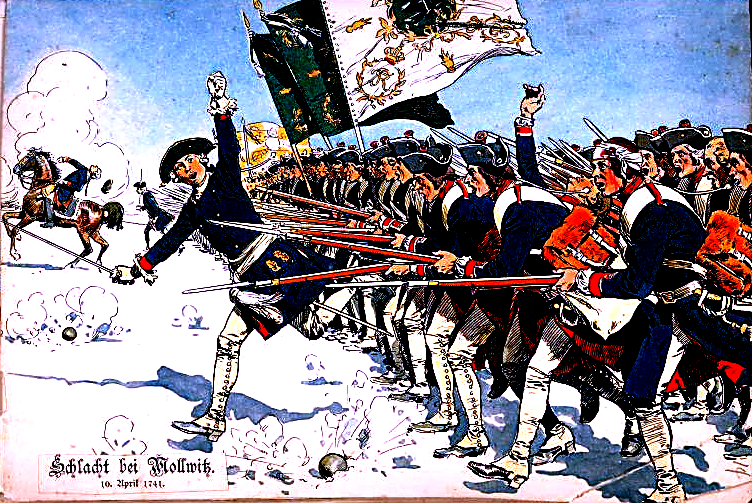
The Battle of Małujowice, 10.04.1741. The Prussian troops were commanded in person by the new King Frederick II and Field Marshal von Schwerin. The Austrian troops were commanded by Field Marshal Neipperg. The Prussian infantry numbered
16 000 soldiers and the Austrian 11 600. The Austrians had the advantage in cavalry, 86 against 33 Prussian squadrons. In all, 41 000 soldiers faced each other. (A squadron was about 60-110 horses).
The battle was won by the Prussians at the cost of 4800 dead; 4500 Austrians fell. As I mentioned above, when the scales of victory were tipping towards Austria, Frederick, on Schwerin's advice, fled the battlefield for Opole, where he found the Austrian army. He returned to Małujowice and celebrated the victory.
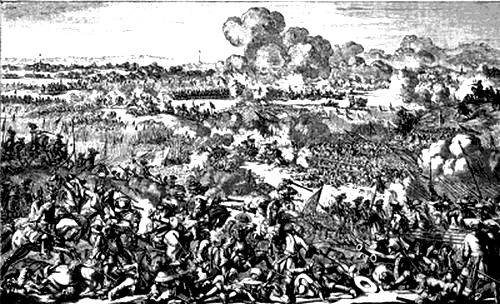
Frederick's entry into Silesia and his holding of the positions he had won made a great impression throughout Europe. For the Habsburg monarchy the loss of Silesia was a bleeding wound. France, Bavaria and Saxony allied against Maria Theresa, and as a result more Silesian wars await us.
Silesia was the stake in Frederick's game for Prussia's great-power status in Europe.
What happened in the first half of the 1740s in our Folwark and parish has not so far been established. Records for the years 1741-1745 are missing.
In 1740 Father Francisco Kapelka baptised:
- Agnes, daughter of Adalbert (Wojciech) and Helena of Zlynice, with Anna Nowacka and Anna Korkowa of Folwark as godparents
- Agnes, daughter of Jakub Świętek of Folwark and Anna Stachula of Chrzcowitz. The godparents were Johannes Kornek, Marianna Lakocina and Susanna Korkowa, all of Folwark
- Marianna, daughter of Paul Lakott of Folwark and Mariana Danielka of Winów. The godparents were Paulo Lysy of Chrzowice and Helena Korkula
Further in the same year we meet these names in Folwark and the surrounding area:
Valentin Kędziora, hortulani of Ochodze, Georgio Langer of Domecko, Christian Henek, Tabernator of Damczić (innkeeper of Chrząszczyce) and other names, Gallus of Boguszyce (hortulani = zagrodnik = Gärtner), Helena Urbaczonka, Hedwiga Piechaczkowa of Krztzowitz (Chrzowice), Dorothea Malicka Seulteschowa of Zlatnik (the sołtys's wife), Michaeli Czaja of Folwark, Anna Gryczmarka of Folwark, Marianna Molitoris Filia Adalberti Piechaczek of Krztzowitz (Marianna, daughter of the miller Wojciech Piechaczek of Chrzowice)
We shall come back to these times (and inhabitants).
Greetings from Folwark, Rudolf