

Frederick II (1740-1786). New times have come: our great-great-grandparents under Prussian rule.
The Battle of Małujowice on 10.04.1741 decided the change of state to which our parish and the surrounding area belonged. In the parish registers these changes are visible to the naked eye. In Habsburg times I did not come across a single entry of a musketeer, cuirassier or hussar. Now, especially at weddings, we have bachelor soldiers, and more importantly, it is not youngsters who marry, but men already old for those times. We know that service in the Prussian army was not easy, and leave for one's own wedding had to be earned. To illustrate all this I have decided this time to present a few newlyweds in our Chrząbeckey parish from those times.
| Date of marriage in Chrzumtzitz | Military rank | Groom | Bride | Witnesses |
|---|---|---|---|---|
| 8 November 1767 | Muszkieter Hayduck | Lampert, bachelor, 27, of Folwark | Hedwigis, 25, maiden, daughter of Matheus Niedziela of Groszowitz | Johann Kotula, Gärtner of Winów, and Jacob Świętek, Bauer of Follwark |
| 7 May 1769 | Curassier Dudeck | Jacob, bachelor, 26, son of the smith Gregor of Ochotz | Marianna, 19, maiden, daughter of the free Gärtner Andreas Dull of Ochotz | Casper Hanus, miller, and Johann Gogolock, both of Ochotz |
| 1 October 1769 | Curassier Woycik | Jacob, bachelor, 30, son of the Gärtner Franciszek of Zlenitz | Margaretha, 24, maiden, daughter of the late Franciszek Scholtiszig of Zlattnik | Casper Capuszciok, Curassier, and Thomas Wrzeciona, Curasier, both of General von Podwils's regiment |
| 14 January 1771 | Muszkieter Furgacz | Johann, bachelor, 55, of Zlattnik | Agnes, 25, maiden, daughter of the late Bauer Georg Kluczny of Zlattnik | Franz Malorny, Bauer, and Paul Golletz, smith of Zlattnik |
| 26 May 1717 | Curassier Wrzeciono | Sebastian, bachelor, 25, of Chrzowitz | Anna, 21, maiden, daughter of the cottager Georg Rybarsz of Chrzomtzitz | Mathias Mocia, 1/2 Bauer, and Langner of Chrzomtzitz |
| 15 June 1772 | Fuiselier Nieslono | Gregorius, widower, 42, of the Fusilier regiment in Glatz (Kłodzko) | Helena, widow, 45, of the late Johann Jarosz of Boguszyce, living in Ligota Prószkowska | Johann Pietruska, Bauer, Michel Bydy, innkeeper, both of Zlattnik |
| 13 February 1774 | Huzar Werotzky | Georgius, bachelor, 27 | Barbara, maiden, 30, daughter of the Bauer Johann Pietrusky of Zlattnik | Thomas Odelga, Bauer, and Martin Lambeck, Bauer, both of Zlattnik |
| 19 November 1775 | Fuiselier Gogolok | Matheus, bachelor, 36, of Dometzko | Hedwigis, maiden, 30, née Grzonka of Dometzko | Gregor Gora, Johann Dudek, shoemaker, both of Domecko |
| 28 January 1776 | Reiter von Opplischen Regiment Malik | Jerzy, bachelor, 30, of Zlattnik | Maidservant Franciszka, 28, née Spiler of Proskau, living in Zlattnik | Matias Odelga, Bauer, and Martin Pietruska, both of Zlattnik |
| 19 January 1777 | Huzar Bother | Jura (Jerzy - Georg), bachelor, 30 | Susanna, maiden, 24, daughter of the late Franciszek Murowski of Folwark | Mathias Czaia, Bauer, Walentin Świętek (old smith) of Folwark |
| 14 May 1777 | Huzar Sadlo | Nikolaus, bachelor, 32 | Maria, maiden, 30, daughter of the late Gärtner Paul Klak of Nowa Kuźnia | Grigert Koręty, Gärtner of Nowa Kuźnia, Franz Kutz, Fusilier, soldier of the Koźle regiment |
| 26 October 1777 | Huzar Giera | Florian, bachelor, 26 | Maria, maiden, 23, daughter of Baltthazar Krawietz, living in Boguschitz | Georg Sokor, Hussar, and Johann Siekiera of Boguschitz |
| 11 October 1779 | Fuiselier Langer | Melchior, bachelor, 36, of Ochotz | Johanna, maiden, 20, daughter of Jacob Dulla of Ochotz | Gregor Wiessala, innkeeper of Domecko, and Franciszek Wulla, organist |
| 16 October 1780 | Reiter von Elfner Comp, garrison Oppeln, Grzyszka | Anton, bachelor, 34, of Zlattnik | Maidservant Dorotha, 29, née Wrzeciono of Chrzowitz | Blazek Pietruska, Bauer, Paul Lysy, Reiter of Zlatnik |
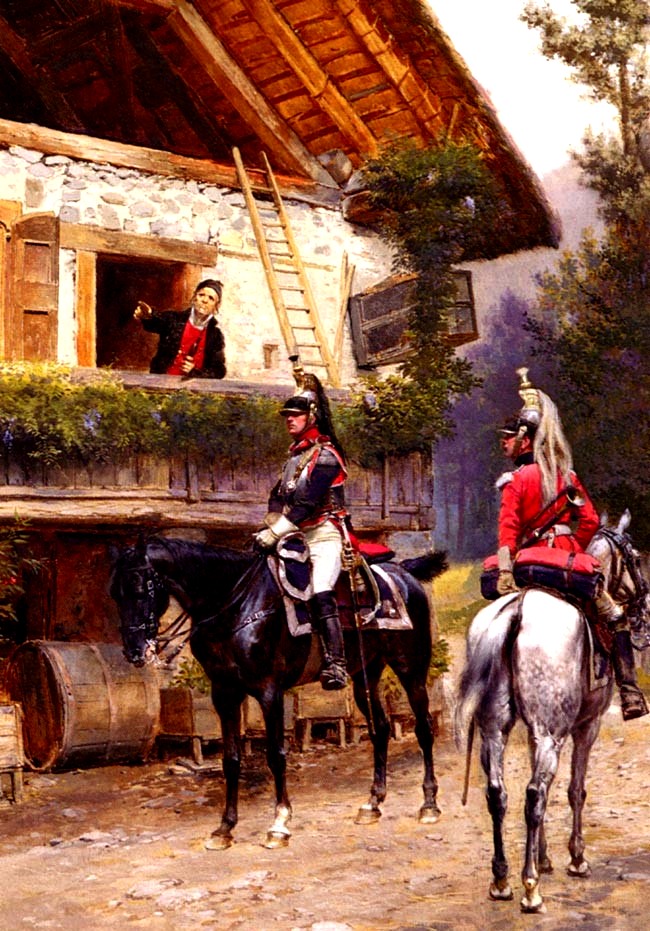
This is what cuirassiers looked like
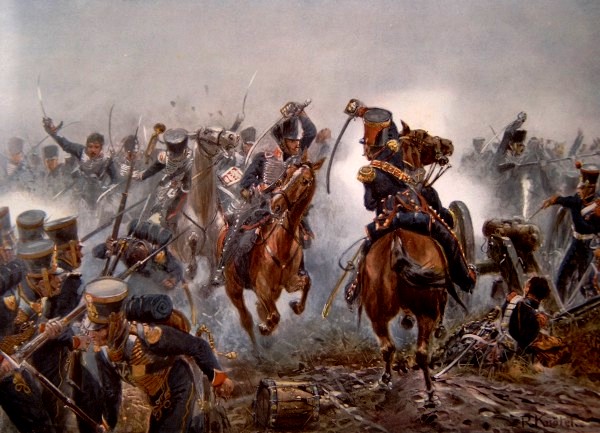
Hussars, Battle of the Nations at Leipzig (16-19 October 1813)
In such a tumult it was hard to stay alive
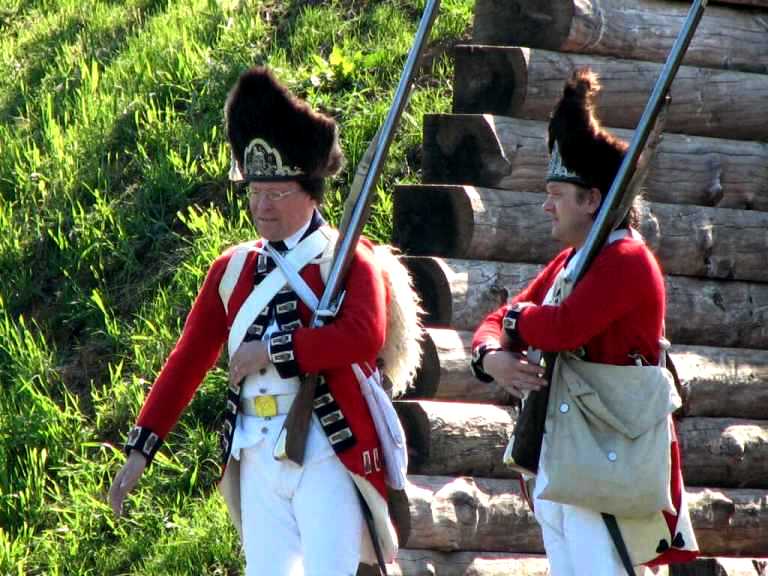
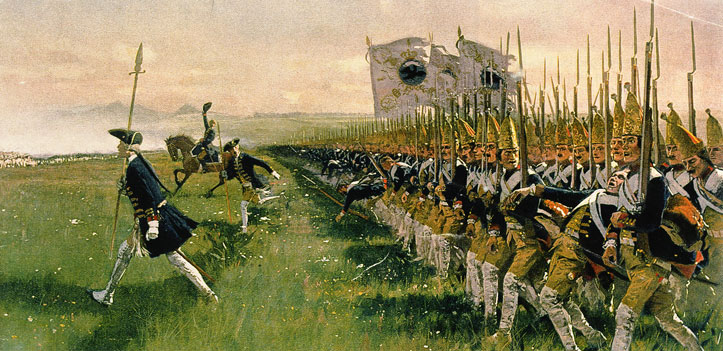
Fusiliers: infantry soldiers armed with flintlock guns called fusils (hence the name). In the 18th century they replaced the musketeers.
In the second half of the 18th century, in Prussia, the light infantry, organised in independent battalions, received the name fusiliers. From the end of the 18th century to the middle of the 19th, most infantry in European armies bore the name fusiliers.
Already during the First Silesian War a French-Bavarian coalition formed against Empress Maria Theresa, and Charles Albert of Bavaria was crowned German emperor as Charles VII on 12 February 1742 in Frankfurt am Main. Maria Theresa, choosing the lesser of two evils for the Habsburgs, in 1742 chose peace with Frederick II, signed in Wrocław in June of that year, and so ended the First Silesian War. The peace terms were unfavourable for the Habsburgs. 80% of the territory of Silesia passed under Prussian rule, and the empress kept only the south of Silesia, the Duchy of Cieszyn. In Głubczyce (1743) ratification documents were exchanged after the new borders were fixed.
Even during the fighting Frederick II set up a special ministry for Silesia, which dealt with the new organisation of the administration (customs, taxes, mining, metallurgy, courts) and all military matters. Silesia was divided into counties (Landräte). Prussia was the first European state to adopt the principle of universal education. In Silesia, mainly for political reasons, he took an interest both in the development of Protestant education, which he supported, and of Catholic education, which he placed under state control.
For the young male population, Frederick II issued an edict in 1743 on compulsory military service in Silesia. About 35 000 soldiers were called up for active service. (Only merchants, townspeople, the head of a peasant family and possibly a son with no other brothers were exempt.) Service lasted more than two years and was harder than under the Habsburgs, so such “Prussian order” was not popular. Young men threatened with conscription fled abroad in large numbers, from our area towards Częstochowa (among them my wife's great-great-grandfather, Bastek of Luboszyce near Opole, who settled near Częstochowa and started a family there).
The peace concluded with Frederick II allowed the Habsburgs to concentrate on the fight against Charles VII. The Austrian troops began to have success and drove Charles VII away, with the prospect of defeating not only Charles but also the French on other fronts. Frederick II now felt threatened! Alarmed by Maria Theresa's successes, he feared that the Habsburg heiress would not stop there, and would demand and win back lost Silesia.
This was the greatest betrayal of his life, as historians write.
He broke the peace treaty signed in 1742 in Wrocław and made a pact with Charles VII and the French against Maria Theresa. Now, on the pretext of helping Emperor Charles VII, in August 1744 he led his army (about 80 000) into Bohemia, thus starting the Second Silesian War. But pressed by the Austrians and the Saxon troops and additionally harassed by the resistance of the population, he had to withdraw, and so the fighting moved to our lands. A hasty Prussian retreat from Bohemia followed. After these setbacks he began to prepare carefully for a new decisive trial.
On 20 January 1745 Emperor Charles VII dies. Maria Theresa found herself in a more favourable position and made peace with his successor (Maximilian III).
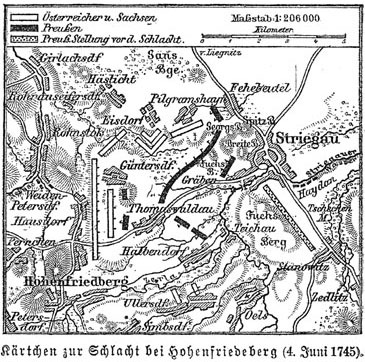
On 28 May 1745 the main Saxon-Austrian army entered Silesia, and Frederick II decided to give a general battle. The main forces of the two armies met on 4 June 1745 at Dobromierz (Hohenfriedeberg) near Strzegom. The combined armies (Saxon-Austrian) under the command of Prince Charles of Lorraine were misled by false reports. On their march they unexpectedly ran into Frederick's army, well prepared in a suitable place, with a strength of 60 000 sabres. Acting by surprise, he did not allow the Austrians to deploy. Prussian losses were about 5000 men, the Austrians 14 000 including prisoners. 66 guns and 76 standards were also captured. The Austrian army was beaten but not destroyed.
December 1745: The victories of Frederick II were confirmed and a new peace treaty was concluded in Dresden, ending the Second Silesian War. For Frederick II the war ended without losses.
In Oppeln a new order began to be introduced. The provincial starosts were abolished (the last one, Count Henkel, was accused of collusion with the Austrians and convicted of treason; he fled to Vienna). At the head of the counties stood starosts, and the highest authority was the government of the regency. The Catholics of Opole received the new rule with great discontent, and because of its attachment to Austria the town suffered greatly in the Silesian Wars. But as Idzikowski writes: the great king (Frederick II) did not forget our area, as is shown by the doubling of the population of Oppeln from 1136 to 2476.
Further in Idzikowski's chronicles (Geschichte der Stadt Oppeln) we can read: This successful striving of the king for further development was terribly interrupted for 7 years in 1756. Maria Theresa could not get over the loss of Silesia. She entangled Frederick in a web of alliances directed against him (Russia, France, Sweden), ready at the first opportunity to join with Austria and attack Frederick.
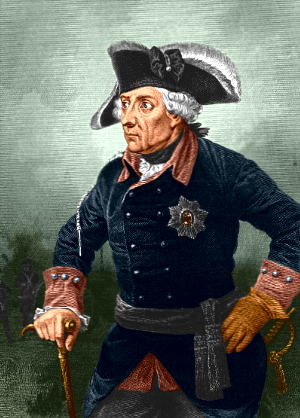
Frederick II the Great von Hohenzollern
born on 24 January in Berlin
King of Prussia 1740-1786
Frederick was the eldest son of Sophia Dorothea of Hanover (1687-1757), who, unlike her husband, was an educated person.
Frederick William I, Frederick's father, despised all-round education and the glitter of the court, preferring simple male pastimes: barracks and hunting. His main concern was to build up Prussia's military power. He even introduced the custom of wearing uniform every day (hence the nickname Soldatenkönig: “soldier king”).
On 12 June 1733 Frederick was forced to marry Elisabeth Christine of Braunschweig-Bevern, who was backed by Austria. The wedding took place at Salzdahlum, but this marriage was reportedly never consummated.
He died on 17 August 1786 in Potsdam.
Until 1756 the Europe of the great powers did not treat Prussia as an equal, and Frederick II was called “this filigree king”.
Thomas Carlyle (1795-1881), Scottish writer and historian, wrote years later: “Many countries have a longer sword than Prussia, but none can draw it from the scabbard so quickly.”
But we shall see this only in the next part, the start of the Third Silesian War, which lasted 7 years.
Greetings from Folwark, Rudolf