

1657-1705, Leopold I our emperor. In 1657 Ferdinand III died and his place was taken by Leopold I. But our Duchy of Opole-Racibórz still belonged to the Polish Vasas.
In 1675 Jerzy Wilhelm died, aged only 15, the last duke of the great family of the Silesian Piasts. The lands he ruled, the duchies of Legnica, Brzeg and Wołów, passed after his death under Habsburg overlordship. When Emperor Leopold I took the duchy into hereditary possession, he confirmed its inhabitants' old rights and privileges, but a reduction of Protestant churches was carried out.
The Hohenzollerns of Brandenburg, however, laid claim to the duchy (of Jerzy Wilhelm) (the Great Elector of Brandenburg, Frederick William, 1644-1688), who under the treaty of mutual inheritance of 1537 had the right to it after the death of the last Piast, Jerzy Wilhelm. The Habsburgs, however, allowed no bargaining. Leopold merely set aside the Duchy of Oława for Duchess Louise, mother of the late Jerzy, and granted the other relatives small pensions.
The death of Jerzy Wilhelm was the start of the dispute over Silesia in the following years between the Habsburgs and the Hohenzollerns. Three Silesian wars await us in the middle of the next century. The great-grandson of the Elector of Brandenburg Frederick William, Frederick II, would take Silesia from the Habsburgs, citing the treaty of 1537.
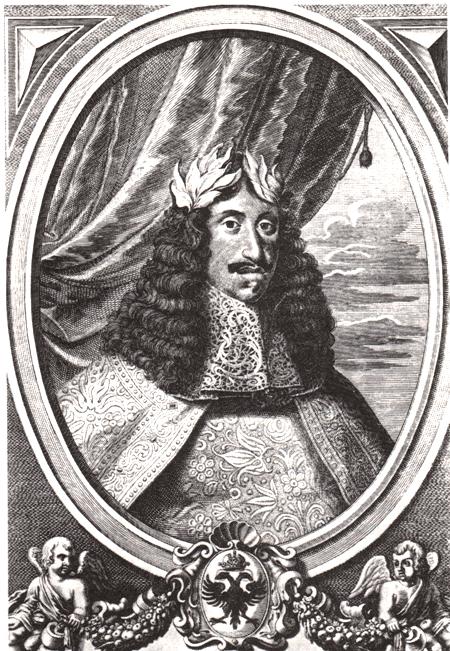
Leopold I, emperor.
Born on 9 June 1640 in Vienna, died on 5 May 1705 in Vienna.
First marriage: Margaretha Theresia, Infanta of Spain. She died aged 22. (4 children)
Second marriage: Claudia Felizitas, Archduchess of Tyrol. She died aged 23. (2 children)
Third marriage: Eleonora Magdalena, Princess of the Palatinate (10 children)
Many children (16 in all). From the third marriage we shall meet Emperor Joseph I and Emperor Charles VI in the next parts of the history of Folwark.
Of his 16 children only 5 outlived Emperor Leopold.
27.06.1655 crowned King of Hungary
14.09.1656 crowned King of Bohemia and Silesia
31.07.1658 elected and crowned Emperor of Rome and the German Reich
The eldest son of Emperor Ferdinand III was Ferdinand V, for whom the Habsburg imperial throne was intended after his father's death. However, he died at 21. This caused great trouble in the family, because the second candidate was his younger brother Leopold IV, prepared from childhood for the clergy. His brother's death meant that he, completely unprepared for such a role, forced the Habsburg court to make great efforts (bribery) so that the Estates would accept the new candidate.
As emperor, in 1663 he found himself at war with the Turks, but not only with them. The French were pressing on Lorraine, and Poland was at war with the Swedes. In 1683 the Turks besieged Vienna and the imperial court moved to Passau. The Polish King Sobieski set out to relieve Vienna, but his troops did not march through our area.
Silesia and Opole felt all these wars only through increased taxes. The first Jesuits settled in Opole, their main task being re-Catholicisation. Count Jan Proskau gave the order a house on the market square in Opole, and the Jesuit order decided to establish its residence in Opole. In 1670 they opened a grammar school, which had 170 pupils the very next year. In 1679 plague broke out in the town and spread with terrible speed (so writes Idzikowski), and half of the inhabitants, about 900, died then. The inn (today Plac Sebastiana) in which the plague broke out was demolished in 1681, and on its site a chapel dedicated to St Sebastian was built, which still stands today. In 1682 a terrible fire broke out in the town of Opole, destroying 105 houses. The Dominican monastery, the Jesuit church and the school building also burned down. They had not yet managed to rebuild the town when in 1684 another fire consumed almost the whole town, and a third fire (1689) also destroyed 49 houses.
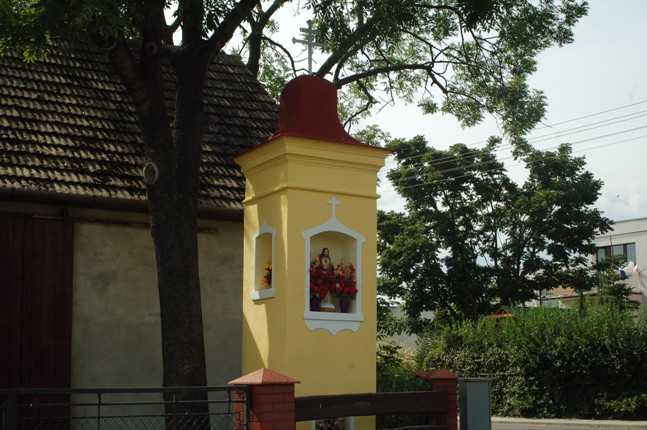
And what was happening in Folwark at this time? As already mentioned in the previous part (XII), in 1664 the chapel at Świętkownia was built. In 1675 the chapel was built that I see every day from my window at the junction of ul. Lipowa and Szkolna.
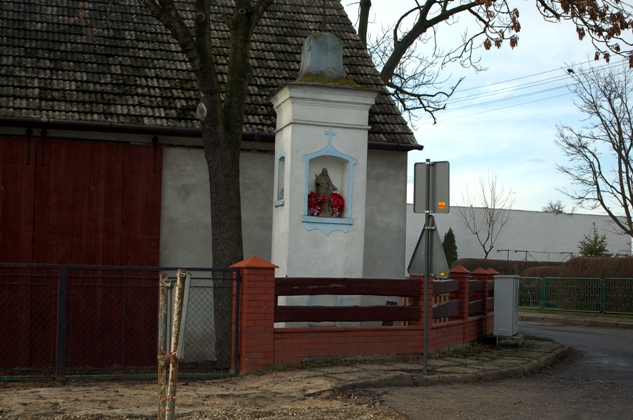
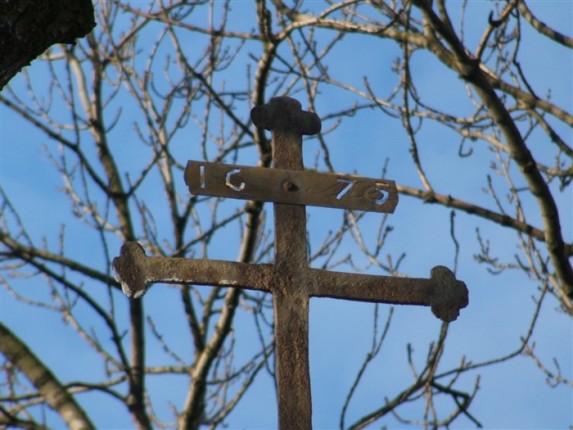
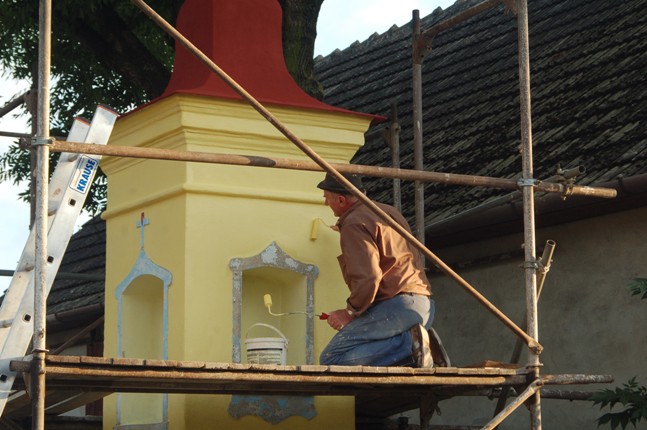
2009
To this day it has not been possible to establish who built the chapel and why, but I secretly hope that in the course of searching for the inhabitants of Folwark in those years certain details can be established. A lot was happening in the area at that time (re-Catholicisation, Jesuits, fires in Opole, plagues and other diseases). Renovation and conservation were carried out in June 2009 by Antoni Chudalla of Folwark.
In our reflections on “Pofyrtane dzieje Folwarku” we have reached the middle of the 17th century. So far we have got to know a few inhabitants of Folwark and the area by name, but only those who were obliged to pay dues, serf labour and church tithes. That is, the “important” ones, who provided income earned on the fields they leased from the owner. If a Folwark peasant leased 1 łan of land, about 16 hectares, then of course he did not work it all himself, even with a large family, because there were no combine harvesters then, and ordinary scythes were surely in short supply too.
So the question is: what was the structure of the rural population in those times and in the following years of the 18th century?
We have most information from the 17th century, when the first records of baptisms, marriages and deaths were introduced. Often the trade was given with the name, how much land a person owned, and whether they owned other property, for example a house. Since time flowed more slowly in those years and changes were not as fast as today, we can assume with great probability that what existed 100 years later (in the middle of the 18th century) differed little from what existed when our chapel, shown above, was built.
In the first half of the 17th century we can divide the population of a Silesian village into several groups. In the records you can find various names for the individual groups (Czech, German, Latin, mixed).
Group I, the most numerous: Komornicy (Einlieger, Inleute, Kammerleute, Hausleute, Mietshäusler). The poorest class, owning nothing, doing all kinds of housework in exchange for food and a small corner.
Group II, also very numerous: Wycużnicy (Auszügler). Elderly parents who, in exchange for the right to benefits in kind and usually a very cramped corner, gave up their farm to their children, relatives or other people.
Group III: Servants, Gesinde. People who worked on noble estates and for rich peasants. They were often children of parents who themselves owned nothing, and had nothing to inherit.
Group IV: Chałupnik - Häusler (Kalupner, Kossäten, Bündner, Strumpfner). They owned their own house, often also a small vegetable garden and a little land.
Group V: Zagrodnicy (Gärtner, Hortulanus, Freigärtner). They owned a few morgen of land.
Group V: Robottgärtner, serf peasants, who owned up to 30 morgen of land.
Group VI: Kmieć - Bauer, divided into (Freibauer, Vollbauer, Dreiviertelbauer, Halbbauer, Viertelbauer and still smaller). I have put in bold the groups that occurred most often in our area. The division depended on how much land he owned and how many teams he kept to work it, with which he also performed services on the manor. The last of these peasants usually owned only one team of oxen. The division ranged from a few morgen to several hundred. There were most Halbbauern.
Group VII are inhabitants who owned workshops as well as land. We often find the entry Kowal - Schmid, Molitoris - Müller (miller), Tabernator - Kretschmer (innkeeper), Zimmerman (joiner).
Scholtze - sołtys.
Time for examples from our parish registers. (Today just one, it's already late.)
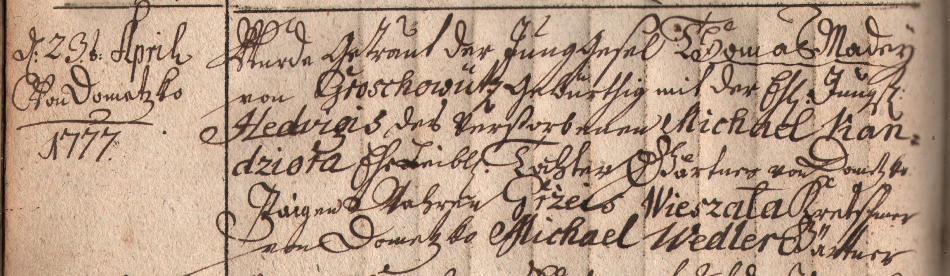
In my free translation: On 23 April 1777 a marriage was performed between Tomasz Madeya of Groszowice and the betrothed Jadwiga Kandziora of Domecko, daughter of Michał, Gärtner. Witnesses: Grzegorz Wieszała, innkeeper of Domecko, Michał Wedler, Gärtner (probably also of Domecko; the entry is missing, but it is elsewhere. Beside it there is additional information that on the wedding day Tomasz is 28 and Jadwiga 24.)
On the basis of such records, searching across the whole parish, I try to find information about the inhabitants of our Folwark. In the next part there will be many names, and perhaps someone will find their ancestors.
Greetings from Folwark, Rudolf