

1705-1711 Joseph I our emperor. He was prepared from childhood, as his two brothers (from Leopold I's first marriage) died early, before he was born. At just 9 he became King of Hungary. At 13 he became King of Rome and the German Reich. From that moment he accompanied his father, Emperor Leopold I, as king and took part in all councils. So he had the chance to learn thoroughly all the secrets of the economics and politics conducted by the Habsburgs. That is why, immediately after the death of his father Leopold I (1705), he was able to run the state without resistance (opposition). As emperor Joseph I did not close himself off from the advice of outsiders, but he always kept a great distance from those around him. In religious matters he was tolerant. At 21 he married Amalia Wilhelmina, Princess of Braunschweig-Lindenburg, a Protestant who converted to Catholicism before the wedding. The beautiful (as they write) and well-educated princess, however, had no great influence on his decisions. He died at 33 in Vienna.
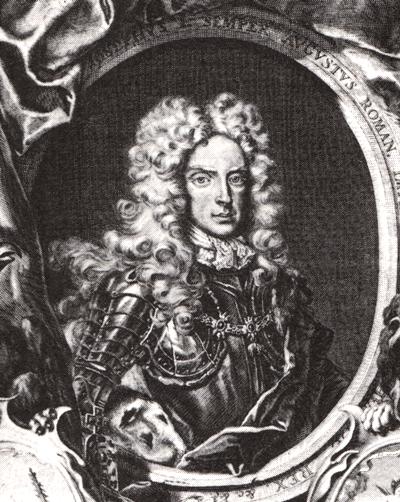
Emperor Joseph I was born on 26.07.1678 in Vienna, as the (7th) child of his father Leopold I and the (1st) child of the third marriage, to Eleonore Magdalene of Pfalz-Neuburg.
He married on 24.02.1699 Princess Amalia Wilhelmina of Braunschweig-Lüneburg. She bore three children (the second died before its first birthday).
9.12.1687 crowned King of Hungary
26.01.1690 crowned King of Rome and the German Reich
5.05.1705 elected King of Bohemia and Silesia (not crowned)
5.05.1705 recognised as emperor.
Died on 17 April 1711 in Vienna
He ruled for only 6 years. He continued the wars waged by his father Leopold I and also introduced further changes in the running of the state, especially in the courts, where great arbitrariness reigned and different standards were applied. The powerful got away with many wicked deeds, while townspeople and peasants were treated according to the harsh code of those times. Idzikowski writes: “they were quickly handed over (instigatori) to the executioner for sharp questioning, and after confessing were sentenced to death by fire, sword or rope, and many (in 1717) were sent to the galleys, each year in September and March, to Vienna”. Idzikowski further writes: Count Jerzy Proskowski and Baltazar Pückler allowed themselves illegal expeditions into forests belonging to the vicariate in Niemodlin. The owners complained that they had been badly beaten and injured by Pückler's servants. Pückler was fined 1000 ducats, but appealed to the emperor against the verdict and did not pay. The case dragged on for years, so that the culprit died a natural death without living to see the imperial pardon.
During the reign of Joseph I (1707) a plague broke out in Poland. All borders were closed, all bridge crossings destroyed and deep ditches dug across the roads. Anyone who crossed the border despite everything was shot, or hanged by the executioner on gallows at the border without trial or any formalities. Inside the duchy no one was allowed to travel without written permission.
On 17 April 1711 Emperor Joseph I dies in Vienna; his place is taken by his younger brother Charles III, but we shall meet him as Emperor Charles VI in the next part.
These are the last years of Habsburg rule in our area. In those two hundred years essentially nothing changed; the old medieval social relations still survived. We were too far from Vienna for the changes introduced there to work here as well. We shall wait another 100 years for changes.
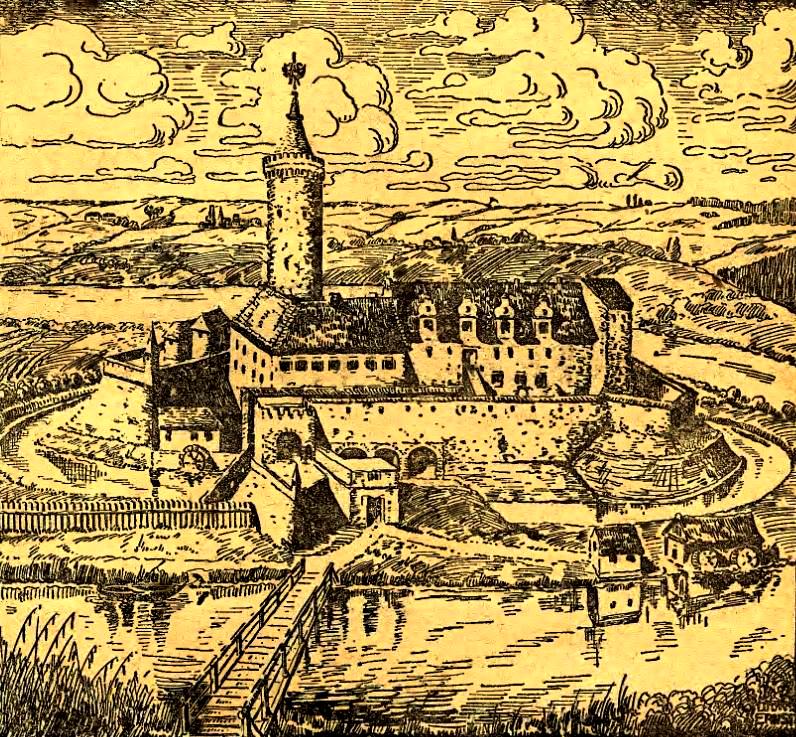
The castle on Ostrówek island in Opole
(sketch, author unknown)
In the background the hills of Winów and Górki are visible
In 1751 Opole had 1186 inhabitants, 20 bakers, 20 butchers, 9 smiths, 7 tailors, 3 wheelwrights, 4 joiners, 12 small traders (shops, stalls), 37 linen weavers, 9 furriers, and also harness makers, hatters, saddlers, locksmiths.
And what was it like in our parish?
So far I have managed to identify only some of them, so in order, we shall start with the most important in the village, the sołtysi (village heads).
| Surname, first name | Place | Function / trade | Documented year |
|---|---|---|---|
| Kornek Franciszek | Folwark | sołtys (Scholtze) | 1769, 1784 |
| Gambietz Gregori | Gorki | sołtys | 1775 |
| Wieshala Michael | Górki Gorek | sołtys | 1794 |
| Rabb Bartek | Wójtowa Wieś Vogsdorf | sołtys | 1797 |
| Kutz Andreas | Nowa Kuźnia Neuhamer | sołtys | 1784 |
| Wieshala Grzegorz | Domecko Dometzko | sołtys | 1792, 1796 |
| Piechaczek Johann | Boguszyce Bogushitz | sołtys | |
| Müller Franciszek | Dombrówka | sołtys | 1803 |
| Kutz Urban | Chrząszczyce | sołtys | 1782 |
| Kowol Michael | Źlinice | sołtys | 1768 |
| Piechaczek Bartholomeo | Chrzowice | miller | 1800, 1784 (Molitor) |
| Schiller Anton | Nowa Kuźnia | miller | 1789 as witness |
| Schiller Anton | Nowa Kuźnia | miller | 1800 as bridegroom, married Jadwiga, aged 22 |
| Wotzka Casper | Boguszyce | miller | 1797, 1792 |
| Cebula Johan | Źlinice | miller | 1799 |
| Sosna Andreas | Domecko | miller | 1798, 1802 |
| Hanus Casper | Ochodze | miller | 1768 |
| Pokuta Thomas | Chrząszczyce | organist | 1775 |
| Czaja Simon | Chrząszczyce | organist | 1803 |
| Czura Simon | Chrząszczyce | Schulmeister | 1799 |
| Nowol Joseph | Prószków | mayor | 1795 |
| Rzitka Johann | Prószków | manufacturer | 1786 |
| Czech Valentin | Chrząszczyce | innkeeper | 1766 (Kretschmer) |
| Czech Tomas | Chrząszczyce | innkeeper | 1797 Tabernator |
| Bida Michael | Złotniki | innkeeper | 1767 (Kretschmer) |
| Lempka Casper | Źlinice | innkeeper | 1768, 1797 Tabernator |
| Wieshala Matheus | Domecko | innkeeper | 1767, Tabernator |
| Kuśnierz Walentinus | Domecko | smith (Schmid) | 1784 |
| Murgasz Wawrzin | Chrząszczyce | smith | 1792 |
| Dudek Johann | Ochodze | smith | 1803 |
| Janikula Franciszek | Folwark | smith | 1783 |
| Janikula Matheus | Boguszyce | smith | 1768 |
| Somer Johan | Domecko | joiner | 1768 |
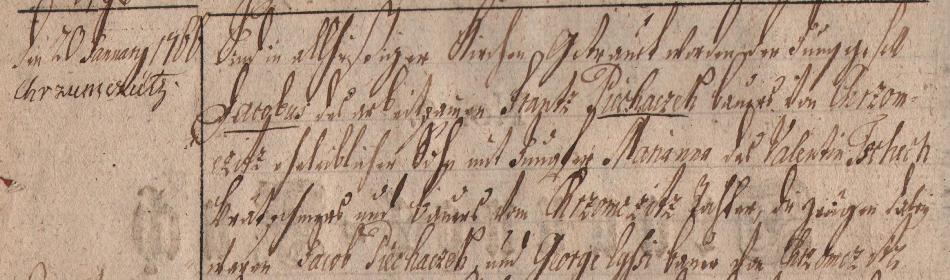
On 20 January 1766 a marriage was performed between Jakub, aged 21, son of Franciszek Piechaczek (Bauer) of Chrząszczyce, and Marianna, daughter of Valentin Czech (innkeeper and Bauer) of Chrząszczyce. Witnesses: Jakub Piechaczek and Georgi Lysy (Bauer) of Chrząszczyce.
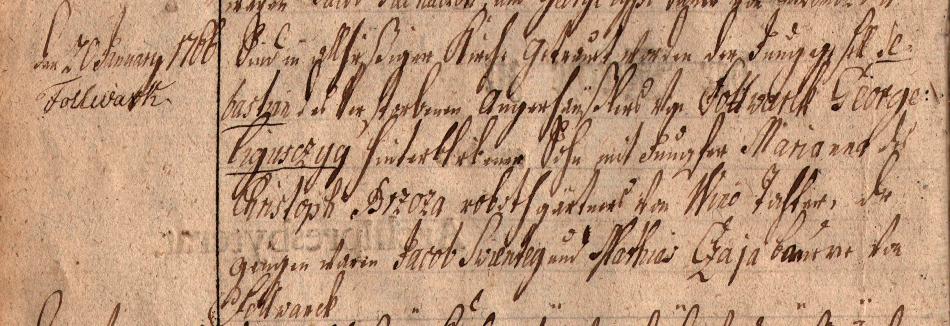
On 20 January 1766 a marriage was performed between Sebastian, aged 26, son of Georg Łuszczyk of Follwark, and Marianna, aged 20, daughter of Christoph Brzoza (Robotgärtner, serf peasant) of Winów. Witnesses: Jakob Świętek and Mathias Czaja (Bauer) of Folwark.
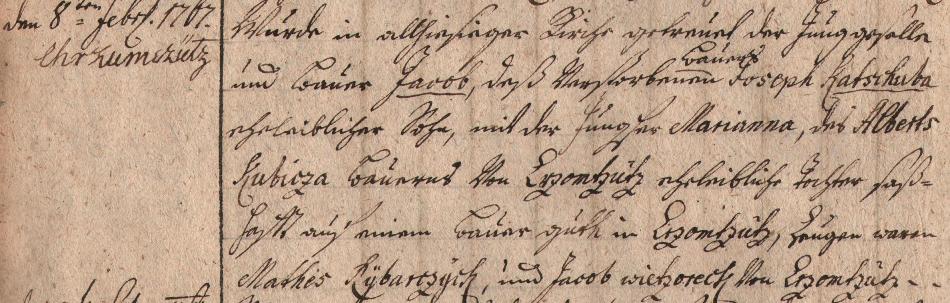
On 8 February 1767 a marriage was performed between Jakub, aged 24, son of Joseph Katszuba (Bauer) of Chrząszczyce, and Marianna, aged 22, daughter of Albert Kubicz (Bauer) of Chrząszczyce. Witnesses: Mathias Rybarczyk and Jakob Wieczorek of Chrząszczyce.
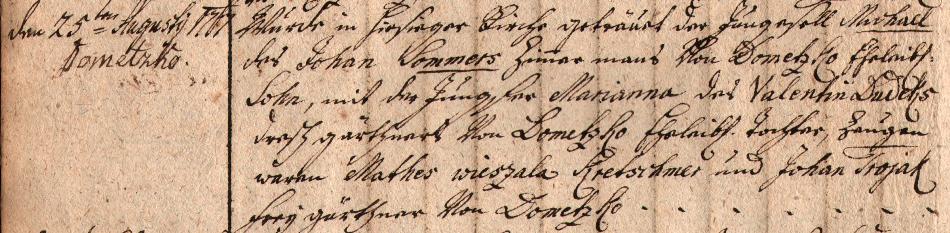
On 25 August 1767 a marriage was performed between Michael, aged 27, son of Johann Sommer (Bauer) of Domecko, and the maiden Marianna, aged 20, daughter of Valentin Dudek (Gärtner, smallholder) of Domecko. Witnesses: Mathes Wieszala (Kretschmer, innkeeper) and Johann Trojak (Freigärtner, free smallholder) of Domecko.
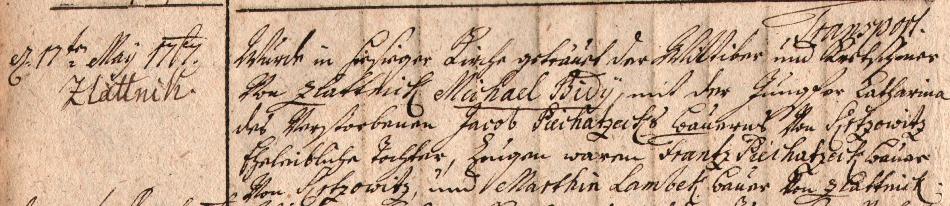
On 17 May 1767 a marriage was performed between Michael Bida, aged 46 (widower, Kretschmer, innkeeper) of Złotniki, and the maiden Catharina, aged 23, daughter of Jakub Piechaczek (Bauer) of Chrzowice. Witnesses: Franciszek Piechaczek (Bauer) of Chrzowice and Martin Lambek (probably Lempka, Bauer) of Złotniki.
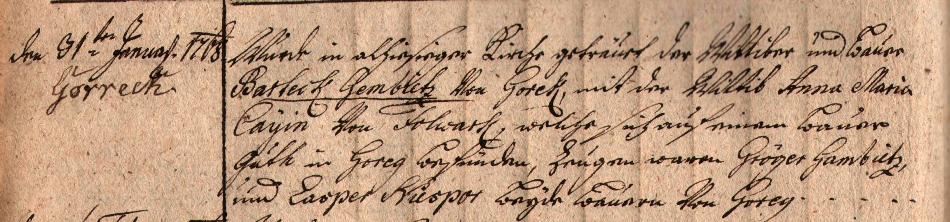
On 31 January 1768 a marriage was performed between Bartek Gambiec, aged 45 (widower, Bauer) of Górki, and the widow Anna Maria Czaja, aged 39, of Folwark (Bäuerin, on land in Górki). Witnesses: Gregor Gambiec and Casper Niespor (Bauern) of Górki.
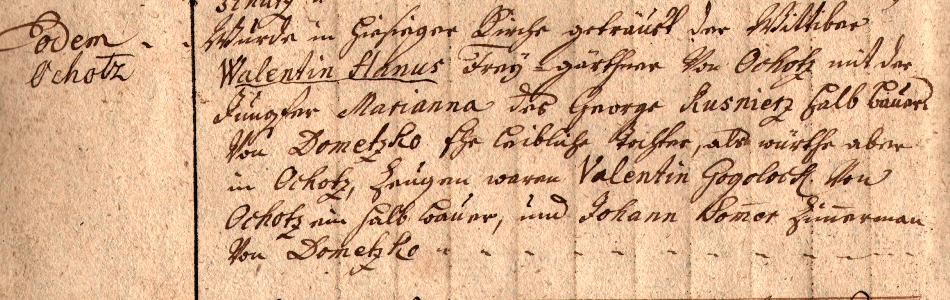
On 29 May 1768 a marriage was performed between Walenty Hanus, aged 28 (widower, Freigärtner, free smallholder) of Ochodze, and the maiden Marianna, aged 17, daughter of Grzegorz Kuśnierz (Halbbauer) of Domecko (with a house in Ochodze?). Witnesses: Valentin Gogolak of Ochodze (Halbbauer) and Johan Somer, joiner, of Domecko.
All translations are my own, not professional (there may be mistakes). That is all for today!
Greetings from Folwark, Rudolf